%20--%3e%3cdefs%3e%3cstyle%3e%20.st0%20{%20fill:%20%23ff1230;%20}%20.st1%20{%20fill:%20%23fff;%20}%20%3c/style%3e%3c/defs%3e%3cpath%20class='st0'%20d='M49.77,34.93l3.47-5.3,23.2-5.86,4.03-6.07-23.14,5.83,3.55-5.33,23.17-5.84,3.96-6.05-23.07,5.8,3.59-5.52-23.16,5.83,3.68-5.68-19.8,4.98c-2.49.63-4.65,2.16-6.07,4.3l-1.81,2.75,20-5.03c.7-.18,1.49-.1,1.75.21.21.25.09,1.12-.24,1.61l-1.85,2.7-19.34,4.87c-2.48.62-4.64,2.15-6.06,4.29l-1.82,2.75,20.12-5.04c.7-.18,1.53.11,1.64.48.09.31-.06,1.12-.4,1.6l-1.79,2.51-19.21,4.82c-2.51.63-4.69,2.19-6.11,4.36l-1.75,2.69,20.19-5.08c1.67-.25,1.96.77,1.1,2.08l-1.9,2.89,19.51-4.94c1.49-.38,2.88,0,1.87,1.62l-1.88,3.01,24.65-6.19,3.01-5.82-23.07,5.79ZM60.94,13.54c.53-.13,1.35.11,1.52.37.19.28-.02,1.14-.37,1.66l-1.73,2.56-22.57,5.67,3.51-5.31,19.64-4.95ZM30.19,35.24l3.49-5.33,19.75-4.95c1.34-.34,1.92.7,1.23,1.76l-1.83,2.83-22.65,5.7Z'/%3e%3cpath%20class='st1'%20d='M236.44,40.24l22.56-33.95h10.5l-22.56,33.95h-10.5Z'/%3e%3cpath%20class='st1'%20d='M368.54,15.18l5.9-8.88h-52.48l-5.64,8.49-3.45,5.19-5.01,7.54h0s40.4,0,40.4,0l-2.82,4.24h-72.13c-2.23,0-3.07-1.46-1.87-3.27l9.11-13.71h29.5l5.95-8.49h-40.31l-5.64,8.49-9.61,14.46c-.36.55-.67,1.08-.92,1.61-.15.31-.28.61-.39.9-1.52,4.06.3,7.25,4.69,8.2.48.1.99.18,1.54.23.44.04.9.06,1.38.06h85.14l8.46-12.73,5.24-7.89h-40.45l2.95-4.44h40.45Z'/%3e%3cpath%20class='st1'%20d='M198.16,6.32c-.19,0-.37-.03-.56-.03h-60.45l-37.03,26.63h-19.71l18.01-26.63h-10.5l-17.48,26.31c-2.17,3.27.17,7.64,4.09,7.64h28.01l37.22-25.46h6.27l-16.92,25.46h10.51l16.92-25.46h27.83l-.02.04h7.11c1.89.18,2.56,1.55,1.44,3.23l-1.3,1.96c-1.2,1.8-3.98,3.27-6.21,3.27h-25.26l-11.28,16.98h10.5l5.64-8.49h15.69c.48,0,.96-.02,1.45-.06.61-.05,1.22-.12,1.84-.23,5.65-.95,11.72-4.14,15.59-8.2.02-.02.04-.04.06-.06.74-.78,5.18-7.47,5.57-8.39h17.48l-16.94,25.49h10.51l16.94-25.49h14.98l5.65-8.5h-55.64Z'/%3e%3c/svg%3e)
Stock Car 2023 in Automobilista 2: Handling Weight Under Braking
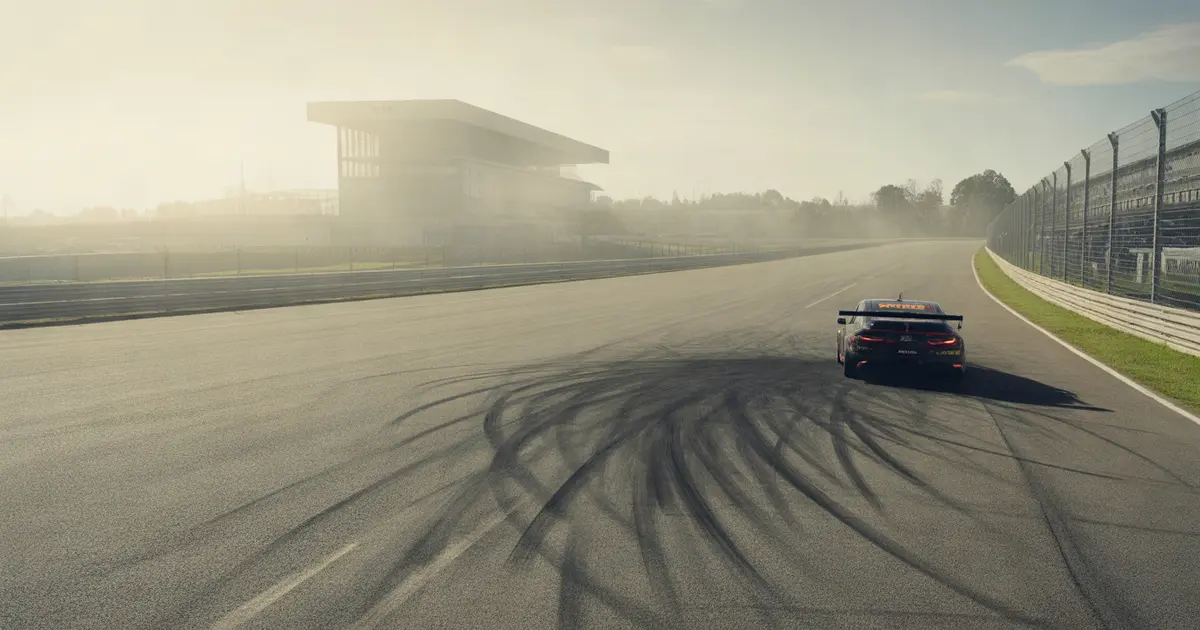
The Stock Car 2023 punishes braking copied from GT3. Understand why weight transfer changes the braking point, initial pressure, and ideal balance.
The Stock Car 2023 requires braking earlier than a GT3 and releasing the pedal in a ramp, not all at once. The reason is simple: the car has more mass and less aerodynamics relative to its weight, so load transfer to the front axle takes longer to build up — and when it does build up, it is greater. Step-input brake pressure locks the front before that load arrives.
This changes how you attack the braking zone compared to cars with more downforce. It is not about braking harder, it is about braking in the right order.
Why weight changes the physics of braking
In cars with a lot of aerodynamic load, the front tyre has grip available from the very first fraction of a second of braking, because speed itself already pushes the car against the ground. In the Stock Car this is smaller. At high speed, the front tyre’s initial grip comes almost entirely from static weight — load transfer from braking has not happened yet.
Practical result: in the first metres of braking, the front tyre has less grip available than you would imagine just by looking at the car’s speed. Stepping hard on the pedal right away locks the wheel exactly when it has the least grip to give.
Where the mistake shows up on track
The most common symptom is a short lock-up at corner entry, followed by partial release and a new application — the pedal “pumps”. This happens because the driver applies peak GT3 pressure to a car that has not yet transferred enough load to sustain that peak.
This mistake is easy to confuse with late braking. The driver feels like they are braking “at the limit” because the wheel locks, but in reality they are losing time to lock-up, not gaining braking distance. To tell the two problems apart, it is worth reviewing why locking the front wheel costs more time than braking early.
How to adjust pressure throughout the braking zone
- Softer initial touch: the first metres on the pedal should carry pressure below peak, giving the weight time to migrate to the front before demanding maximum grip from it.
- Peak in the middle of braking, not at the start: maximum brake pressure should coincide with the moment load transfer is already complete, usually a little after the initial touch.
- Release proportional to steering input: as the car turns into the corner, release the brake in the same proportion you turn the wheel, so you do not unload the front all at once.
- Fine-tune corner by corner, not for the whole track: hard, high-speed braking zones (like the end of a straight) suffer more from this effect than short, medium-speed braking points.
This gradual release follows the same principle as trail braking that tracks steering proportion, except in the Stock Car the tolerance window is narrower: getting the ramp wrong costs lock-up, not just lost time.
Stock Car 2023 vs GT3: what changes in braking
| Aspect | GT3 (ACC/AMS2) | Stock Car 2023 |
|---|---|---|
| Initial front grip | High, from downforce | Low, depends on transfer |
| Ideal pressure peak | Right at the start | After a few metres |
| Tolerance to pressure error | Higher | Lower, locks easily |
This table is not a fixed rule for every corner, but it explains why copying GT3 braking feel straight into the Stock Car usually ends in a locked wheel.
What to check in the data to confirm it
Compare the brake pressure channel with the front wheel’s angular speed over the same stretch. If wheel speed drops to zero for a fraction of a second right at the start of braking, the problem is too-early peak pressure, not a late braking point.
- Step-input brake pressure: an almost vertical rise right at the start indicates application without a ramp.
- Wheel speed with a dip: a sharp drop followed by recovery confirms lock-up, even if it looks subtle on the replay.
- Lap-to-lap comparison: on a genuinely fast lap, the pressure peak usually comes slightly shifted after the initial touch.
To know which channels to open first without getting lost in telemetry, it is worth reviewing which three channels to check first in your telemetry.
Brake balance: how far to go
Moving the balance rearward reduces the chance of locking the front on entry, but it has a limit. Overdo it and you lose trail-braking grip mid-corner, because the rear starts braking too much and the car loses rotation stability.
Getting the Stock Car’s brake balance right does not eliminate lock-up on its own — it only gives you more margin to get the hand pressure right.
If the car keeps locking even after moving the balance, the problem is probably the application ramp, not the setup. It is worth confirming this in the data before you keep changing setup numbers blindly.
Common mistake: treating track and tyre as constants
Behaviour changes with the state of the front tyre. A hotter, more worn tyre loses some initial grip, which sharpens the effect of weight on braking — the car locks with less pressure than at the start of the stint.
This also varies with the track: high-speed braking zones on long straights suffer more from this effect than medium-speed braking in technical corners. Reiza’s tyre model makes this behaviour very visible in the data, as shown by how Reiza’s tyre model reveals errors other sims hide.
How Laptics fits into this
Laptics automatically records telemetry while you drive in Automobilista 2 and compares your laps by corner phase, including the braking phase. This shows, lap by lap, whether the pressure peak is arriving too early and how much time that specific lock-up is costing.
The Driver DNA also helps you see whether this step-braking pattern repeats across several corners and different tracks, which points to a driving habit, not a one-off corner.
Practical summary
- Do not copy a GT3’s pressure peak: the Stock Car needs a ramp, with the peak a little after the initial touch.
- Confirm lock-up in the data: look at wheel speed, not just the visual replay.
- Adjust balance in moderation: it gives you margin, but does not replace hand adjustment on the pedal.
- Reassess as the tyre wears: the same pressure that worked early in the stint may lock later.
Frequently asked questions
Why does the Stock Car 2023 lock the front tyre more than a GT3?
Because it has less downforce relative to its weight, so the front tyre's initial grip under braking depends more on load transfer, which takes a few metres to build up.
Should I brake earlier in the Stock Car than in other AMS2 cars?
Yes, generally, because the car is heavier and the total braking distance is longer, even with wide tyres.
Does moving the brake balance rearward fix front lock-up?
It helps give margin, but too much takes away trail-braking stability because the rear starts braking too much during corner rotation.
How do I confirm in the data if I am locking the wheel too early?
Compare the brake pressure channel with the front wheel's angular speed; a sharp drop right at the start of braking confirms lock-up, even if it looks subtle on the replay.
Does tyre wear change how you should brake in the Stock Car?
Yes, a hotter, more worn tyre loses initial grip, so the same pressure peak that worked early in the stint may lock the wheel later in the race.
Does Laptics show where I am locking the tyre under braking?
Laptics compares your laps by corner phase, including braking, and shows how much time each specific lock-up is costing in your lap.
Want to see this in your own telemetry?
I want to analyze my braking with data