%20--%3e%3cdefs%3e%3cstyle%3e%20.st0%20{%20fill:%20%23ff1230;%20}%20.st1%20{%20fill:%20%23fff;%20}%20%3c/style%3e%3c/defs%3e%3cpath%20class='st0'%20d='M49.77,34.93l3.47-5.3,23.2-5.86,4.03-6.07-23.14,5.83,3.55-5.33,23.17-5.84,3.96-6.05-23.07,5.8,3.59-5.52-23.16,5.83,3.68-5.68-19.8,4.98c-2.49.63-4.65,2.16-6.07,4.3l-1.81,2.75,20-5.03c.7-.18,1.49-.1,1.75.21.21.25.09,1.12-.24,1.61l-1.85,2.7-19.34,4.87c-2.48.62-4.64,2.15-6.06,4.29l-1.82,2.75,20.12-5.04c.7-.18,1.53.11,1.64.48.09.31-.06,1.12-.4,1.6l-1.79,2.51-19.21,4.82c-2.51.63-4.69,2.19-6.11,4.36l-1.75,2.69,20.19-5.08c1.67-.25,1.96.77,1.1,2.08l-1.9,2.89,19.51-4.94c1.49-.38,2.88,0,1.87,1.62l-1.88,3.01,24.65-6.19,3.01-5.82-23.07,5.79ZM60.94,13.54c.53-.13,1.35.11,1.52.37.19.28-.02,1.14-.37,1.66l-1.73,2.56-22.57,5.67,3.51-5.31,19.64-4.95ZM30.19,35.24l3.49-5.33,19.75-4.95c1.34-.34,1.92.7,1.23,1.76l-1.83,2.83-22.65,5.7Z'/%3e%3cpath%20class='st1'%20d='M236.44,40.24l22.56-33.95h10.5l-22.56,33.95h-10.5Z'/%3e%3cpath%20class='st1'%20d='M368.54,15.18l5.9-8.88h-52.48l-5.64,8.49-3.45,5.19-5.01,7.54h0s40.4,0,40.4,0l-2.82,4.24h-72.13c-2.23,0-3.07-1.46-1.87-3.27l9.11-13.71h29.5l5.95-8.49h-40.31l-5.64,8.49-9.61,14.46c-.36.55-.67,1.08-.92,1.61-.15.31-.28.61-.39.9-1.52,4.06.3,7.25,4.69,8.2.48.1.99.18,1.54.23.44.04.9.06,1.38.06h85.14l8.46-12.73,5.24-7.89h-40.45l2.95-4.44h40.45Z'/%3e%3cpath%20class='st1'%20d='M198.16,6.32c-.19,0-.37-.03-.56-.03h-60.45l-37.03,26.63h-19.71l18.01-26.63h-10.5l-17.48,26.31c-2.17,3.27.17,7.64,4.09,7.64h28.01l37.22-25.46h6.27l-16.92,25.46h10.51l16.92-25.46h27.83l-.02.04h7.11c1.89.18,2.56,1.55,1.44,3.23l-1.3,1.96c-1.2,1.8-3.98,3.27-6.21,3.27h-25.26l-11.28,16.98h10.5l5.64-8.49h15.69c.48,0,.96-.02,1.45-.06.61-.05,1.22-.12,1.84-.23,5.65-.95,11.72-4.14,15.59-8.2.02-.02.04-.04.06-.06.74-.78,5.18-7.47,5.57-8.39h17.48l-16.94,25.49h10.51l16.94-25.49h14.98l5.65-8.5h-55.64Z'/%3e%3c/svg%3e)
Why Locking the Front Wheel Costs More Time Than Braking Early
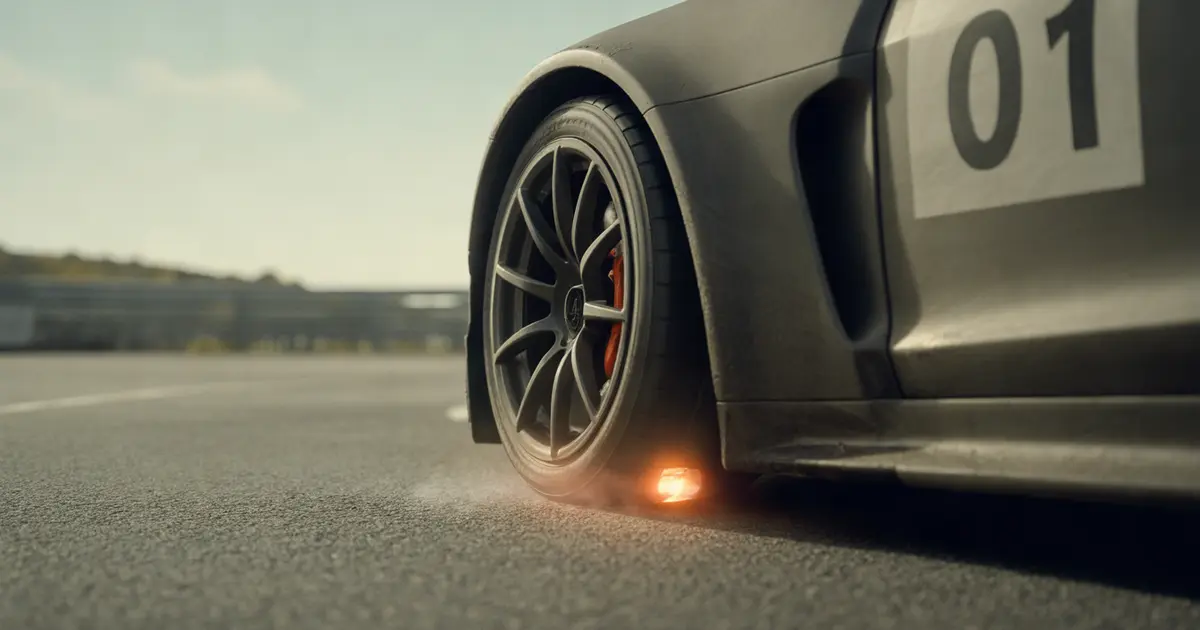
Braking early costs meters in a straight line. Locking the front wheel costs the whole corner. See how to separate the two mistakes in your telemetry data.
Locking the front wheel costs more time because, at the instant it locks, the tire stops generating lateral force — exactly when you need steering the most. Braking early costs meters in a straight line; locking the wheel costs the whole corner, because the car loses its ability to turn at the right point.
The difference feels subtle on the wheel, but not on the stopwatch. A late brake point that ends in a lockup is slower than a conservative point that preserves tire rotation. Here's where this shows up in the data and how to train the fix.
Braking Early Isn't the Problem It Seems to Be
Braking a few meters before the limit has a predictable cost: loss in a straight line, during a phase when the car is already stable. It's a small, consistent mistake that's easy to correct gradually.
Locking the wheel is a different category of mistake. It happens during the transition between braking and turning, when the front tire is already working near its combined grip limit. Once it locks, it loses lateral and longitudinal grip at the same time — and the car stops responding to steering input.
Braking early costs meters. Locking the wheel costs the whole corner.
Where the Time Gets Lost, Phase by Phase
A lockup costs time across three connected moments:
- During braking: a sliding tire brakes worse than a tire rolling at the limit.
- On entry: without lateral grip, the car runs straighter than planned and the line drifts wide.
- On exit: the correction opens up the corner radius, the apex arrives later, and less angle is left to accelerate.
That's why locking the wheel costs more than braking early: the mistake propagates into phases of the lap the driver doesn't even associate with the brake.
How to Spot This in Your Data
Three channels tell this story: brake pressure, front wheel angular speed, and steering angle. A lockup shows up as a spike where the wheel's speed drops faster than the car's deceleration.
If the steering shows a sudden correction at the exact moment of the brake pressure spike, that's a lockup, not a line mistake. It's worth checking whether you're turning the wheel too early on entry before concluding the problem is just the brake.
Compare the lap with a lockup against a clean lap on the same corner. If exit speed drops even with the same brake point, the lockup is to blame, not late braking itself.
Car and Track Change the Margin for Error
In cars with ABS — most GT3s, GT4s, and the F1 25 cars — the system prevents a full lockup, but there's still a saturation loss: the tire is already at its rotation limit, and any extra steering input there costs time. It's worth checking whether trail braking is slowing you down, because the symptom looks like a lockup even without ABS engaging.
In cars without ABS — MX-5, Skip Barber, part of Automobilista 2's vintage grid — the lockup is literal and easier to avoid by reducing brake pressure.
The track also changes the risk: braking zones with a change in slope reduce load on the front axle at the worst possible moment, like the Descida do Lago braking zone at Interlagos in a GT3 car.
Common Causes
- High pressure on initial bite: the spike exceeds the available grip before the tire settles.
- Cold or uneven tire: less grip at the moment of highest brake pressure.
- Braking and steering too early: the combined longitudinal and lateral load exceeds the tire's limit before it should.
- Bump or camber change: vertical load shifts mid-braking and locks up at the same pressure that was previously safe.
- 1Initial bite
Brake pressure rises fast and exceeds available grip.
- 2Loss of rotation
The wheel locks and stops generating lateral force.
- 3Car won't turn
The line runs wide of the planned point.
- 4Correction
The driver releases the brake and opens up the corner radius.
- 5Slower exit
The apex arrives late and less angle is left to accelerate.
Symptom vs. Cause: How Not to Mix Them Up
| Symptom | Likely cause | Where to look |
|---|---|---|
| Car “pushes” on entry | Wheel locked and lost rotation | Sudden drop in wheel speed |
| Steering correction right after braking | Momentary lockup | Steering dips and returns at the brake pressure spike |
| Slower exit with a clean apex | Load ended up on the wrong axle | Compare exit speed between laps |
How to Train the Fix
- Isolate one heavy-braking corner and record eight to ten laps in a row without changing the brake point.
- Compare brake pressure and wheel speed between the fastest and slowest lap in the set.
- Reduce the initial pressure in a small step, keeping the same brake point, and check whether the lockup disappears.
- Move the brake point deeper gradually, only after the lockup is gone with the adjusted pressure.
- Repeat on a different corner profile, ideally one straight-line braking zone and another with a slope change.
The goal isn't to eliminate the lockup all at once. It's to find, corner by corner, the initial pressure limit without going past it — that's what separates an effective late brake point from one that costs the whole corner.
What the Data Shows That the Eye Doesn't
From behind the wheel, a lockup and early braking sometimes feel like the same mistake: the car “didn't turn in.” Telemetry separates the two because it shows the exact instant the wheel lost speed relative to the car, not just the result on exit.
The Laptics app records this telemetry automatically while you drive and compares your laps phase by phase through each corner, showing how much time each lockup cost separately from time lost due to brake point. The Driver DNA feature helps you see whether a lockup is an isolated event or a trait that repeats across multiple tracks.
This helps you decide where to train first: whether the biggest cost really is the lockup or another phase, like wearing out the front tire too early in the race — a similar symptom, but one that calls for a different fix.
Practical Summary
Braking early costs meters — predictable and easy to fix. Locking the front wheel costs the whole corner, because the tire loses rotation at the exact instant you need it most. Before pushing the brake point deeper, confirm in the data that you're not already past the current limit.
Start with the corner where you feel the car “push” on entry the most. Isolate the brake, compare the laps, and adjust the pressure before adjusting the point.
Frequently asked questions
Does locking the front wheel always show up as smoke or tire squeal?
Not necessarily. In cars with ABS, the lockup is modulated and may not produce visible smoke, but it still costs time through grip saturation.
Does braking earlier always prevent a lockup?
It reduces the risk, but doesn't guarantee it. If the initial pressure is too high, a lockup can still happen even with a conservative brake point.
Can I tell if I'm locking up without looking at telemetry?
It's hard to be sure by feel alone, because the symptom is easily confused with a line mistake. The wheel speed channel is the reliable way to confirm it.
Do ABS cars, like iRacing's GT3s, actually lock up?
They rarely lock up completely, but they suffer a saturation loss when steering is added on top of braking at the limit, which feels like a lockup.
Is it worth shifting brake balance rearward to avoid front lockup?
It can help, but it shifts the braking load and changes the car's behavior in the corner. Test in small increments and compare lap time, not just the feel.
Does a lockup cost more in fast or slow corners?
It usually costs more in heavy-braking corners at medium to high speed, where the loss of lateral grip has a bigger effect on the line.
Does Laptics automatically identify a lockup?
The analysis compares your laps phase by phase through each corner and points out where time was lost. It's up to the driver to cross-check that against the brake channel to confirm whether it was a lockup.
Want to see this in your own telemetry?
See where your lockup costs time