%20--%3e%3cdefs%3e%3cstyle%3e%20.st0%20{%20fill:%20%23ff1230;%20}%20.st1%20{%20fill:%20%23fff;%20}%20%3c/style%3e%3c/defs%3e%3cpath%20class='st0'%20d='M49.77,34.93l3.47-5.3,23.2-5.86,4.03-6.07-23.14,5.83,3.55-5.33,23.17-5.84,3.96-6.05-23.07,5.8,3.59-5.52-23.16,5.83,3.68-5.68-19.8,4.98c-2.49.63-4.65,2.16-6.07,4.3l-1.81,2.75,20-5.03c.7-.18,1.49-.1,1.75.21.21.25.09,1.12-.24,1.61l-1.85,2.7-19.34,4.87c-2.48.62-4.64,2.15-6.06,4.29l-1.82,2.75,20.12-5.04c.7-.18,1.53.11,1.64.48.09.31-.06,1.12-.4,1.6l-1.79,2.51-19.21,4.82c-2.51.63-4.69,2.19-6.11,4.36l-1.75,2.69,20.19-5.08c1.67-.25,1.96.77,1.1,2.08l-1.9,2.89,19.51-4.94c1.49-.38,2.88,0,1.87,1.62l-1.88,3.01,24.65-6.19,3.01-5.82-23.07,5.79ZM60.94,13.54c.53-.13,1.35.11,1.52.37.19.28-.02,1.14-.37,1.66l-1.73,2.56-22.57,5.67,3.51-5.31,19.64-4.95ZM30.19,35.24l3.49-5.33,19.75-4.95c1.34-.34,1.92.7,1.23,1.76l-1.83,2.83-22.65,5.7Z'/%3e%3cpath%20class='st1'%20d='M236.44,40.24l22.56-33.95h10.5l-22.56,33.95h-10.5Z'/%3e%3cpath%20class='st1'%20d='M368.54,15.18l5.9-8.88h-52.48l-5.64,8.49-3.45,5.19-5.01,7.54h0s40.4,0,40.4,0l-2.82,4.24h-72.13c-2.23,0-3.07-1.46-1.87-3.27l9.11-13.71h29.5l5.95-8.49h-40.31l-5.64,8.49-9.61,14.46c-.36.55-.67,1.08-.92,1.61-.15.31-.28.61-.39.9-1.52,4.06.3,7.25,4.69,8.2.48.1.99.18,1.54.23.44.04.9.06,1.38.06h85.14l8.46-12.73,5.24-7.89h-40.45l2.95-4.44h40.45Z'/%3e%3cpath%20class='st1'%20d='M198.16,6.32c-.19,0-.37-.03-.56-.03h-60.45l-37.03,26.63h-19.71l18.01-26.63h-10.5l-17.48,26.31c-2.17,3.27.17,7.64,4.09,7.64h28.01l37.22-25.46h6.27l-16.92,25.46h10.51l16.92-25.46h27.83l-.02.04h7.11c1.89.18,2.56,1.55,1.44,3.23l-1.3,1.96c-1.2,1.8-3.98,3.27-6.21,3.27h-25.26l-11.28,16.98h10.5l5.64-8.49h15.69c.48,0,.96-.02,1.45-.06.61-.05,1.22-.12,1.84-.23,5.65-.95,11.72-4.14,15.59-8.2.02-.02.04-.04.06-.06.74-.78,5.18-7.47,5.57-8.39h17.48l-16.94,25.49h10.51l16.94-25.49h14.98l5.65-8.5h-55.64Z'/%3e%3c/svg%3e)
iRating 1500 to 2000: What Actually Unlocks the Next Tier
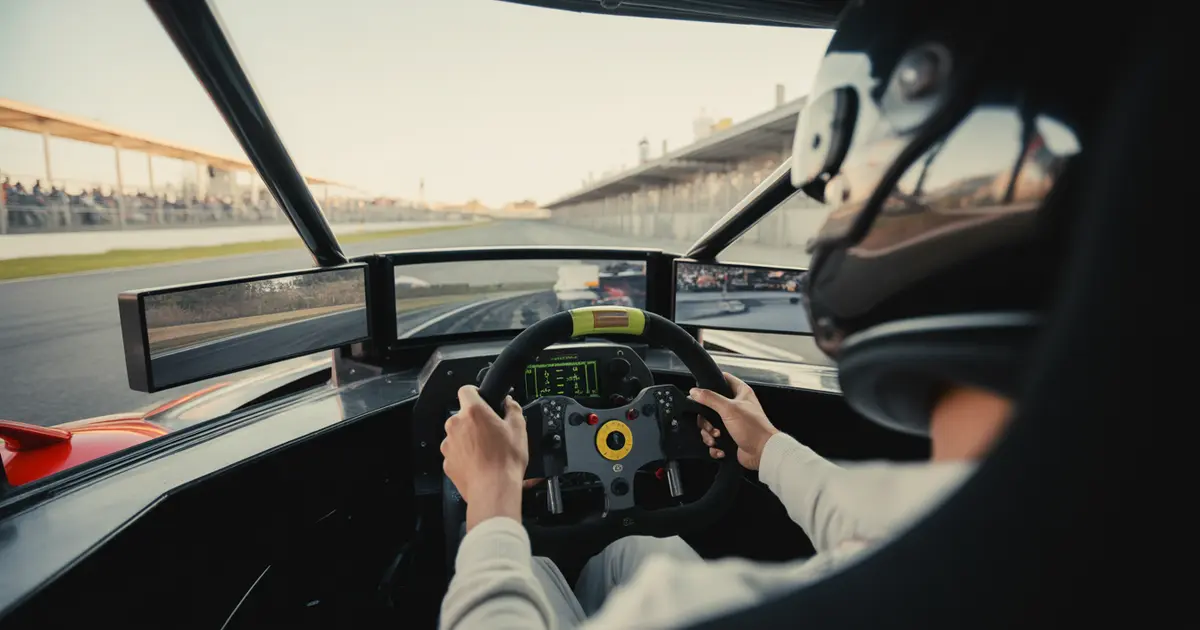
Between 1500 and 2000 iRating, the problem isn’t fast-lap pace anymore. It’s lap-to-lap variance and incidents that cost multiple positions at once.
Between 1500 and 2000 iRating, what unlocks the next tier is no longer raw lap pace. It’s reducing the variance between laps and cutting the incidents that cost multiple positions at once. At this level you already know how to trace a good line; the problem is repeating that line under pressure, race after race.
The bottleneck is no longer the fast lap
Below 1500, gaining iRating is usually a matter of pace: learning the line, braking points, tire management. Above 2000, the grid is already homogeneous and the differentiator becomes fine, thousandths-level consistency.
In the middle, between 1500 and 2000, the typical driver already has a good lap in their pocket. What’s missing is making that lap repeat ten times in a twenty-lap race, without one big mistake in between.
What actually changes between 1500 and 2000
The difference between being stuck at 1600 and climbing to 1900 rarely shows up in your best lap time. It shows up somewhere else.
| Race symptom | Likely cause |
|---|---|
| Good best lap, but poor average | High variance between laps, not lack of pace |
| Loses positions in 2 or 3 specific corners | A repetitive, specific error in one phase of the corner |
| Clean race until an incident wipes out the result | Risk management in traffic, not speed |
That changes the training question. It’s not “how do I get faster”, it’s “where am I inconsistent, and why”.
Where the time is hiding
The first step is to stop looking only at lap time and instead look at the gap between your best lap and your average lap. If that gap is large, the problem is repetition, not line-tracing talent.
For this to work as a diagnostic, it helps to understand how to shrink the gap between your best lap and your average lap. Next, you need to find which corner that inconsistency lives in — and there’s a direct way to know exactly which corner is costing you the most time in your lap.
The common mistake in this range: pushing instead of repeating
The most common mistake between 1500 and 2000 is treating every lap as an isolated pole attempt. The driver pushes the limit in every corner, every lap, including laps where they should just be managing position.
That works for a lap or two and breaks on the third: a rotation error, a locked tire, contact in a battle. The final result drops more than if they had driven two tenths slower and clean.
The fix isn’t to slow the overall pace. It’s knowing how to separate an attack lap from a management lap, and that’s a conscious decision, not a reflex.
How to train this tomorrow
- Run the same track for ten laps in a row without changing setup or fuel/tire combo, and log the gap between your best and your average, not just the best time.
- Mark the corner where the gap shows up by comparing phase by phase — entry, apex, exit — between a good lap and a bad lap in the same session.
- Isolate the exact input that changes: brake point, initial pressure, or brake release relative to steering, which is where most drivers lose time without noticing; to understand the mechanics of this, it’s worth reviewing how to release the brake in proportion to steering input.
- Repeat the isolated corner instead of the full lap, ten, fifteen times, until the gap between attempts shrinks.
- Go back to the full race only after that, and check whether the gap between best and average improved across the whole track, not just the trained corner.
If the problem isn’t one corner but the exit of all of them, the target is different: understanding why you lose time in the rotation phase and not in braking usually explains why the car “gets away” at the same point of the turn every time.
How this changes by car and by track
A car with lots of mechanical grip and little aero, like most GT3s at low speed, forgives braking inconsistency more and punishes rotation inconsistency more. A formula car with relevant aero flips that: the costly mistake is entering a medium-speed corner too fast and losing the car under high load.
A track with many low-speed corners concentrates the risk at the exit, because that’s where traction decides the next straight. A fast track concentrates the risk at the entry, because a high-speed mistake costs more time per corner.
This also applies to the start, where inconsistency in reaction and positioning in the first meters can wipe out the gain from a good qualifying lap; it’s worth reviewing how to avoid losing three positions in the first 200 meters if that’s where you lose the most iRating.
When the method doesn’t work
If you already have a small gap between best and average, and you’re still stuck, the problem might not be you — it might be the category or time slot you chose, with grids too inconsistent to reflect your real level.
In that case, switching category or time slot for a few weeks is a more honest test than insisting on technical training that’s already working.
Where Laptics helps with this diagnosis
Laptics automatically records telemetry while you race in iRacing, Assetto Corsa, ACC, GT7, or F1 25, and compares your laps by corner phase to show exactly where time is really lost. Driver DNA points out the traits that repeat — including inconsistency traits — and Race Vault stores your sessions so you can compare before and after training.
In this iRating range, whoever repeats the good lap climbs faster than whoever just chases a better lap.
Practical summary
- Measure the gap between your best lap and your average lap before any other adjustment.
- Locate the corner where that gap concentrates, phase by phase.
- Train the isolated corner in repetition, not the whole lap.
- Separate attack laps from management laps within the same race.
- Reassess category or time slot if the gap is already small and the result is still stuck.
Frequently asked questions
Do I need to be faster to go from 1500 to 2000 iRating?
Not necessarily. In most cases the gain comes from cutting big mistakes and lap-to-lap variance, not from setting a faster lap.
Which metric shows whether the problem is consistency, not pace?
The gap between your best lap and your average lap in the same session. If it’s large, the bottleneck is repetition.
Is it better to train in qualifying or in a long race?
A long race exposes the consistency problem better, because it forces you to repeat the same execution under tire wear and battling.
What should I do when the gap disappears in one corner but shows up in another?
Isolate the new corner with the same process: compare phase by phase between the good lap and the bad lap before training the full lap again.
Does a category with an inconsistent grid affect iRating in this range?
Yes. Uneven grids increase the chance of an incident outside your control, which skews the result even with clean driving.
Does Laptics tell me which setup to use to gain consistency?
No. Laptics analyzes your telemetry and shows where time is lost by corner phase; setup adjustments and driving decisions are still yours to make.
How much training time is needed to reduce lap-to-lap variance?
It depends on the car, the track, and the driver’s current error level; there’s no fixed number, but isolated repetition of the problem corner tends to show an effect faster than running full laps.
Want to see this in your own telemetry?
Discover Laptics