%20--%3e%3cdefs%3e%3cstyle%3e%20.st0%20{%20fill:%20%23ff1230;%20}%20.st1%20{%20fill:%20%23fff;%20}%20%3c/style%3e%3c/defs%3e%3cpath%20class='st0'%20d='M49.77,34.93l3.47-5.3,23.2-5.86,4.03-6.07-23.14,5.83,3.55-5.33,23.17-5.84,3.96-6.05-23.07,5.8,3.59-5.52-23.16,5.83,3.68-5.68-19.8,4.98c-2.49.63-4.65,2.16-6.07,4.3l-1.81,2.75,20-5.03c.7-.18,1.49-.1,1.75.21.21.25.09,1.12-.24,1.61l-1.85,2.7-19.34,4.87c-2.48.62-4.64,2.15-6.06,4.29l-1.82,2.75,20.12-5.04c.7-.18,1.53.11,1.64.48.09.31-.06,1.12-.4,1.6l-1.79,2.51-19.21,4.82c-2.51.63-4.69,2.19-6.11,4.36l-1.75,2.69,20.19-5.08c1.67-.25,1.96.77,1.1,2.08l-1.9,2.89,19.51-4.94c1.49-.38,2.88,0,1.87,1.62l-1.88,3.01,24.65-6.19,3.01-5.82-23.07,5.79ZM60.94,13.54c.53-.13,1.35.11,1.52.37.19.28-.02,1.14-.37,1.66l-1.73,2.56-22.57,5.67,3.51-5.31,19.64-4.95ZM30.19,35.24l3.49-5.33,19.75-4.95c1.34-.34,1.92.7,1.23,1.76l-1.83,2.83-22.65,5.7Z'/%3e%3cpath%20class='st1'%20d='M236.44,40.24l22.56-33.95h10.5l-22.56,33.95h-10.5Z'/%3e%3cpath%20class='st1'%20d='M368.54,15.18l5.9-8.88h-52.48l-5.64,8.49-3.45,5.19-5.01,7.54h0s40.4,0,40.4,0l-2.82,4.24h-72.13c-2.23,0-3.07-1.46-1.87-3.27l9.11-13.71h29.5l5.95-8.49h-40.31l-5.64,8.49-9.61,14.46c-.36.55-.67,1.08-.92,1.61-.15.31-.28.61-.39.9-1.52,4.06.3,7.25,4.69,8.2.48.1.99.18,1.54.23.44.04.9.06,1.38.06h85.14l8.46-12.73,5.24-7.89h-40.45l2.95-4.44h40.45Z'/%3e%3cpath%20class='st1'%20d='M198.16,6.32c-.19,0-.37-.03-.56-.03h-60.45l-37.03,26.63h-19.71l18.01-26.63h-10.5l-17.48,26.31c-2.17,3.27.17,7.64,4.09,7.64h28.01l37.22-25.46h6.27l-16.92,25.46h10.51l16.92-25.46h27.83l-.02.04h7.11c1.89.18,2.56,1.55,1.44,3.23l-1.3,1.96c-1.2,1.8-3.98,3.27-6.21,3.27h-25.26l-11.28,16.98h10.5l5.64-8.49h15.69c.48,0,.96-.02,1.45-.06.61-.05,1.22-.12,1.84-.23,5.65-.95,11.72-4.14,15.59-8.2.02-.02.04-.04.06-.06.74-.78,5.18-7.47,5.57-8.39h17.48l-16.94,25.49h10.51l16.94-25.49h14.98l5.65-8.5h-55.64Z'/%3e%3c/svg%3e)
Race Start: How to Avoid Losing Three Positions in the First 200 Meters
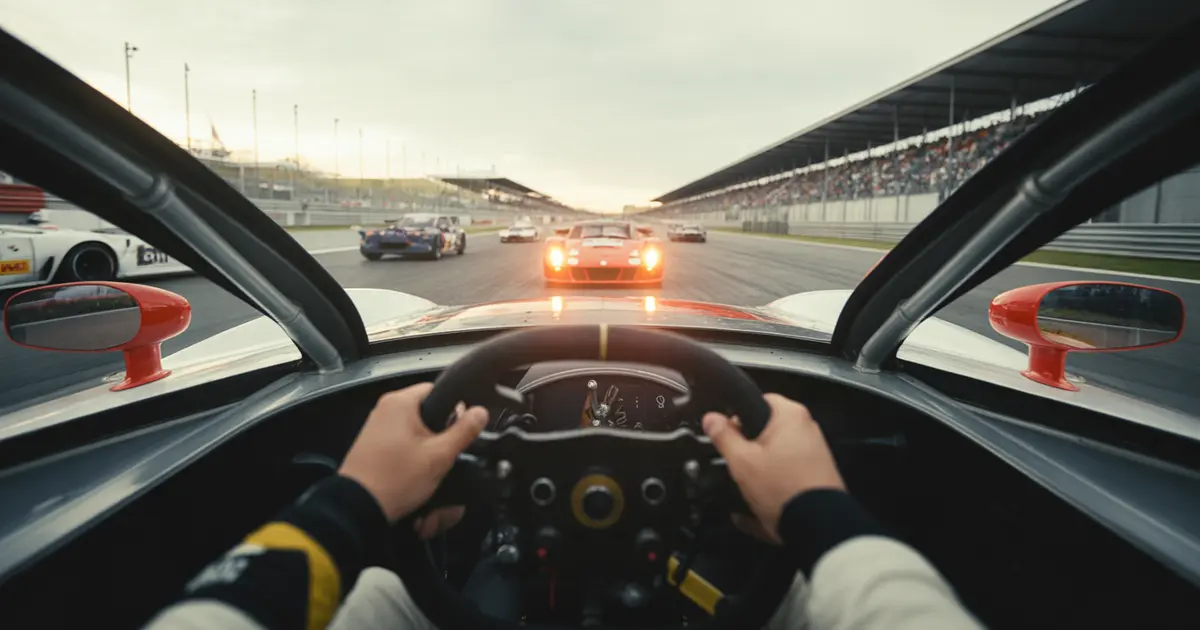
The three positions disappear at three different moments during the start. See how to identify which one is your problem before trying to fix everything at once.
You lose those three positions at three different moments: a delayed reaction to green, loss of traction in the first meters, or a badly judged brake point on the approach to turn 1. It’s not a lack of start talent — it’s not knowing which of the three is costing you the most.
The problem is that all three look the same on the replay. They all end the same way: you launch in P5 and arrive at turn 1 in P8. But the cause completely changes what you should practice tomorrow.
The three points where the position disappears
Each of these points has a different visual symptom on the replay and a separate technical cause. Mixing all three together in your diagnosis is why so many drivers end up practicing the wrong thing.
| Symptom | Likely cause | What to adjust |
|---|---|---|
| The car beside you launches the same but slowly passes you | Delayed reaction to green | Train the visual trigger in isolation, without a car beside you |
| Wheels spin and the car overheats on exit | Throttle beyond available grip | Modulate the pedal instead of full throttle in the first meters |
| You arrive too fast at turn 1 and have to release the brake | Brake point calibrated for an empty track | Recalculate the brake point accounting for traffic beside you |
Diagnosis: which of the three is your problem
Before practicing anything, isolate where the position is actually lost. Most drivers assume they lost it at turn 1 when they had really already lost it in the first 20 meters.
- Isolate the first three seconds of the replay and time the gap between the light going out and the car’s first movement.
- Compare the throttle trace of the start lap with a normal race lap, looking only at the first two seconds.
- Mark the turn 1 brake point on the start lap and compare it with the brake point on the following laps, without traffic.
- Note which segment — 0 to 20 meters, 20 to 100 meters, or 100 to 200 meters — is where the position was actually lost, not just where it showed up on the leaderboard.
This kind of segment-by-segment breakdown is the same reasoning used to identify which corner of the lap is costing you the most time: without splitting by phase, you end up optimizing the wrong piece.
- 1Reaction to green
Interval between the light going out and the car’s first movement.
- 2Initial traction
Throttle management in the first meters without losing grip.
- 3Approach to turn 1
Recalculated brake point accounting for cars alongside.
- 4Defense or attack
Lateral positioning that decides whether the position holds.
Training reaction and traction without relying on a real start
Online race starts come with traffic, luck, and chaos. To isolate the variable, train the first two elements separately.
- Repeated solo starts: launch from an empty grid, with no other cars, and time from green to the first full wheel rotation.
- The game’s light pattern: every simulator has a different random timing between the last red light and green — training in another title won’t transfer the rhythm.
- Pedal recording: record the throttle trace in the first two seconds and compare start to start, looking for where your foot goes flat too early.
How this changes by car and by track
The relative weight of each of the three points isn’t the same in every car. That changes what’s worth practicing first.
- GT3 and GTE: the launch depends more on throttle modulation than on the clutch, since most cars launch in first gear without shifting early.
- Open-wheel cars: the wrong rev drop kills traction entirely, especially on a cold track or with little rubber laid down at the start.
- Road cars in GT7: lower relative power makes lateral positioning matter more than pure traction.
The track matters too: starts with a short straight into a tight turn 1 punish late braking harder, while long straights give you time to recover from a traction mistake.
The common mistake: fixing the launch and forgetting turn 1
Many drivers train the start until they master the first 50 meters and still lose position at turn 1. The reason is simple: braking habits change when there’s a car beside you, and almost nobody trains that separately.
Braking next to another car requires releasing the pedal in the same proportion as the steering input, without relying on open space to correct — the same logic behind releasing the brake in proportion to steering input in trail braking applies here, just under traffic pressure.
The position you lose at the start is rarely a start-only problem — it’s usually the same braking or throttle habit that already costs you time in any corner of the lap.
How to confirm it in the data
Comparing only the final position doesn’t show where the time was lost. Overlaying the throttle trace and brake point from the start against a clean lap reveals the exact moment that cost you the position.
If you don’t yet have the habit of checking telemetry outside the start, it’s worth learning where to begin when you’ve never opened a graph before before trying to isolate a stretch as short as the first 200 meters.
Where Laptics comes in
Laptics automatically records your telemetry while you drive, including the start lap, and compares it phase by phase against your other laps. The Driver DNA helps you see whether the same throttle or braking pattern repeats race after race — which is what separates a one-off mistake from a habit worth training in the Training Center.
Practical summary
- Split the diagnosis into three segments before changing anything: reaction, traction, turn 1 braking.
- Practice isolated starts to remove traffic from the equation and focus only on your reaction time.
- Revisit the turn 1 brake point assuming there will be a car beside you, not an empty track.
Frequently asked questions
What’s the most common start mistake that costs you a position?
Calibrating the turn 1 brake point as if the track were empty, without accounting for the car beside you. That forces you to release the brake mid-corner and lose the line.
How can I train reaction to green without relying on other cars?
Launch from an empty grid, alone, and repeat the start timing only the interval between green and the first wheel rotation.
Does a rear-wheel-drive car need different start training?
Yes, the focus shifts more toward throttle modulation than clutch work, since most cars launch in first gear without shifting early.
Is it worth risking an outside pass at turn 1?
It depends on how tight the corner is and how short the start straight is. Tight corners with a short straight punish outside attempts more.
How do I know if I lost time at the start or only at turn 1?
Isolate the first three seconds of the replay and compare the throttle trace with a normal lap — if the delay already shows up there, the problem isn’t turn 1.
Does a grid with lower iRating change your start strategy?
Yes, more unpredictable traffic calls for a more conservative brake point at turn 1, even if it costs you an immediate position.
Can I train starts alone, without other cars on track?
Yes, and it’s recommended to isolate reaction and traction. What you can’t train alone is defending position under side-by-side pressure.
Does Laptics record the start automatically?
Yes, capture happens automatically during the session; you don’t need to export anything manually to later analyze the start phase by phase.
Want to see this in your own telemetry?
I want to analyze my starts