%20--%3e%3cdefs%3e%3cstyle%3e%20.st0%20{%20fill:%20%23ff1230;%20}%20.st1%20{%20fill:%20%23fff;%20}%20%3c/style%3e%3c/defs%3e%3cpath%20class='st0'%20d='M49.77,34.93l3.47-5.3,23.2-5.86,4.03-6.07-23.14,5.83,3.55-5.33,23.17-5.84,3.96-6.05-23.07,5.8,3.59-5.52-23.16,5.83,3.68-5.68-19.8,4.98c-2.49.63-4.65,2.16-6.07,4.3l-1.81,2.75,20-5.03c.7-.18,1.49-.1,1.75.21.21.25.09,1.12-.24,1.61l-1.85,2.7-19.34,4.87c-2.48.62-4.64,2.15-6.06,4.29l-1.82,2.75,20.12-5.04c.7-.18,1.53.11,1.64.48.09.31-.06,1.12-.4,1.6l-1.79,2.51-19.21,4.82c-2.51.63-4.69,2.19-6.11,4.36l-1.75,2.69,20.19-5.08c1.67-.25,1.96.77,1.1,2.08l-1.9,2.89,19.51-4.94c1.49-.38,2.88,0,1.87,1.62l-1.88,3.01,24.65-6.19,3.01-5.82-23.07,5.79ZM60.94,13.54c.53-.13,1.35.11,1.52.37.19.28-.02,1.14-.37,1.66l-1.73,2.56-22.57,5.67,3.51-5.31,19.64-4.95ZM30.19,35.24l3.49-5.33,19.75-4.95c1.34-.34,1.92.7,1.23,1.76l-1.83,2.83-22.65,5.7Z'/%3e%3cpath%20class='st1'%20d='M236.44,40.24l22.56-33.95h10.5l-22.56,33.95h-10.5Z'/%3e%3cpath%20class='st1'%20d='M368.54,15.18l5.9-8.88h-52.48l-5.64,8.49-3.45,5.19-5.01,7.54h0s40.4,0,40.4,0l-2.82,4.24h-72.13c-2.23,0-3.07-1.46-1.87-3.27l9.11-13.71h29.5l5.95-8.49h-40.31l-5.64,8.49-9.61,14.46c-.36.55-.67,1.08-.92,1.61-.15.31-.28.61-.39.9-1.52,4.06.3,7.25,4.69,8.2.48.1.99.18,1.54.23.44.04.9.06,1.38.06h85.14l8.46-12.73,5.24-7.89h-40.45l2.95-4.44h40.45Z'/%3e%3cpath%20class='st1'%20d='M198.16,6.32c-.19,0-.37-.03-.56-.03h-60.45l-37.03,26.63h-19.71l18.01-26.63h-10.5l-17.48,26.31c-2.17,3.27.17,7.64,4.09,7.64h28.01l37.22-25.46h6.27l-16.92,25.46h10.51l16.92-25.46h27.83l-.02.04h7.11c1.89.18,2.56,1.55,1.44,3.23l-1.3,1.96c-1.2,1.8-3.98,3.27-6.21,3.27h-25.26l-11.28,16.98h10.5l5.64-8.49h15.69c.48,0,.96-.02,1.45-.06.61-.05,1.22-.12,1.84-.23,5.65-.95,11.72-4.14,15.59-8.2.02-.02.04-.04.06-.06.74-.78,5.18-7.47,5.57-8.39h17.48l-16.94,25.49h10.51l16.94-25.49h14.98l5.65-8.5h-55.64Z'/%3e%3c/svg%3e)
How to Reduce the Gap Between Your Best Lap and Average Lap
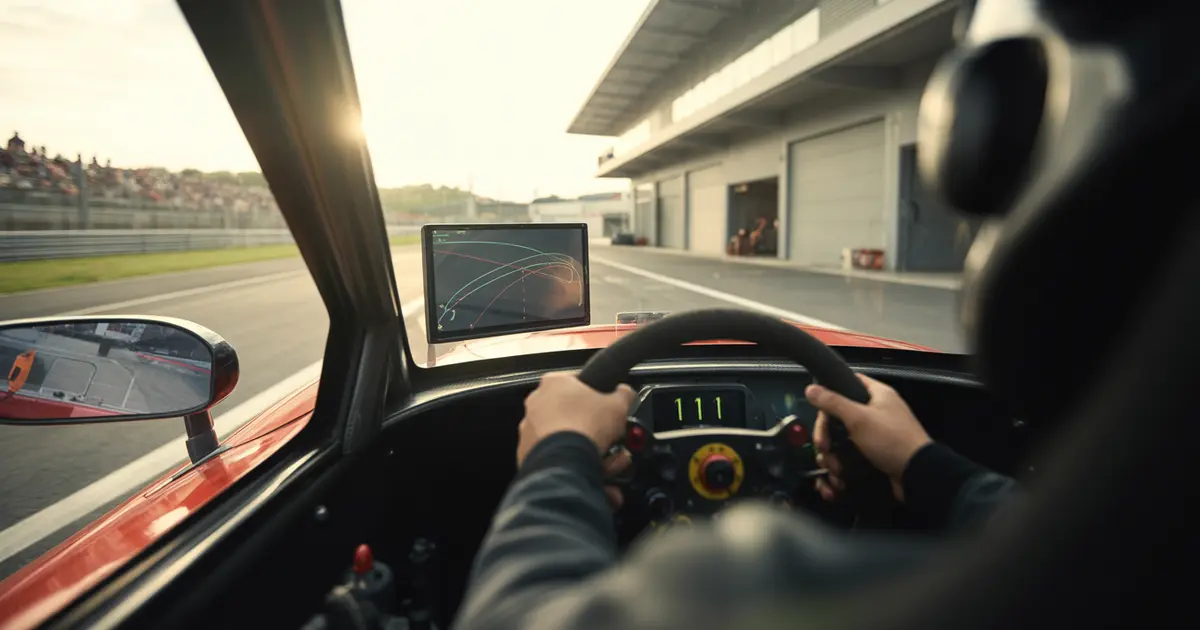
The gap between the perfect lap and the typical lap shrinks when you stop trying to ‘be more consistent’ and start training the exact phase where you repeatedly lose time, in the same corner.
The gap between your best lap and your average lap shrinks when you stop aiming at the entire lap and start aiming at the exact phase of the corner where you repeatedly lose time. It is not about ‘being more consistent’ in general — it is about fixing one specific movement, in one specific corner, until it becomes a habit.
This number — best lap minus average lap of a stint — is one of the most honest indicators that exist in simracing. It does not measure your potential. It measures what you can repeat under pressure, lap after lap, with tires already a bit different and a head already a bit tired.
What this gap really measures
A driver who is fast on a single lap and a driver who is fast on average are different things. The first found the limit once. The second knows where the limit is and can stay close to it consistently.
A large gap usually does not come from one isolated bad corner. It comes from one or two phases — late braking, turn-in point, throttle pickup — that you get right sometimes and wrong other times, without noticing the pattern.
Diagnosis by phase, not by lap
Looking at the full lap time hides where the error lives. The same final time can come from perfect braking with a bad exit, or the opposite. Split the corner into braking, entry, apex and traction before judging anything.
| Symptom | Likely phase | Common cause |
|---|---|---|
| Good lap comes with a clean exit | Traction | Inconsistent throttle progression |
| Bad lap gets stuck mid-corner | Entry / apex | Turn-in point varies with tire confidence |
| Time is lost before you even brake | Braking | Reference point shifts with fatigue |
If the pattern is always in braking, the fix is technical and trainable in a few sessions. It is worth reviewing how you release the brake as you turn the wheel — the central theme of trail braking and the ratio between brake and steering.
How to isolate the phase that bleeds time
Take your best stint of five or more clean laps. Compare, corner by corner, the fastest lap against the slowest lap of the same stint — not against the whole session, against the same tire set and fuel load.
- Delta by sector: identifies in which third of the track time is lost, but it is still too broad to become a drill.
- Delta by corner: already shows which specific corner varies most between your laps — usually two or three, not the whole track.
- Delta by phase within the corner: shows whether the problem is braking, turn-in or traction, which is the level where you can actually train.
Consistency is not doing the same lap twice. It is making the same mistake every time, in a place you already know how to fix.
Three-session protocol to close the gap
Once you have identified the phase, the training needs to be narrow. Training the whole track again only reinforces the same error pattern.
- Session 1 — isolation: run only the problem corner in free mode, ten to fifteen times in a row, without worrying about the rest of the lap.
- Session 2 — context: go back to running full laps, but keep your attention only on that phase; let the rest happen on autopilot.
- Session 3 — pressure: enter a short race or online race and check whether the pattern holds when there are cars nearby and tires degrading.
If the gap does not drop in session 3, the problem was not technical — it was about attention or decision-making under pressure, and the training changes.
Mistakes that widen the gap without you noticing
- Mixing different stints: comparing a lap on fresh tires against one on worn tires artificially inflates the gap.
- Ignoring fuel load: a heavier car at the start of the stint changes the braking point; treating that as a driving error is a wrong diagnosis.
- Training tired: long sessions without a break increase variance more than any technical adjustment can fix.
- Chasing the perfect lap: chasing a single magic lap does not lower the average; lowering the worst lap of the stint does.
The gap changes by car and by track
Cars with more delicate traction — GT3s on a wet track, low-downforce single-seaters at low speed — naturally have a larger gap, because the margin for error is smaller. Comparing your gap in a GT3 with another driver’s gap in a road car tells you nothing.
Tracks with decreasing-radius corners or negative camber also punish any variation in turn-in point more severely. On these layouts, the same small mistake costs more time than it would in a constant-radius corner.
Where telemetry helps this diagnosis
Doing this phase-by-phase breakdown manually, lap by lap, is possible — but it takes time most drivers do not have after a training session. Laptics records telemetry automatically while you drive and compares your laps by corner phase, showing where time is lost repeatedly. The Driver DNA helps you see whether this pattern repeats across different tracks or is specific to one layout.
Practical summary
Stop measuring the gap by the whole lap. Break it down by phase, find the corner and the phase that vary most between your good and bad laps, and train it in isolation before training under pressure. The number only drops when the training becomes narrow enough to attack the cause, not the symptom.
Frequently asked questions
What is a good value for the difference between best lap and average lap?
There is no universal number: it depends on the car, the track and tire conditions. What matters is tracking your own progress over time, in the same car and track.
Is comparing laps from different stints reliable?
No. Tires and fuel change the car’s behavior, so it is best to compare laps within the same stint, under similar conditions.
Does training more hours automatically reduce this gap?
Not necessarily. Hours without focus on a specific phase tend to reinforce the same error pattern instead of fixing it.
Should the gap be the same in every corner of the track?
No. More technical corners or ones with a smaller margin for error naturally show more variation than simple, constant-radius corners.
How do I know if the problem is technical or a lack of focus under pressure?
If the gap drops when you isolate the corner in free practice but returns when you enter a race, the problem is attention and decision-making, not pure technique.
Does Laptics automatically identify this problem phase?
The AI analysis compares your laps by corner phase and points out where time is repeatedly lost, which helps direct your training.
Is it worth focusing only on the slowest corner of the track?
Only if that corner is also the most inconsistent one. Corners that are slow in absolute time are not always the ones that vary most between your laps.
Want to see this in your own telemetry?
I want to analyze my laps with Laptics