%20--%3e%3cdefs%3e%3cstyle%3e%20.st0%20{%20fill:%20%23ff1230;%20}%20.st1%20{%20fill:%20%23fff;%20}%20%3c/style%3e%3c/defs%3e%3cpath%20class='st0'%20d='M49.77,34.93l3.47-5.3,23.2-5.86,4.03-6.07-23.14,5.83,3.55-5.33,23.17-5.84,3.96-6.05-23.07,5.8,3.59-5.52-23.16,5.83,3.68-5.68-19.8,4.98c-2.49.63-4.65,2.16-6.07,4.3l-1.81,2.75,20-5.03c.7-.18,1.49-.1,1.75.21.21.25.09,1.12-.24,1.61l-1.85,2.7-19.34,4.87c-2.48.62-4.64,2.15-6.06,4.29l-1.82,2.75,20.12-5.04c.7-.18,1.53.11,1.64.48.09.31-.06,1.12-.4,1.6l-1.79,2.51-19.21,4.82c-2.51.63-4.69,2.19-6.11,4.36l-1.75,2.69,20.19-5.08c1.67-.25,1.96.77,1.1,2.08l-1.9,2.89,19.51-4.94c1.49-.38,2.88,0,1.87,1.62l-1.88,3.01,24.65-6.19,3.01-5.82-23.07,5.79ZM60.94,13.54c.53-.13,1.35.11,1.52.37.19.28-.02,1.14-.37,1.66l-1.73,2.56-22.57,5.67,3.51-5.31,19.64-4.95ZM30.19,35.24l3.49-5.33,19.75-4.95c1.34-.34,1.92.7,1.23,1.76l-1.83,2.83-22.65,5.7Z'/%3e%3cpath%20class='st1'%20d='M236.44,40.24l22.56-33.95h10.5l-22.56,33.95h-10.5Z'/%3e%3cpath%20class='st1'%20d='M368.54,15.18l5.9-8.88h-52.48l-5.64,8.49-3.45,5.19-5.01,7.54h0s40.4,0,40.4,0l-2.82,4.24h-72.13c-2.23,0-3.07-1.46-1.87-3.27l9.11-13.71h29.5l5.95-8.49h-40.31l-5.64,8.49-9.61,14.46c-.36.55-.67,1.08-.92,1.61-.15.31-.28.61-.39.9-1.52,4.06.3,7.25,4.69,8.2.48.1.99.18,1.54.23.44.04.9.06,1.38.06h85.14l8.46-12.73,5.24-7.89h-40.45l2.95-4.44h40.45Z'/%3e%3cpath%20class='st1'%20d='M198.16,6.32c-.19,0-.37-.03-.56-.03h-60.45l-37.03,26.63h-19.71l18.01-26.63h-10.5l-17.48,26.31c-2.17,3.27.17,7.64,4.09,7.64h28.01l37.22-25.46h6.27l-16.92,25.46h10.51l16.92-25.46h27.83l-.02.04h7.11c1.89.18,2.56,1.55,1.44,3.23l-1.3,1.96c-1.2,1.8-3.98,3.27-6.21,3.27h-25.26l-11.28,16.98h10.5l5.64-8.49h15.69c.48,0,.96-.02,1.45-.06.61-.05,1.22-.12,1.84-.23,5.65-.95,11.72-4.14,15.59-8.2.02-.02.04-.04.06-.06.74-.78,5.18-7.47,5.57-8.39h17.48l-16.94,25.49h10.51l16.94-25.49h14.98l5.65-8.5h-55.64Z'/%3e%3c/svg%3e)
How to Know Exactly Which Corner Is Costing You the Most Time on Your Lap
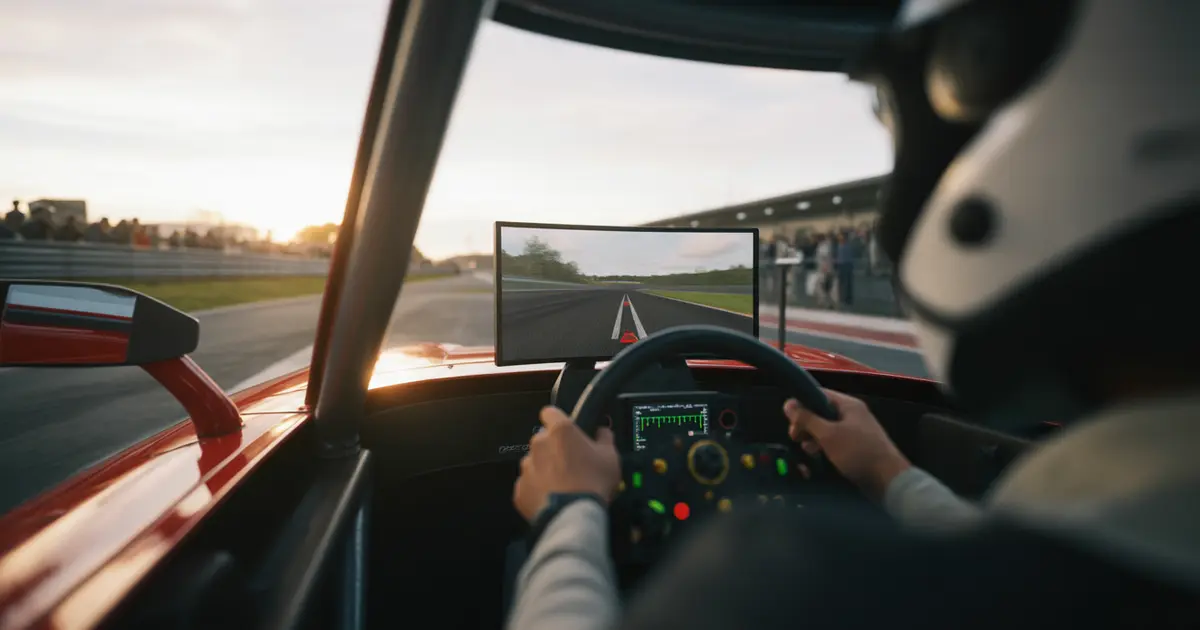
It’s not about remembering where you “felt” you made a mistake. It’s about reading the corner-by-corner time delta against a reference and no longer guessing.
You compare your lap, corner by corner, against a reference — your best lap or the ghost of a faster driver — and you watch the time delta graph, not the memory of where it “felt” like you made a mistake. The corner costing you the most time is where that delta line drops fastest or keeps dropping longest, not the corner that stuck in your head after the stint.
That distinction separates drivers who train with direction from those who train in the dark. The feeling of a mistake is real, but it measures discomfort, not time. The two sometimes line up. Most of the time, they don’t.
Why the “I messed up here” feeling is misleading
A corner where you lock a tire, run wide, or feel the car step out creates a strong memory. A corner where you’re simply 0.15s slower frame by frame, with no drama at all, creates no memory whatsoever.
The problem is that the second category usually costs more time per lap than the first. A blatant mistake in a slow corner can be worth less than an entry speed 2 km/h lower, repeated across three fast corners, with no visible scare at all.
The method: time delta per corner, not per whole lap
Looking at total lap time compared to the reference only tells you that you’re slower. It doesn’t tell you where. That’s what the delta trace is for — it shows the accumulated gain or loss throughout the circuit.
- Pick the right reference: your own best lap from the session, not a lap from another car or another setup — comparing different cars distorts the reading.
- Overlay the current lap with the reference and watch where the delta line changes slope, not just where it ends up in the red.
- Mark the stretches where the drop is constant over several meters — that’s cornering speed loss, not a one-off braking mistake.
- Split each corner into phases — braking, entry, apex, traction, and exit — and see in which phase the delta starts falling.
- Repeat over three or four clean laps before concluding anything. A single lap could have been affected by traffic or wind.
Separating symptom from cause
After finding the corner, the next step is finding the phase inside it. A corner isn’t a single point, it’s a sequence of decisions, and each phase has its own signature in the data.
| Delta symptom | Likely phase | What to look at |
|---|---|---|
| Drops before the apex | Braking/entry | Brake point and speed decay curve |
| Drops at the apex | Line/trajectory | Corner radius on the track map, not just speed |
| Drops on exit | Traction | Throttle application and residual steering angle |
This table doesn’t replace the graph, it’s a shortcut for knowing where to look first within the right channel. Anyone who wants to understand the ratio between releasing the brake and opening the wheel during that entry phase can review how to release the brake in proportion to steering before trying to fix it in the simulator.
Driving error or car limitation?
Not every drop in the delta is your mistake. Some cars simply lose time in certain corners due to setup, tire wear, or fuel load on board, and that also shows up as negative delta.
- Compare the same corner on fresh tires and worn tires — if the loss grows with wear, it’s a tire trait, not a line error.
- Compare a full tank with a low tank — load changes behavior in high-load corners, especially in GT3 and LMP.
- Check whether the loss exists on every lap or only some — if it’s intermittent, it’s execution; if it’s constant, it may be setup or car balance.
Skipping this step is the most common mistake among those who start looking at time delta: they assume every red corner is a driving flaw and try to “drive better” a problem that’s actually a setup issue.
When the data doesn’t confirm what you felt
Sometimes you’d swear you lost time in a corner and the delta shows something else. That’s information, not a contradiction. It usually means the mistake is one corner earlier — a bad entry that only shows up as time loss in the next corner, once exit speed was already compromised.
The corner where you lose time is rarely the corner where you feel you lost it. It’s almost always the previous one.
Before changing your line or brake point, confirm this by checking the entry speed of the “guilty” corner against the reference. If it was already lower before you even braked, the problem started earlier.
How to isolate this without wasting time analyzing
Doing this comparison lap by lap, corner by corner, by hand, is what eats up the most time for someone who already knows how to drive but doesn’t have hours free to become a data engineer. That’s the exact gap Laptics automates: the app records telemetry while you race, with no manual export, and the AI analysis already shows how much time each phase of each corner cost compared to your other laps.
This doesn’t replace understanding why — the Driver DNA helps you see whether that loss is a trait that repeats across several tracks, or something isolated to that one session. Anyone already using this to shrink the gap between their good lap and their average lap can see the full topic in how to reduce the gap between your best lap and your average lap.
Practical summary
Stop trusting the memory of where it “felt” like you made a mistake. Overlay the time delta against your best lap, find where the line drops in a sustained way, break it down by phase inside the corner, and confirm whether the cause is execution or a car trait at that moment of the race. Repeat across several laps before changing anything about your line.
Frequently asked questions
Which graph shows where I’m losing time in each corner?
The time delta graph against a reference lap, overlaid by track distance, is what shows this. It accumulates gain or loss throughout the circuit, corner by corner.
Should I compare my lap to the fastest sector of the day or to another driver’s ghost?
Start by comparing with your own best lap. Comparing to another driver only makes sense if the car and setup are identical, otherwise the reading mixes machine differences with driving differences.
Does a small delta drop across several corners matter more than one big mistake in a single corner?
Yes, often. Small repeated losses across several points in the lap tend to add up to more time than one isolated, visible mistake in a single corner.
How do I know if the time loss is my mistake or the car’s limitation?
Compare the same corner on fresh tires versus worn tires, and with a full tank versus a low tank. If the loss changes with these conditions, it’s a car trait; if it’s intermittent between otherwise identical laps, it’s execution.
Does the mistake always show up in the corner where I feel I messed up?
No. It’s common for the real mistake to be in the previous corner, with the effect only showing up as time loss in the next one, once entry speed was already compromised.
Does Laptics record this data automatically or do I need to export a file?
Capture is automatic while you race in iRacing, Assetto Corsa, ACC, Gran Turismo 7, or F1 25, with nothing to export manually.
How many laps do I need to analyze before changing my line in a corner?
At least three or four clean laps, without traffic or incidents, to confirm the loss is consistent and not an isolated event from that one attempt.
Want to see this in your own telemetry?
I want to see my corners by phase