%20--%3e%3cdefs%3e%3cstyle%3e%20.st0%20{%20fill:%20%23ff1230;%20}%20.st1%20{%20fill:%20%23fff;%20}%20%3c/style%3e%3c/defs%3e%3cpath%20class='st0'%20d='M49.77,34.93l3.47-5.3,23.2-5.86,4.03-6.07-23.14,5.83,3.55-5.33,23.17-5.84,3.96-6.05-23.07,5.8,3.59-5.52-23.16,5.83,3.68-5.68-19.8,4.98c-2.49.63-4.65,2.16-6.07,4.3l-1.81,2.75,20-5.03c.7-.18,1.49-.1,1.75.21.21.25.09,1.12-.24,1.61l-1.85,2.7-19.34,4.87c-2.48.62-4.64,2.15-6.06,4.29l-1.82,2.75,20.12-5.04c.7-.18,1.53.11,1.64.48.09.31-.06,1.12-.4,1.6l-1.79,2.51-19.21,4.82c-2.51.63-4.69,2.19-6.11,4.36l-1.75,2.69,20.19-5.08c1.67-.25,1.96.77,1.1,2.08l-1.9,2.89,19.51-4.94c1.49-.38,2.88,0,1.87,1.62l-1.88,3.01,24.65-6.19,3.01-5.82-23.07,5.79ZM60.94,13.54c.53-.13,1.35.11,1.52.37.19.28-.02,1.14-.37,1.66l-1.73,2.56-22.57,5.67,3.51-5.31,19.64-4.95ZM30.19,35.24l3.49-5.33,19.75-4.95c1.34-.34,1.92.7,1.23,1.76l-1.83,2.83-22.65,5.7Z'/%3e%3cpath%20class='st1'%20d='M236.44,40.24l22.56-33.95h10.5l-22.56,33.95h-10.5Z'/%3e%3cpath%20class='st1'%20d='M368.54,15.18l5.9-8.88h-52.48l-5.64,8.49-3.45,5.19-5.01,7.54h0s40.4,0,40.4,0l-2.82,4.24h-72.13c-2.23,0-3.07-1.46-1.87-3.27l9.11-13.71h29.5l5.95-8.49h-40.31l-5.64,8.49-9.61,14.46c-.36.55-.67,1.08-.92,1.61-.15.31-.28.61-.39.9-1.52,4.06.3,7.25,4.69,8.2.48.1.99.18,1.54.23.44.04.9.06,1.38.06h85.14l8.46-12.73,5.24-7.89h-40.45l2.95-4.44h40.45Z'/%3e%3cpath%20class='st1'%20d='M198.16,6.32c-.19,0-.37-.03-.56-.03h-60.45l-37.03,26.63h-19.71l18.01-26.63h-10.5l-17.48,26.31c-2.17,3.27.17,7.64,4.09,7.64h28.01l37.22-25.46h6.27l-16.92,25.46h10.51l16.92-25.46h27.83l-.02.04h7.11c1.89.18,2.56,1.55,1.44,3.23l-1.3,1.96c-1.2,1.8-3.98,3.27-6.21,3.27h-25.26l-11.28,16.98h10.5l5.64-8.49h15.69c.48,0,.96-.02,1.45-.06.61-.05,1.22-.12,1.84-.23,5.65-.95,11.72-4.14,15.59-8.2.02-.02.04-.04.06-.06.74-.78,5.18-7.47,5.57-8.39h17.48l-16.94,25.49h10.51l16.94-25.49h14.98l5.65-8.5h-55.64Z'/%3e%3c/svg%3e)
Formula Classic: How to Adapt Your Style for a Narrow-Wing Car on Vintage Slicks
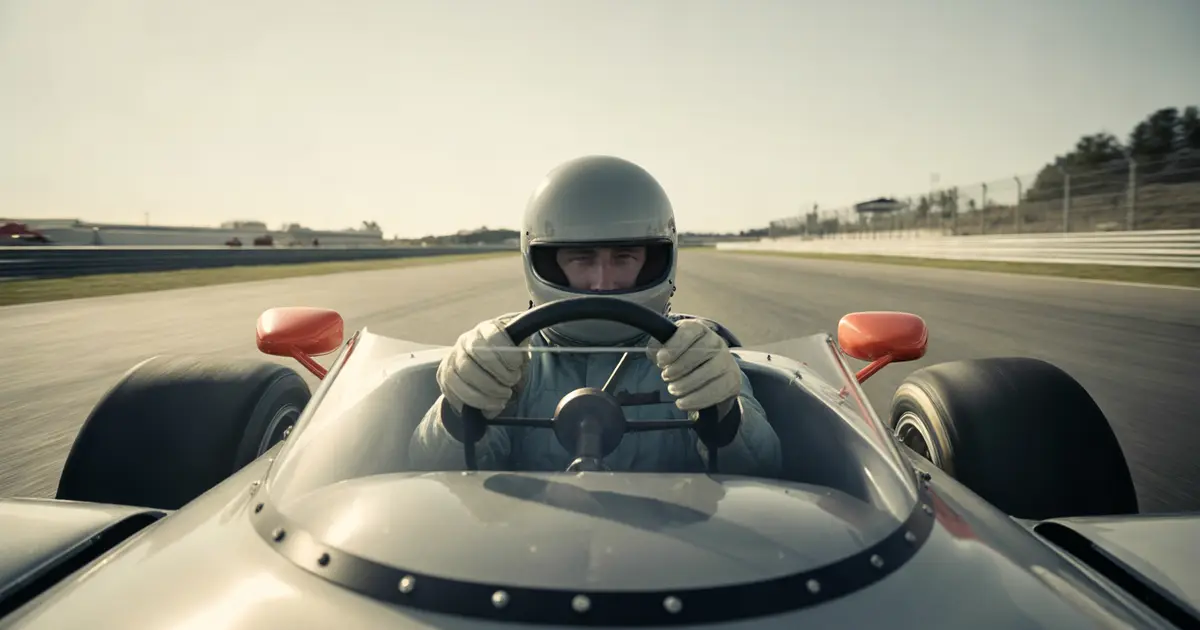
A narrow-wing car on vintage slick tires demands less trail braking, more patience on turn-in, and a smoother throttle. See what changes and how to train it starting tomorrow.
A narrow-wing car on vintage slick tires calls for less trail braking, a smoother turn-in, and throttle applied earlier, in a progressive way. The reason is simple: without modern downforce, high-speed grip disappears sooner, and vintage slick tires have a much narrower slip window than the radial rubber on today's cars.
This changes how you attack a corner from start to finish. Drivers coming from GT3, Formula Ultimate, or any car with a big wing feel the car “float” for the first few laps until they understand this new limit.
What changes physically
The Formula Classic in Automobilista 2 recreates an era when aerodynamic load was almost decorative. Grip comes mostly from mechanical setup: weight distribution, springs, anti-roll bars, and the tire itself.
The vintage slick tire, with no tread and a compound from another generation, has a narrower peak of grip. Go slightly past the ideal slip angle and the rear or front lets go more abruptly than it would on a modern slick.
| Aspect | Car with modern downforce |
|---|---|
| Fast corner | Carries speed on entry, aero holds it |
| Braking | Long, aggressive trail braking |
| Traction | Can open the throttle early, electronics help |
Braking: release early, turn after
In a car with a big wing, part of trail braking works because front aerodynamic load still helps the tire turn while the brake releases. In the Formula Classic, that help doesn't exist.
This means: finish braking in a straight line earlier and let the steering input happen once the car is already more stable. If you release the brake together with the steering input, like you would in a GT3, the front end of the vintage slick tire loses grip before the corner is complete.
It's worth revisiting the principle of releasing the brake in proportion to the steering input: here the proportion is more conservative, with less overlap between braking and turning.
- 1Straight-line braking
Hard braking in a straight line, no steering input yet.
- 2Early release
Brake pressure releases almost fully before the main turn-in begins.
- 3Stabilized turn-in
Steering applied once the car is already free of heavy braking load.
- 4Progressive throttle
Partial throttle still mid-corner, increasing gradually.
Fast corners: mechanical load, not aerodynamic
In medium and high-speed corners, the most common mistake is keeping the same entry confidence you'd have in a big-wing car. The result is late understeer: the car seems to be doing fine and then suddenly runs wide.
In this car, entry grip comes from static load plus suspension setup, not from speed squared like in modern aero cars. That's why a fast corner demands a slightly slower entry and a cleaner radius, with no mid-corner steering corrections.
- Reduce entry speed by 2 to 3 km/h in fast corners until you feel where the vintage slick tire still responds without sliding.
- Avoid correcting the wheel mid-corner: on a vintage slick tire, a late correction costs more time than recovering from a slightly conservative entry.
- Watch the curbs carefully: without a wing, the car loses contact for longer when riding over them.
Exit traction: throttle earlier, not harder
With less power relative to weight and no modern electronic differential, the Formula Classic tolerates earlier throttle application than you'd expect, as long as it's progressive.
The common mistake is holding the throttle until the car is fully straightened, copying the habit from turbocharged, heavy cars like the Stock Car 2023. Here that costs time: the car is light, and traction accepts partial throttle even mid-corner.
How to spot the mistake in practice
Three symptoms indicate you're still driving as if you had modern downforce:
- Mid-corner understeer in fast sections where you used to keep full commitment in a GT3 or Formula Ultimate.
- Front wheel lockup under braking, a sign that trail braking is extended too far for this tire; it's worth revisiting why locking the front wheel costs more time than braking earlier.
- Loose rear on exit when the throttle is applied abruptly instead of progressively.
If these three symptoms show up together, the fix isn't in the setup: it's in your style. Changing springs or anti-roll bars won't fix a braking habit built for a different type of car.
In the Formula Classic, lap time doesn't come from carrying more speed into the corner. It comes from losing less vintage-slick grip in every phase of the lap.
Where to compare: Classic vs. extreme downforce car
To feel the style difference clearly, it's worth alternating sessions between the Formula Classic and a car at the opposite extreme, like the Formula Reiza V12 and its extreme downforce. The contrast shows where your body is still applying the wrong reflex.
Confirming it in the data
After adjusting your style on track, the next step is confirming it in the graph. Two channels tell the full story here: brake pressure on entry and steering angle versus rear yaw rate.
If brake pressure still fades gradually well inside the corner, the old habit remains. If the steering peak happens before the car stabilizes, the front end of the vintage slick tire has likely already passed its ideal point.
Vintage slick tire pressure and temperature also shift the working window between cold and warm sessions; the principle of adjusting pressure based on operating temperature applies here too, just with a smaller margin for error.
In the Laptics app, telemetry capture happens automatically during the session, and the analysis compares the corner phase by phase, showing exactly where the Classic's braking, steering, or throttle still cost time. This helps confirm whether the style change has become a habit or is still a conscious effort.
Practical summary
- Braking: finish earlier, overlap less brake with steering.
- Fast corner: enter a bit slower, with no mid-corner correction.
- Exit: open the throttle earlier, but progressively.
- Validation: check brake pressure and steering in the graph, not just the on-track feel.
Frequently asked questions
Does the Formula Classic need a different setup or just a style change?
Both help, but style comes first. Setup can't fix trail braking that was built for a downforce car.
Why does a vintage slick tire slide more suddenly than a modern slick?
Its slip angle window is narrower, so the transition from grip to slide happens more abruptly.
Can I use the same braking reference from the Formula Reiza V12 in the Classic?
No. The V12 has downforce that helps the front end turn during trail braking; the Classic doesn't have that help.
Is understeer in the Classic always a style issue?
In most cases yes, but it's worth checking tire temperature and pressure before ruling out a setup cause.
Does Laptics record Formula Classic telemetry automatically?
Yes, on iRacing, Assetto Corsa, and ACC on PC capture is automatic; on Automobilista 2 the analysis workflow follows the same principle of comparing the corner phase by phase.
How long does it take to adapt your style to this type of car?
It depends on the driver and the track, but the first sign of progress usually shows up when front wheel lockup disappears under braking.
Want to see this in your own telemetry?
I want to analyze my laps