%20--%3e%3cdefs%3e%3cstyle%3e%20.st0%20{%20fill:%20%23ff1230;%20}%20.st1%20{%20fill:%20%23fff;%20}%20%3c/style%3e%3c/defs%3e%3cpath%20class='st0'%20d='M49.77,34.93l3.47-5.3,23.2-5.86,4.03-6.07-23.14,5.83,3.55-5.33,23.17-5.84,3.96-6.05-23.07,5.8,3.59-5.52-23.16,5.83,3.68-5.68-19.8,4.98c-2.49.63-4.65,2.16-6.07,4.3l-1.81,2.75,20-5.03c.7-.18,1.49-.1,1.75.21.21.25.09,1.12-.24,1.61l-1.85,2.7-19.34,4.87c-2.48.62-4.64,2.15-6.06,4.29l-1.82,2.75,20.12-5.04c.7-.18,1.53.11,1.64.48.09.31-.06,1.12-.4,1.6l-1.79,2.51-19.21,4.82c-2.51.63-4.69,2.19-6.11,4.36l-1.75,2.69,20.19-5.08c1.67-.25,1.96.77,1.1,2.08l-1.9,2.89,19.51-4.94c1.49-.38,2.88,0,1.87,1.62l-1.88,3.01,24.65-6.19,3.01-5.82-23.07,5.79ZM60.94,13.54c.53-.13,1.35.11,1.52.37.19.28-.02,1.14-.37,1.66l-1.73,2.56-22.57,5.67,3.51-5.31,19.64-4.95ZM30.19,35.24l3.49-5.33,19.75-4.95c1.34-.34,1.92.7,1.23,1.76l-1.83,2.83-22.65,5.7Z'/%3e%3cpath%20class='st1'%20d='M236.44,40.24l22.56-33.95h10.5l-22.56,33.95h-10.5Z'/%3e%3cpath%20class='st1'%20d='M368.54,15.18l5.9-8.88h-52.48l-5.64,8.49-3.45,5.19-5.01,7.54h0s40.4,0,40.4,0l-2.82,4.24h-72.13c-2.23,0-3.07-1.46-1.87-3.27l9.11-13.71h29.5l5.95-8.49h-40.31l-5.64,8.49-9.61,14.46c-.36.55-.67,1.08-.92,1.61-.15.31-.28.61-.39.9-1.52,4.06.3,7.25,4.69,8.2.48.1.99.18,1.54.23.44.04.9.06,1.38.06h85.14l8.46-12.73,5.24-7.89h-40.45l2.95-4.44h40.45Z'/%3e%3cpath%20class='st1'%20d='M198.16,6.32c-.19,0-.37-.03-.56-.03h-60.45l-37.03,26.63h-19.71l18.01-26.63h-10.5l-17.48,26.31c-2.17,3.27.17,7.64,4.09,7.64h28.01l37.22-25.46h6.27l-16.92,25.46h10.51l16.92-25.46h27.83l-.02.04h7.11c1.89.18,2.56,1.55,1.44,3.23l-1.3,1.96c-1.2,1.8-3.98,3.27-6.21,3.27h-25.26l-11.28,16.98h10.5l5.64-8.49h15.69c.48,0,.96-.02,1.45-.06.61-.05,1.22-.12,1.84-.23,5.65-.95,11.72-4.14,15.59-8.2.02-.02.04-.04.06-.06.74-.78,5.18-7.47,5.57-8.39h17.48l-16.94,25.49h10.51l16.94-25.49h14.98l5.65-8.5h-55.64Z'/%3e%3c/svg%3e)
Cascavel: How to Use the Banking to Gain Time Without Feeling It
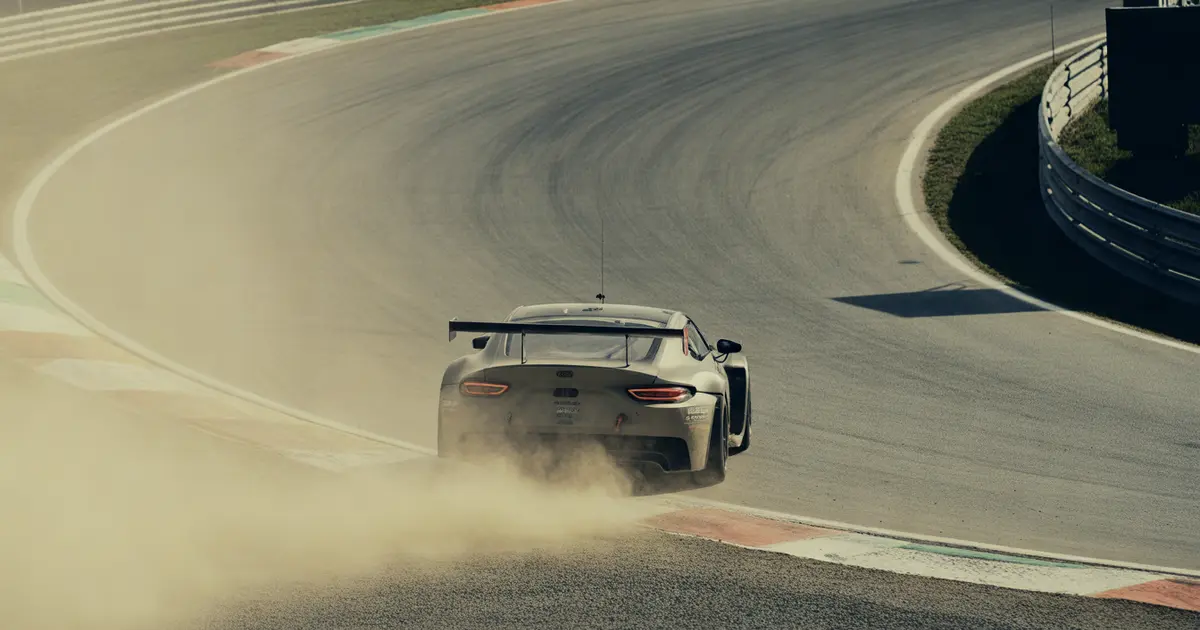
The banking on Cascavel's final corner supports part of the lateral load and frees up grip the driver isn't using. See where this shows up in the lap and how to confirm it in the data.
Cascavel's banking tilts the asphalt on the final corner, and that tilt supports part of the lateral force that, on a flat corner, would fall entirely on the tire. The result is a higher cornering speed without the felt lateral g rising in the same proportion — which is why the gain doesn't show up as a sense of risk, only on the stopwatch.
This confuses drivers who drive by feel. The brain calibrates the limit by the force it senses in the neck and the seat, and the banking reduces that perceived force even when the tire still has grip to spare. Anyone who brakes or lifts using the same reference as a flat corner is giving away free time.
What the banking physically changes
On a flat corner, all the centripetal force comes from the friction between tire and asphalt. On the banking, part of that force is supplied by the track's own tilt, which pushes the car toward the inside of the corner. That leaves more friction available for something else: handling a faster entry speed or tolerating extra lateral acceleration already on exit.
In practice, the car accepts entering faster than the corner “looks” like it allows visually. The geometric line changes little, but the speed window the tire can handle there is larger than on any flat corner of similar radius.
Why you don't feel the gain
The lateral g the driver perceives — through the seat, motion rig, or visual reading of the car — is the sum of the corner's force and the banking's effect acting against part of that force. Since the banking cancels out a fraction of it before it reaches your body, the corner feels easier than it physically is.
It's this mismatch between perception and the real limit that leaves time on the table: the driver slows down based on an artificially low sense of risk, while the tire still has margin.
Where Cascavel's banking fools the driver
- Early braking: the driver lifts based on the visual curvature, not the real grip available on the incline, losing entry speed the car could have carried.
- Conservative apex point: without the strong sense of lateral load, the driver hesitates to take a later, tighter apex, and the corner ends up longer than it needs to be.
- Late re-acceleration: the throttle comes back at the same pace as on a flat corner, when the banking is already supporting part of the traction needed to open the throttle earlier.
- Misreading the transition: the stretch where the banking starts and ends changes the car's behavior abruptly, and anyone who hasn't trained that transition adjusts the wheel too late.
Common mistake: treating the banking like a flat corner
The most common mistake at Cascavel isn't a lack of courage — it's applying the same mental model from any other corner on the calendar to a stretch that behaves differently.
| Symptom in the data | Likely cause |
|---|---|
| Brake released early, before the apex of the banking | Visual reference from a flat corner, not real grip |
| Low minimum speed compared to reference laps | Apex taken too early from lack of load sensation |
| Throttle reaches 100% late on exit | Re-acceleration calibrated by the body, not the tire's limit |
How to validate the gain in the data
Feel proves nothing here — it's exactly the channel that fails on this corner. The way to confirm it is to compare minimum speed, brake point, and throttle pickup between your lap and a faster reference on the same stretch.
- Mark the start and end of the banking as a fixed distance reference, not a feel-based one, so you always compare the same point.
- Compare your lap's minimum speed with that of a reference lap on the same corner.
- Look at the point where throttle returns to 100% and check how many meters of delay exist compared to the reference.
- Test releasing the brake later in small increments and check whether minimum speed rises without the car running off line.
- Repeat over three or four laps before concluding anything — an isolated gain on one lap can be track noise, not consolidated technique.
For this to work you need to know exactly which stretch is costing time before touching anything, and that's where identifying which corner is costing the most time in the lap comes in as a starting point.
The case changes by car
A light car with downforce uses the banking to carry more entry speed, because the aero already helps support the corner even on the flat part of the track. A heavier, more powerful car, like most of the GT3 grid, feels the banking more on exit: the extra traction the incline offers is what allows the throttle to open earlier without spinning.
This is similar to what happens in high-power cars with little electronic help, where the traction limit on exit is already the deciding factor — as discussed in how the Última GTR handles high power and the traction limit. The banking doesn't solve that limit, it just pushes it a little further.
Reiza's tire model also matters here: the load the banking transfers to the tire is read differently depending on temperature and working pressure, something that becomes clearer when you understand how Reiza's tire model reveals errors other sims hide.
The banking doesn't forgive a misread — it just hides the mistake until the tire warns you, and by then it's already cost you the whole lap.
How to confirm this in your telemetry
Before testing the banking in practice, it's worth knowing which channels to look at first so you don't get lost in a graph. The first three to check on this stretch are speed, steering angle, and throttle position, as detailed in which three channels to look at first in telemetry.
Laptics' app records telemetry automatically while you drive in Automobilista 2 and compares your laps phase by phase, showing in seconds and meters where the brake was released early or the throttle came back late on the banking. The Driver DNA also helps you see whether this pattern of conservative braking repeats on other high-speed corners, not just at Cascavel.
Practical summary
Cascavel's banking gives time to whoever drives by the data, not by feel. Mark the stretch, compare minimum speed and throttle pickup point against a reference, and adjust in small increments until the tire, not the body, tells you where the limit is.
Frequently asked questions
Why does the banked corner feel easier than it actually is?
Because the track's tilt supports part of the lateral force before it reaches your body, reducing the sense of risk even when the tire still has grip to spare.
Is the time gain on the banking the same for every car?
No. Cars with more downforce feel the effect more on entry, while heavier, more powerful cars feel it more on exit, thanks to the extra traction the incline provides.
How do I know if I'm braking too early on the banking?
Compare your brake point and minimum speed with a reference lap on the same corner; a consistent delay in throttle pickup is also a sign of it.
Can I feel this gain without looking at telemetry?
Rarely. The sense of lateral load is exactly the channel the banking distorts, so the adjustment is more reliable when validated with data.
Does the risk of spinning increase when pushing the banking harder?
It does if the adjustment is made by trial without a reference; that's why it's best to test in small increments and compare minimum speed each lap.
Does Laptics point out the exact ideal brake point on the banking?
Laptics shows where your lap loses time compared to other laps by corner phase; deciding how much to adjust the brake is still up to you.
Does the banking's effect change with tire wear?
Yes, the grip margin the banking frees up decreases as the tire degrades, so the brake point needs to be reviewed throughout a long stint.
Want to see this in your own telemetry?
Test Laptics on your next lap