%20--%3e%3cdefs%3e%3cstyle%3e%20.st0%20{%20fill:%20%23ff1230;%20}%20.st1%20{%20fill:%20%23fff;%20}%20%3c/style%3e%3c/defs%3e%3cpath%20class='st0'%20d='M49.77,34.93l3.47-5.3,23.2-5.86,4.03-6.07-23.14,5.83,3.55-5.33,23.17-5.84,3.96-6.05-23.07,5.8,3.59-5.52-23.16,5.83,3.68-5.68-19.8,4.98c-2.49.63-4.65,2.16-6.07,4.3l-1.81,2.75,20-5.03c.7-.18,1.49-.1,1.75.21.21.25.09,1.12-.24,1.61l-1.85,2.7-19.34,4.87c-2.48.62-4.64,2.15-6.06,4.29l-1.82,2.75,20.12-5.04c.7-.18,1.53.11,1.64.48.09.31-.06,1.12-.4,1.6l-1.79,2.51-19.21,4.82c-2.51.63-4.69,2.19-6.11,4.36l-1.75,2.69,20.19-5.08c1.67-.25,1.96.77,1.1,2.08l-1.9,2.89,19.51-4.94c1.49-.38,2.88,0,1.87,1.62l-1.88,3.01,24.65-6.19,3.01-5.82-23.07,5.79ZM60.94,13.54c.53-.13,1.35.11,1.52.37.19.28-.02,1.14-.37,1.66l-1.73,2.56-22.57,5.67,3.51-5.31,19.64-4.95ZM30.19,35.24l3.49-5.33,19.75-4.95c1.34-.34,1.92.7,1.23,1.76l-1.83,2.83-22.65,5.7Z'/%3e%3cpath%20class='st1'%20d='M236.44,40.24l22.56-33.95h10.5l-22.56,33.95h-10.5Z'/%3e%3cpath%20class='st1'%20d='M368.54,15.18l5.9-8.88h-52.48l-5.64,8.49-3.45,5.19-5.01,7.54h0s40.4,0,40.4,0l-2.82,4.24h-72.13c-2.23,0-3.07-1.46-1.87-3.27l9.11-13.71h29.5l5.95-8.49h-40.31l-5.64,8.49-9.61,14.46c-.36.55-.67,1.08-.92,1.61-.15.31-.28.61-.39.9-1.52,4.06.3,7.25,4.69,8.2.48.1.99.18,1.54.23.44.04.9.06,1.38.06h85.14l8.46-12.73,5.24-7.89h-40.45l2.95-4.44h40.45Z'/%3e%3cpath%20class='st1'%20d='M198.16,6.32c-.19,0-.37-.03-.56-.03h-60.45l-37.03,26.63h-19.71l18.01-26.63h-10.5l-17.48,26.31c-2.17,3.27.17,7.64,4.09,7.64h28.01l37.22-25.46h6.27l-16.92,25.46h10.51l16.92-25.46h27.83l-.02.04h7.11c1.89.18,2.56,1.55,1.44,3.23l-1.3,1.96c-1.2,1.8-3.98,3.27-6.21,3.27h-25.26l-11.28,16.98h10.5l5.64-8.49h15.69c.48,0,.96-.02,1.45-.06.61-.05,1.22-.12,1.84-.23,5.65-.95,11.72-4.14,15.59-8.2.02-.02.04-.04.06-.06.74-.78,5.18-7.47,5.57-8.39h17.48l-16.94,25.49h10.51l16.94-25.49h14.98l5.65-8.5h-55.64Z'/%3e%3c/svg%3e)
Ultima GTR in Automobilista 2: High Power and the Traction Limit
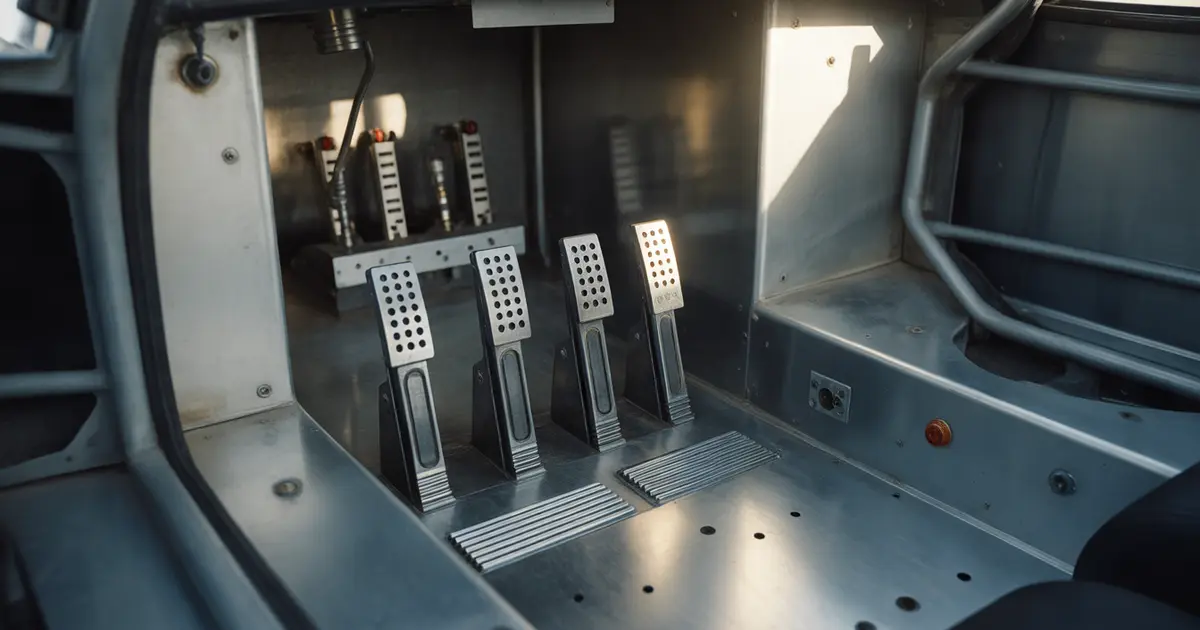
The Ultima GTR doesn’t lose time braking — it loses it on exit. See where traction breaks, what to adjust in the setup, and how to train the right throttle input.
The Ultima GTR delivers more power than most cars you have driven in Automobilista 2, and that changes where time gets lost: it is no longer about braking, it is about corner exit. The limit is now the rear, not the front tire.
That means the diagnosis changes. If you are treating the Ultima GTR like a regular GT3, you are optimizing the wrong phase of the corner.
Why traction becomes the limiting factor
With moderate downforce and high torque in low and mid gears, the Ultima GTR saturates the rear tire before you finish unwinding the wheel. The car does not warn you with a big scare: it slides progressively, and that progressive slide is easy to normalize without noticing.
The common mistake is compensating for that instability by holding the throttle back longer than necessary across the whole track, even in corners where traction is not an issue. That costs time where you did not even need to be afraid.
Where exactly the time is lost
Split the corner into three moments and you find the exact spot: mid-corner, the start of rotation, and the point of full throttle application. In the Ultima GTR, the problem almost always lives between the second and third.
| Symptom in the car | Corner phase | Likely cause |
|---|---|---|
| Rear lets go when turning the wheel | Rotation | Throttle applied too early relative to steering angle |
| Oversteer only in slow corners | Slow corner exit | Lack of patience to align the car before full throttle |
| Car stable but slow | Fast corner exit | Throttle released below what the tire can handle |
Notice that the third symptom is also lost time, just a silent one. You do not lock anything, you do not slide anything, but you are leaving traction on the table.
Setup: what to adjust before changing your style
- Power lock differential: reducing it slightly delivers more traction on exit, but increases understeer on entry if you overdo it.
- Brake bias: a less loaded rear under braking arrives more stable at the apex, which makes it easier to open the throttle earlier.
- Rear camber: less negative delivers more contact patch on the straight-line exit, at the cost of support in fast corners under lateral load.
- Rear ride height: lowering it too much removes mechanical traction on bumpy tracks; it is worth testing a few clicks higher on rougher circuits.
- Coast differential map: a tighter coast setting stabilizes the rear during trail braking and prevents the car from already arriving “nervous” at the exit.
Setup solves part of the problem. The other part is the movement of your right foot, and no car adjustment replaces that.
How to train the right throttle input
- Isolate one slow corner: pick the smallest-radius corner on the track and repeat only that one, without worrying about the rest of the lap.
- Mark the alignment point: identify where the wheel is already nearly straight before applying full throttle.
- Apply as a ramp, not a step: roll the throttle on continuously, not like a switch flipped all at once.
- Compare two laps side by side: one where you held the throttle back out of fear, and another where you applied it too early and lost the rear.
- Repeat on a track with a different corner exit: what works in a 90-degree corner does not always work in a wide, high-speed corner.
- 1Mid-corner
Car still laterally loaded, throttle neutral.
- 2Start of rotation
Steering wheel begins to unwind, throttle comes in progressively.
- 3Alignment
Wheel nearly straight, rear still sensitive to abrupt changes.
- 4Full application
Full throttle only after the car is aligned with the track.
When the problem is not the throttle
If the rear still breaks loose even with progressive throttle application, the problem might be how the tire is being warmed up over the stint. A rear tire that is too cold or degraded too early loses its traction margin before you even get near full throttle. It is worth reviewing how you are reading the Reiza tire model in Automobilista 2 for this specific car.
Another point that often goes unnoticed: drivers used to front-wheel-drive or lightweight cars tend to find the Ultima GTR as strange as they find a rear-wheel-drive car without electronic aids. It is worth comparing it with what changes in a car like the Beetle in Copa Fusca, which also demands rear traction with no safety net.
How to confirm it in the data, not the feeling
The feeling that “the rear got away” is real, but it does not tell you how much it cost. The throttle position channel against the car’s yaw rate channel shows exactly the point where the application was too early or too late.
If you already lose time in a similar way in slow corners with other cars, it is worth reviewing what usually happens on the MX-5’s slow corner exit: the patience principle is the same, except in the Ultima GTR the cost of the mistake is higher because the power amplifies any slide.
In the Ultima GTR, the front tire is almost never the limit. The clock is running against the rear.
Where Laptics comes in
Laptics’ corner-phase analysis separates exactly these three moments — mid-corner, rotation, and full application — and shows in which one you lose the most time on every lap of the session. That avoids guessing whether the problem is setup or technique: the data points to the phase, and the four-step base setup adjustment helps you decide what to change first before altering your driving style.
Practical summary
Treat the Ultima GTR as an exercise in patience on exit, not courage under braking. Split the corner into phases, confirm in the data where the throttle application is early or late, adjust the differential before blaming the tire, and repeat the drill on corners of different radius before considering the problem solved.
Frequently asked questions
Does the Ultima GTR lose more time under braking or on corner exit?
On most tracks, corner exit costs more time than braking, because the high power saturates the rear tire before the wheel is aligned.
Does lowering the differential’s power lock always help traction?
It helps up to a point; reducing it too much increases understeer on corner entry, so the adjustment depends on the track and needs to be tested in small increments.
Should you use the same rear setup on smooth and bumpy tracks?
No. Bumpy tracks usually need a slightly higher rear ride height to preserve mechanical traction, while smooth tracks allow a lower car without losing contact.
How do you know if the problem is driving style or setup?
Compare throttle position with steering angle on the telemetry graph; if the application is early relative to the car’s alignment, it is a technique issue, not a setup one.
Is high negative rear camber always bad for traction?
It is not bad in fast corners with high lateral load, but it reduces contact patch on the straight-line exit, which is exactly where the Ultima GTR needs maximum traction.
Does cold tire temperature affect rear behavior in this category?
Yes, a rear tire below its temperature window reduces the available traction margin, which makes the rear let go even with correct throttle application.
Want to see this in your own telemetry?
See Laptics’ corner-phase analysis