%20--%3e%3cdefs%3e%3cstyle%3e%20.st0%20{%20fill:%20%23ff1230;%20}%20.st1%20{%20fill:%20%23fff;%20}%20%3c/style%3e%3c/defs%3e%3cpath%20class='st0'%20d='M49.77,34.93l3.47-5.3,23.2-5.86,4.03-6.07-23.14,5.83,3.55-5.33,23.17-5.84,3.96-6.05-23.07,5.8,3.59-5.52-23.16,5.83,3.68-5.68-19.8,4.98c-2.49.63-4.65,2.16-6.07,4.3l-1.81,2.75,20-5.03c.7-.18,1.49-.1,1.75.21.21.25.09,1.12-.24,1.61l-1.85,2.7-19.34,4.87c-2.48.62-4.64,2.15-6.06,4.29l-1.82,2.75,20.12-5.04c.7-.18,1.53.11,1.64.48.09.31-.06,1.12-.4,1.6l-1.79,2.51-19.21,4.82c-2.51.63-4.69,2.19-6.11,4.36l-1.75,2.69,20.19-5.08c1.67-.25,1.96.77,1.1,2.08l-1.9,2.89,19.51-4.94c1.49-.38,2.88,0,1.87,1.62l-1.88,3.01,24.65-6.19,3.01-5.82-23.07,5.79ZM60.94,13.54c.53-.13,1.35.11,1.52.37.19.28-.02,1.14-.37,1.66l-1.73,2.56-22.57,5.67,3.51-5.31,19.64-4.95ZM30.19,35.24l3.49-5.33,19.75-4.95c1.34-.34,1.92.7,1.23,1.76l-1.83,2.83-22.65,5.7Z'/%3e%3cpath%20class='st1'%20d='M236.44,40.24l22.56-33.95h10.5l-22.56,33.95h-10.5Z'/%3e%3cpath%20class='st1'%20d='M368.54,15.18l5.9-8.88h-52.48l-5.64,8.49-3.45,5.19-5.01,7.54h0s40.4,0,40.4,0l-2.82,4.24h-72.13c-2.23,0-3.07-1.46-1.87-3.27l9.11-13.71h29.5l5.95-8.49h-40.31l-5.64,8.49-9.61,14.46c-.36.55-.67,1.08-.92,1.61-.15.31-.28.61-.39.9-1.52,4.06.3,7.25,4.69,8.2.48.1.99.18,1.54.23.44.04.9.06,1.38.06h85.14l8.46-12.73,5.24-7.89h-40.45l2.95-4.44h40.45Z'/%3e%3cpath%20class='st1'%20d='M198.16,6.32c-.19,0-.37-.03-.56-.03h-60.45l-37.03,26.63h-19.71l18.01-26.63h-10.5l-17.48,26.31c-2.17,3.27.17,7.64,4.09,7.64h28.01l37.22-25.46h6.27l-16.92,25.46h10.51l16.92-25.46h27.83l-.02.04h7.11c1.89.18,2.56,1.55,1.44,3.23l-1.3,1.96c-1.2,1.8-3.98,3.27-6.21,3.27h-25.26l-11.28,16.98h10.5l5.64-8.49h15.69c.48,0,.96-.02,1.45-.06.61-.05,1.22-.12,1.84-.23,5.65-.95,11.72-4.14,15.59-8.2.02-.02.04-.04.06-.06.74-.78,5.18-7.47,5.57-8.39h17.48l-16.94,25.49h10.51l16.94-25.49h14.98l5.65-8.5h-55.64Z'/%3e%3c/svg%3e)
How to Build a Two-Week Training Plan for a Track
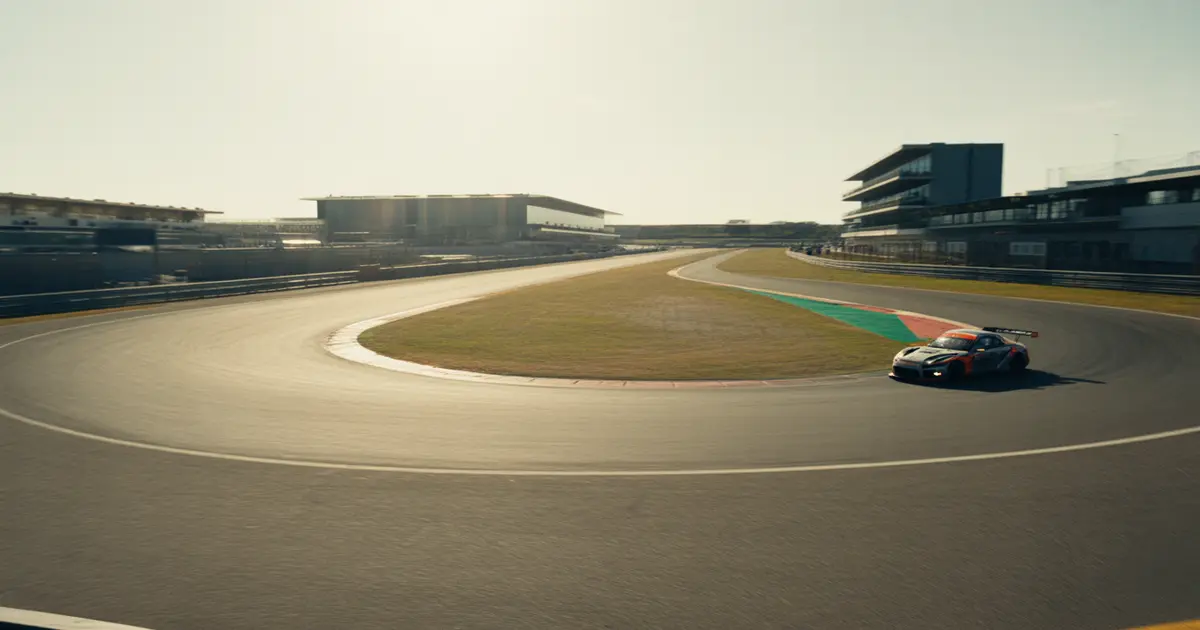
A two-week roadmap to master a specific track: what to train in week one, what to consolidate in week two, and how to check if it worked in the data.
A two-week plan for a track splits into two phases: the first week isolates where you lose time corner by corner, the second consolidates that fix into race pace. Without this split, the driver runs the whole track every day, feels like they are training, and never leaves the plateau.
The most common mistake is treating the two weeks as one long block: more laps, more hours, the same question repeated. The plan works when each week has a different goal and a clear criterion for moving to the next stage.
What the format of the plan depends on
There is no fixed plan that fits every track or car. Before building the schedule, define three things.
- How many corners actually cost time: tracks with one concentrated technical section (an S, a chicane) call for more isolated repetition; tracks with many similar medium-speed corners call for more full-lap running.
- How the car behaves at the end of a stint: a car that degrades tires quickly shifts the reference line between lap 3 and lap 15, so the plan needs to include practice on used tires, not only fresh ones.
- How much track time you have per day: a 40-minute daily plan is different from a two-hour one; volume decides how many corners you can isolate per session.
Week 1: mapping where the time is going
The first week is not about improving lap time. It is about finding, with data, which phase of which corner costs the most.
Days 1 to 3: baseline and comparison
Run a short reference session (10 to 15 clean laps, no traffic) and compare your lap to that of a faster driver on the same track and car. The goal here is to identify exactly which corner is costing the most time in the lap, not to fix anything yet.
If the gap shows up spread across several small corners, the problem is usually consistency, not one specific corner. This changes the training for week 2.
Days 4 to 7: isolating the costliest corner
With the corner identified, stop running full laps. Train only the entry, apex and exit sequence of that corner, repeating until the move becomes automatic. Often the lost time is not in braking but right after it — it is worth reviewing why the loss usually sits in the rotation phase rather than in braking.
- Record three laps in a row focusing only on the entry to the isolated corner, without worrying about the rest of the track.
- Compare the braking and rotation phases against the reference lap chosen on day 1.
- Adjust one point at a time: brake point, turn-in point or throttle-on point — never all three in the same session.
- Confirm the gain on half-worn tires, not only on the first laps of the stint.
- 1Baseline
Compares your lap to a reference and locates the corner that costs the most time.
- 2Isolation
Repeats only the target corner, adjusting one point at a time.
- 3Full stint
Tests the fix with degrading tires and falling fuel.
- 4Validation
Confirms whether the gap between best lap and average lap shrank.
Week 2: consolidating into race pace
In the second week the goal changes: it is no longer about isolating, it is about keeping the gain under pressure — traffic, degrading tires, falling fuel. This is where drivers usually lose what they gained in week 1, because they trained the isolated corner but never tested it inside a full stint.
| Aspect | Week 1 | Week 2 |
|---|---|---|
| Focus | Corner-by-corner diagnosis | Full race pace |
| Format | Repeated isolated laps | Stints of 10 to 20 laps |
| Criterion to advance | Corner fixed on fresh tires | Fix holds on used tires |
If the gain from week 1 disappears as soon as the tire degrades, the fix was not actually solved — it was masked by fresh-tire grip. This is common and does not mean the training failed; it means the consolidation step was missing.
How much track time per session
Very long sessions cause fatigue, and the last hour of practice usually reinforces error rather than correcting it. Prefer short sessions with a single goal: one session for braking, another for corner exit, another for a full stint. This also makes it easier to compare data against data, because each session tests only one variable.
Common mistakes that stall the plan
- Switching the target corner every day: without enough repetition, no adjustment turns into habit and the driver gets lost partway through week 1.
- Jumping straight to week 2: training race pace without having isolated the problem corner only reinforces the mistake at higher speed.
- Measuring only lap time: lap time hides where the gain or loss happened; without looking phase by phase, the driver does not know whether they fixed the cause or just compensated somewhere else.
- Ignoring brake release: on decreasing-radius corners, much of the lost time sits in the transition between braking and turning — it is worth reviewing how to release the brake in proportion to steering input before assuming the problem is the brake point.
How to validate whether the plan worked
The criterion is not “the lap got faster.” It is whether the gap between your best lap and your average lap shrank — a sign that the fix became repetition, not the luck of one isolated lap. This is the same reasoning behind reducing the gap between the best lap and the average lap.
A two-week plan does not exist to lower lap time once. It exists to make the fast lap repeatable.
If after the two weeks the target corner improved but another one got worse, that is not failure: it is a sign the car was compensating somewhere else. Go back to the week 1 diagnosis on that new corner before extending the plan.
Example application by track
On tracks with one concentrated technical section, like the Senna S at Interlagos, week 1 usually pays off faster because the problem is confined to two or three meters of track. On tracks with many similar medium-speed corners, week 1 takes longer because you need to rule out candidates before finding the right corner.
Where data analysis fits into this process
The plan described here depends on comparing lap against lap and phase against phase every day — that is manual work if done by eye. Laptics records telemetry automatically while you drive, in iRacing, Assetto Corsa, ACC, GT7 and F1 25, and the AI analysis already breaks down lost time by corner phase, which cuts the work of digging through graphs between one session of the plan and the next.
Practical summary
Week 1: baseline, comparison, isolate the costliest corner. Week 2: full stint, tire degrading, confirm the fix survives race pressure. Measure by the gap between best lap and average lap, not by the time of one isolated lap.
Frequently asked questions
Is two weeks enough to master a track?
It depends on the car and how many corners actually cost real time. For tracks with one concentrated technical section it is usually enough; for tracks with many similar medium-speed corners, you may need to extend week 1.
Should I train every day on fresh tires?
No. Fresh tires are useful for isolating the move in week 1, but the fix is only ready once it survives on half-worn tires, which is the real race scenario.
How do I know which corner to prioritize in week 1?
Compare your lap to a faster driver’s, phase by phase, and see where the time gap concentrates. A corner with loss spread across several small phases is different from a corner with one clearly worse phase.
Does the plan change if I switch cars on the same track?
Yes. Cars with different braking or traction behavior require a new baseline, because the reference point of the target corner shifts with the car.
What if the time did not improve after the two weeks?
Check whether the gain on the isolated corner disappeared during the full stint — a sign the fix was only cosmetic on fresh tires. Go back to the isolation step before assuming the plan failed.
Do I need to repeat this plan for every track on the calendar?
Yes, the diagnosis is specific to the car-and-track combination. The method repeats, but the target corner and the fix change with every track.
Want to see this in your own telemetry?
See how Laptics analyzes your sessions