%20--%3e%3cdefs%3e%3cstyle%3e%20.st0%20{%20fill:%20%23ff1230;%20}%20.st1%20{%20fill:%20%23fff;%20}%20%3c/style%3e%3c/defs%3e%3cpath%20class='st0'%20d='M49.77,34.93l3.47-5.3,23.2-5.86,4.03-6.07-23.14,5.83,3.55-5.33,23.17-5.84,3.96-6.05-23.07,5.8,3.59-5.52-23.16,5.83,3.68-5.68-19.8,4.98c-2.49.63-4.65,2.16-6.07,4.3l-1.81,2.75,20-5.03c.7-.18,1.49-.1,1.75.21.21.25.09,1.12-.24,1.61l-1.85,2.7-19.34,4.87c-2.48.62-4.64,2.15-6.06,4.29l-1.82,2.75,20.12-5.04c.7-.18,1.53.11,1.64.48.09.31-.06,1.12-.4,1.6l-1.79,2.51-19.21,4.82c-2.51.63-4.69,2.19-6.11,4.36l-1.75,2.69,20.19-5.08c1.67-.25,1.96.77,1.1,2.08l-1.9,2.89,19.51-4.94c1.49-.38,2.88,0,1.87,1.62l-1.88,3.01,24.65-6.19,3.01-5.82-23.07,5.79ZM60.94,13.54c.53-.13,1.35.11,1.52.37.19.28-.02,1.14-.37,1.66l-1.73,2.56-22.57,5.67,3.51-5.31,19.64-4.95ZM30.19,35.24l3.49-5.33,19.75-4.95c1.34-.34,1.92.7,1.23,1.76l-1.83,2.83-22.65,5.7Z'/%3e%3cpath%20class='st1'%20d='M236.44,40.24l22.56-33.95h10.5l-22.56,33.95h-10.5Z'/%3e%3cpath%20class='st1'%20d='M368.54,15.18l5.9-8.88h-52.48l-5.64,8.49-3.45,5.19-5.01,7.54h0s40.4,0,40.4,0l-2.82,4.24h-72.13c-2.23,0-3.07-1.46-1.87-3.27l9.11-13.71h29.5l5.95-8.49h-40.31l-5.64,8.49-9.61,14.46c-.36.55-.67,1.08-.92,1.61-.15.31-.28.61-.39.9-1.52,4.06.3,7.25,4.69,8.2.48.1.99.18,1.54.23.44.04.9.06,1.38.06h85.14l8.46-12.73,5.24-7.89h-40.45l2.95-4.44h40.45Z'/%3e%3cpath%20class='st1'%20d='M198.16,6.32c-.19,0-.37-.03-.56-.03h-60.45l-37.03,26.63h-19.71l18.01-26.63h-10.5l-17.48,26.31c-2.17,3.27.17,7.64,4.09,7.64h28.01l37.22-25.46h6.27l-16.92,25.46h10.51l16.92-25.46h27.83l-.02.04h7.11c1.89.18,2.56,1.55,1.44,3.23l-1.3,1.96c-1.2,1.8-3.98,3.27-6.21,3.27h-25.26l-11.28,16.98h10.5l5.64-8.49h15.69c.48,0,.96-.02,1.45-.06.61-.05,1.22-.12,1.84-.23,5.65-.95,11.72-4.14,15.59-8.2.02-.02.04-.04.06-.06.74-.78,5.18-7.47,5.57-8.39h17.48l-16.94,25.49h10.51l16.94-25.49h14.98l5.65-8.5h-55.64Z'/%3e%3c/svg%3e)
Mazda MX-5 on iRacing: How to Gain Time Without Power
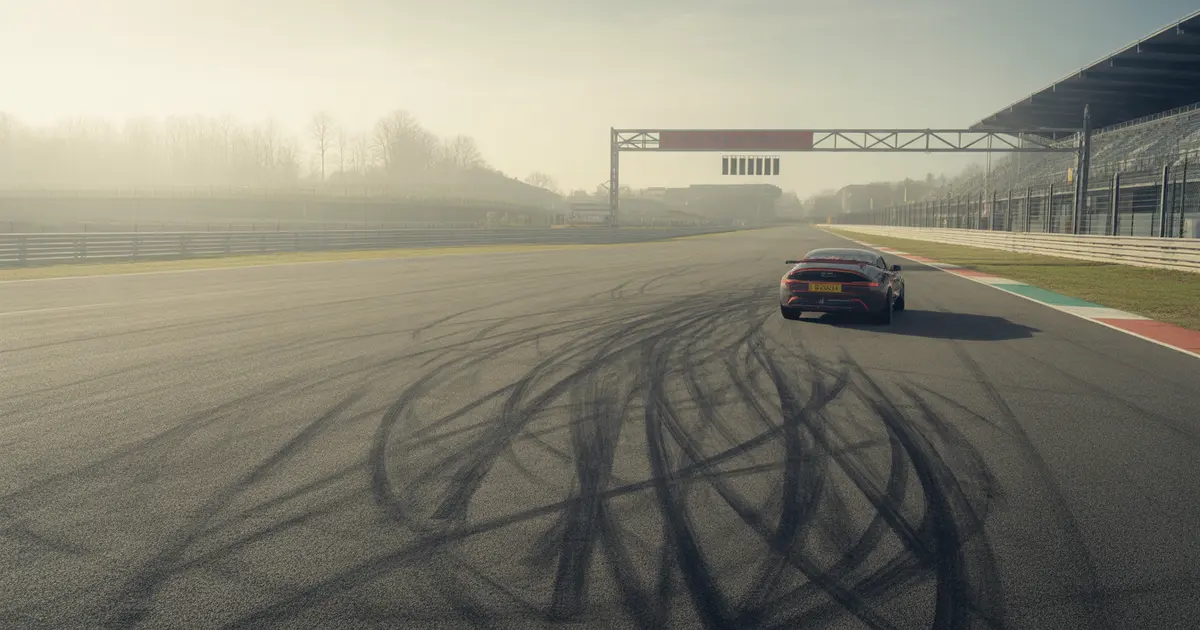
In the MX-5 time doesn’t come from the engine: it comes from holding speed through the corner. See where to spot the real gain and what to train tomorrow.
In the Mazda MX-5 on iRacing, lap time doesn’t come from hitting the throttle harder: it comes from losing less speed inside the corner. Because the car has so little power, a mistake in rotation or line doesn’t get fixed on exit, since there’s no engine left to make up for it.
That changes what’s worth training. In a high-power car, the driver can partly compensate for a bad entry with an aggressive exit. In the MX-5 that exit doesn’t exist: the corner’s minimum speed pretty much defines the entire lap time.
Where the time actually lives
In the MX-5, the phase that most separates drivers of similar level isn’t braking or the straight. It’s the passage through the middle of the corner, the stretch between peak braking and the start of full throttle.
That happens because the car has tyres and a chassis capable of sustaining high lateral speed, but low power to recover whatever gets lost there. Every km/h lost mid-corner turns into time the following straight never gives back.
Rotation before traction
Since there isn’t enough torque to “pull” the car out of the corner, priorities shift: rotating the car early, still under residual brake, matters more than risking early traction on exit.
- Longer trail braking: releasing the brake gradually up to the apex helps rotate the car without relying on a sharp steering input, which in the MX-5 creates under- or oversteer too fast to correct with the throttle.
- Geometric apex, not late: an earlier apex keeps the car pointed at the straight without losing rotation mid-corner, which is exactly where the MX-5 holds speed better than more powerful cars.
- Progressive throttle, not on-off: applying throttle gradually from mid-corner keeps traction without cutting the rotation you already built.
This logic is the same one discussed in how to release the brake in proportion to the steering: in the MX-5 a proportion mistake costs more because there’s no power to hide it.
Common mistake: driving as if you had power
The most common mistake for drivers coming from a more powerful car is braking too late, hoping to make it up on exit. In the MX-5 that produces exactly the opposite of what you want: less speed mid-corner and no exit left to recover it.
How to spot it in the data
The symptom shows up on the speed trace as a deeper and wider dip mid-corner, compared to the reference lap. If the dip is similar in depth but wider, the problem is rotation, not braking.
Consistency matters more than peak performance
Because the MX-5 doesn’t forgive execution mistakes, the gap between a good lap and a bad one tends to be bigger than in a more powerful car. That makes lap-to-lap consistency a training target just as important as your fastest lap.
In the MX-5, the fastest corner isn’t the one you exit with the most force: it’s the one you carry through without losing rotation.
It’s worth tracking this across a full stint, not just an isolated lap. The topic is covered in more depth in how to shrink the gap between your best lap and your average lap.
How this changes by track
How much rotation outweighs power varies with the layout. A technical track amplifies the advantage of drivers who rotate well; a track with a long straight demands less of that and more of a clean exit from the last corner before the DRS zone (when there is one).
| Track type | What matters most | What to train |
|---|---|---|
| Technical, linked corners | Keeping rotation between corners | Rotation and trail braking |
| Long straight after final corner | Exit angle | Apex point and throttle |
| Constant-radius corners | Sustained minimum speed | Line and tyre |
How to validate it in the data, step by step
- Compare the minimum speed of the same corner between your lap and the reference lap, corner by corner, not just the total lap time.
- Look at the width of the dip in speed: a wide dip points to slow rotation, a narrow and shallow dip points to execution close to ideal.
- Mark where throttle returns to 100% and compare the track position between the two laps, not just the timestamp.
- Repeat over three to five consecutive laps before changing anything in the setup, because one isolated mistake isn’t a pattern.
This kind of corner-by-corner comparison is the same process described in how to know exactly which corner is costing you the most time, just applied to a car where the cost of a mistake is more visible.
Where Laptics comes in
Laptics records telemetry on its own while you drive the MX-5 on iRacing and compares your laps by corner phase, showing how much time each move costs. The Driver DNA helps you see whether the pattern is slow rotation or late braking repeating across several corners, not just one.
Practical summary
In the MX-5, gaining time without power means protecting mid-corner speed before thinking about the exit. Good rotation and lap-to-lap consistency are worth more than risking one extra km/h under braking.
- Tomorrow: pick two technical corners on your current track and compare the width of the speed dip against your best lap.
- Then: repeat the same stint a few times and see if the dip’s width changes between laps, that tells you whether the issue is technique or attention fatigue.
Frequently asked questions
Is the MX-5 a good car for training telemetry reading?
Yes, because mistakes show up more clearly on the speed trace, since there’s no power to hide a bad entry or poor rotation.
Is it worth using more engine braking on the MX-5 to help rotation?
It helps in slow corners, but the gain depends on setup and track; the main effect still comes from releasing the brake progressively.
How do I know if I’m losing time on entry or exit of the corner?
Compare the minimum speed and the width of the mid-corner dip against a reference lap; a wide dip points to a rotation issue, not an exit issue.
Does setup matter more than driving in the MX-5?
Setup has less room for gain in the MX-5 than in cars with more downforce or power; execution usually weighs more on lap time.
Does the front or rear tyre degrade more in the MX-5?
It depends on setup and driving style; lightweight cars like the MX-5 tend to show more visible degradation when there’s excess steering mid-corner.
What’s the most common mistake for drivers coming from a more powerful car?
Braking late expecting to make it up on exit, which in the MX-5 causes a loss of mid-corner speed with no gain afterward.
Is it worth changing the line on a track with a long straight?
It’s worth prioritizing the exit angle of the corner before the straight, even if it costs a bit of minimum speed in that specific corner.
Want to see this in your own telemetry?
See how Laptics analyzes your laps