%20--%3e%3cdefs%3e%3cstyle%3e%20.st0%20{%20fill:%20%23ff1230;%20}%20.st1%20{%20fill:%20%23fff;%20}%20%3c/style%3e%3c/defs%3e%3cpath%20class='st0'%20d='M49.77,34.93l3.47-5.3,23.2-5.86,4.03-6.07-23.14,5.83,3.55-5.33,23.17-5.84,3.96-6.05-23.07,5.8,3.59-5.52-23.16,5.83,3.68-5.68-19.8,4.98c-2.49.63-4.65,2.16-6.07,4.3l-1.81,2.75,20-5.03c.7-.18,1.49-.1,1.75.21.21.25.09,1.12-.24,1.61l-1.85,2.7-19.34,4.87c-2.48.62-4.64,2.15-6.06,4.29l-1.82,2.75,20.12-5.04c.7-.18,1.53.11,1.64.48.09.31-.06,1.12-.4,1.6l-1.79,2.51-19.21,4.82c-2.51.63-4.69,2.19-6.11,4.36l-1.75,2.69,20.19-5.08c1.67-.25,1.96.77,1.1,2.08l-1.9,2.89,19.51-4.94c1.49-.38,2.88,0,1.87,1.62l-1.88,3.01,24.65-6.19,3.01-5.82-23.07,5.79ZM60.94,13.54c.53-.13,1.35.11,1.52.37.19.28-.02,1.14-.37,1.66l-1.73,2.56-22.57,5.67,3.51-5.31,19.64-4.95ZM30.19,35.24l3.49-5.33,19.75-4.95c1.34-.34,1.92.7,1.23,1.76l-1.83,2.83-22.65,5.7Z'/%3e%3cpath%20class='st1'%20d='M236.44,40.24l22.56-33.95h10.5l-22.56,33.95h-10.5Z'/%3e%3cpath%20class='st1'%20d='M368.54,15.18l5.9-8.88h-52.48l-5.64,8.49-3.45,5.19-5.01,7.54h0s40.4,0,40.4,0l-2.82,4.24h-72.13c-2.23,0-3.07-1.46-1.87-3.27l9.11-13.71h29.5l5.95-8.49h-40.31l-5.64,8.49-9.61,14.46c-.36.55-.67,1.08-.92,1.61-.15.31-.28.61-.39.9-1.52,4.06.3,7.25,4.69,8.2.48.1.99.18,1.54.23.44.04.9.06,1.38.06h85.14l8.46-12.73,5.24-7.89h-40.45l2.95-4.44h40.45Z'/%3e%3cpath%20class='st1'%20d='M198.16,6.32c-.19,0-.37-.03-.56-.03h-60.45l-37.03,26.63h-19.71l18.01-26.63h-10.5l-17.48,26.31c-2.17,3.27.17,7.64,4.09,7.64h28.01l37.22-25.46h6.27l-16.92,25.46h10.51l16.92-25.46h27.83l-.02.04h7.11c1.89.18,2.56,1.55,1.44,3.23l-1.3,1.96c-1.2,1.8-3.98,3.27-6.21,3.27h-25.26l-11.28,16.98h10.5l5.64-8.49h15.69c.48,0,.96-.02,1.45-.06.61-.05,1.22-.12,1.84-.23,5.65-.95,11.72-4.14,15.59-8.2.02-.02.04-.04.06-.06.74-.78,5.18-7.47,5.57-8.39h17.48l-16.94,25.49h10.51l16.94-25.49h14.98l5.65-8.5h-55.64Z'/%3e%3c/svg%3e)
GT1 McLaren F1 GTR: How to Control a Car Without Modern Downforce
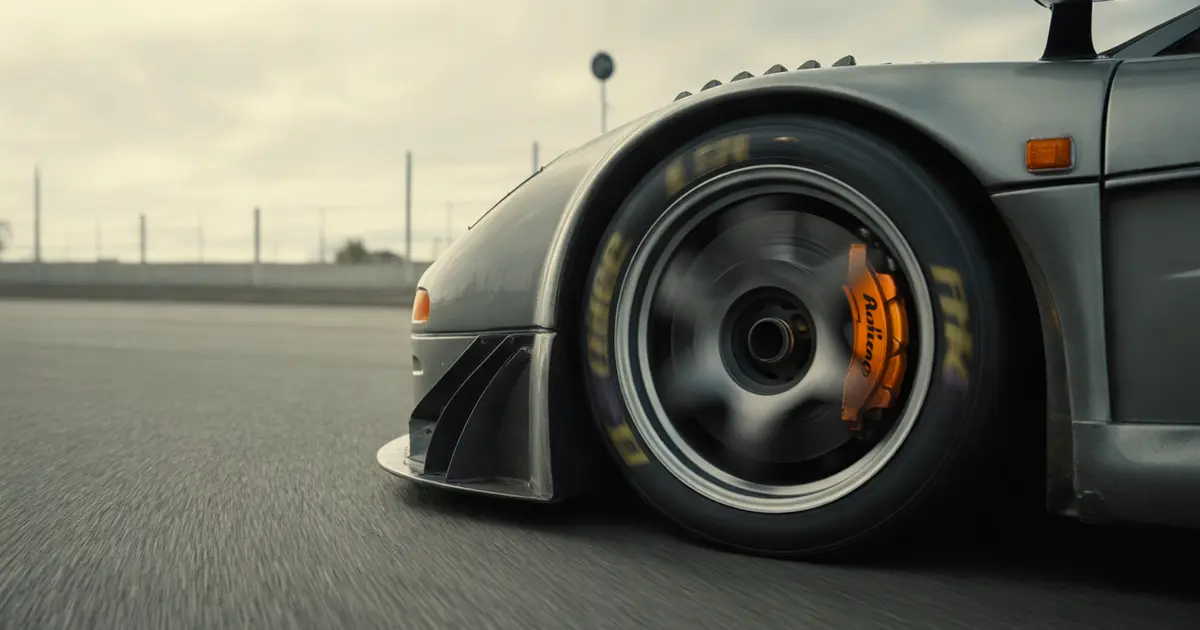
The McLaren F1 GTR in Automobilista 2 punishes anyone who drives it like a GT3. See what changes in braking, setup, and training when grip comes from the tires, not the air.
The McLaren F1 GTR carries only a fraction of the downforce a modern GT3 generates in a fast corner. Its grip comes mainly from springs, tires, and weight transfer, not from a wing or diffuser — so driving it well means entering high-speed corners slower, extending the trail braking, and letting the suspension settle before asking for steering input.
Why the Fast-Corner Logic Changes
In a GT3 or in a prototype with extreme aero, the corner actually gets safer the faster you enter, because the air presses the car into the ground. That is not how the F1 GTR behaves. Grip does not scale with speed the same way, so an overly fast entry is not forgiven by any invisible force.
This flips the habit of anyone used to GT3s or the Reiza Formula V12 with extreme downforce. There, entering too fast usually just costs lap time. Here, it usually costs the rear end.
Where the Mistake Shows Up in the Data
The most common symptom is the speed trace dropping too late on approach, followed by an abrupt throttle lift mid-corner. The driver feels the car slide and reacts by lifting off completely, which shifts weight forward and unloads the rear even more.
On the graph, this shows up as a step in the throttle channel instead of a smooth ramp. Comparing this pattern between fast and slow laps reveals whether the problem is the entry itself or the correction that follows it.
Braking: Weight Transfer Is Your Ally
Without downforce helping with deceleration, straight-line braking is actually relatively easier — the car does not have that heavy aerodynamic nose pulling it down at high speed. The critical point is the transition: releasing the brake while turning the wheel.
A Wider Window, a Smoother Motion
Trail braking in the F1 GTR needs to be longer and more progressive than in a GT3. The idea stays the same — releasing the brake in proportion to steering input, as described in how to release the brake in proportion to steering — but here releasing too fast costs more, because there is no aero load to rebuild front grip quickly.
Locking the front wheel is still the worst possible mistake, for the same reason explained in why locking the front wheel costs more time than braking early: with no steering response, any lost grip becomes even harder to recover.
Modern GT3 vs. GT1 Without Downforce
| Aspect | Modern GT3 | GT1 (F1 GTR) |
|---|---|---|
| Grip in a fast corner | Grows with speed | Depends on spring and tire |
| Entry margin | Forgives slight excess | Punishes excess immediately |
| Response to lifting off | Predictable | Can unsettle the rear |
Setup: Making Up for Missing Aero With Mechanics
Since grip comes from the chassis, setup matters more than it does in cars with an adjustable wing. A few points deserve a review before any fine tuning:
- Springs and anti-roll bar: control body roll without relying on downforce to keep the car flat; too stiff at the rear removes the last safety margin in a fast corner.
- Ride height: affects the small amount of aero that does exist, but has a bigger impact on suspension geometry and roll behavior.
- Differential: in a mid-rear-engined car with little grip, the differential decides whether corner exit is clean traction or wheelspin.
- Tire pressure: with less aero load pressing the tire into the asphalt, the ideal temperature window is narrower, and any pressure mistake shows up faster in wear.
If you do not have a reference baseline yet, review which four setup adjustments to try first before attempting anything specific to a car without downforce.
- 1Initial Braking
Straight-line deceleration, without significant aerodynamic help.
- 2Transition
Brake release proportional to steering input, extended over a longer window.
- 3Rotation
Grip depends on spring and tire; excess steering unsettles the rear.
- 4Throttle Reapplication
Partial, progressive throttle, without an abrupt step.
Training Routine to Validate in the Simulator
- Pick a familiar fast corner: choose a track where you already have a braking-point reference from another car.
- Record three clean laps: one with a conservative entry, one at the perceived limit, and one intentionally faster than comfortable.
- Compare the throttle channel after braking: look for abrupt steps instead of smooth ramps.
- Mark where the rear moves: relate that point to the entry speed of the fastest of the three laps.
- Reduce entry speed by 2 to 3 km/h on the next attempt: and check whether lap time improves or worsens — this test tells you if the limit was real or imagined.
Common Mistake When Moving From GT3 to GT1
The most frequent mistake is not entering too fast — it is correcting incorrectly after entering too fast. Lifting off the throttle completely, mid-corner, shifts weight onto the front axle and strips even more grip from a rear that already had little to spare.
The right correction is to keep partial throttle applied and let the car slow down more gradually, balancing it with the steering wheel instead of the pedal.
In a car without modern downforce, the right fast corner is the one where you enter slower and exit faster — not the other way around.
Where Laptics Fits Into This Training
Telemetry from the F1 GTR records itself while you drive in Automobilista 2, and the analysis compares the corner phase by phase between the conservative-entry lap and the limit-entry lap. That shows, in numbers, whether the gain on entry made up for the loss on exit — without relying on feel.
The Driver DNA also helps identify whether that abrupt throttle lift is a habit that repeats on other tracks and other cars, not just on this specific GT1.
Practical Summary
Enter fast corners slower, extend the trail braking, and correct with the steering wheel, not the pedal. Adjust springs, anti-roll bar, and differential before fine-tuning anything else, and validate every entry change by comparing the throttle trace between laps.
Frequently asked questions
Does the McLaren F1 GTR have zero downforce?
It is not zero, but it is far lower than a modern GT3 in a fast corner. Most of the grip comes from springs, tires, and weight transfer.
Why does the rear let go more easily in this car?
Because aero does not grow with speed, any excess steering or abrupt throttle lift removes grip the car cannot quickly replace.
Should I brake earlier than in a GT3?
Generally yes, with a more gradual braking phase and a longer trail braking window during the transition into the corner.
Does a stiff setup help compensate for missing downforce?
Too stiff at the rear can remove the last safety margin in a fast corner. Spring and anti-roll bar tuning should prioritize predictability, not maximum stiffness.
How do I know if I am entering the corner too fast?
Compare the throttle channel between laps: if you see an abrupt step instead of a smooth ramp, the entry probably went beyond what the car can handle without downforce.
Does Laptics tell me the right setup for this car?
Laptics does not deliver a ready-made setup. It shows where the lap loses time phase by phase through the corner, which helps you decide which adjustment to try first.
Does this behavior repeat in other older cars without aero?
Yes, any car with little aerodynamic dependence punishes excessive entry and abrupt corrections in a similar way, only the intensity changes.
Want to see this in your own telemetry?
Analyze My GT1 Laps