%20--%3e%3cdefs%3e%3cstyle%3e%20.st0%20{%20fill:%20%23ff1230;%20}%20.st1%20{%20fill:%20%23fff;%20}%20%3c/style%3e%3c/defs%3e%3cpath%20class='st0'%20d='M49.77,34.93l3.47-5.3,23.2-5.86,4.03-6.07-23.14,5.83,3.55-5.33,23.17-5.84,3.96-6.05-23.07,5.8,3.59-5.52-23.16,5.83,3.68-5.68-19.8,4.98c-2.49.63-4.65,2.16-6.07,4.3l-1.81,2.75,20-5.03c.7-.18,1.49-.1,1.75.21.21.25.09,1.12-.24,1.61l-1.85,2.7-19.34,4.87c-2.48.62-4.64,2.15-6.06,4.29l-1.82,2.75,20.12-5.04c.7-.18,1.53.11,1.64.48.09.31-.06,1.12-.4,1.6l-1.79,2.51-19.21,4.82c-2.51.63-4.69,2.19-6.11,4.36l-1.75,2.69,20.19-5.08c1.67-.25,1.96.77,1.1,2.08l-1.9,2.89,19.51-4.94c1.49-.38,2.88,0,1.87,1.62l-1.88,3.01,24.65-6.19,3.01-5.82-23.07,5.79ZM60.94,13.54c.53-.13,1.35.11,1.52.37.19.28-.02,1.14-.37,1.66l-1.73,2.56-22.57,5.67,3.51-5.31,19.64-4.95ZM30.19,35.24l3.49-5.33,19.75-4.95c1.34-.34,1.92.7,1.23,1.76l-1.83,2.83-22.65,5.7Z'/%3e%3cpath%20class='st1'%20d='M236.44,40.24l22.56-33.95h10.5l-22.56,33.95h-10.5Z'/%3e%3cpath%20class='st1'%20d='M368.54,15.18l5.9-8.88h-52.48l-5.64,8.49-3.45,5.19-5.01,7.54h0s40.4,0,40.4,0l-2.82,4.24h-72.13c-2.23,0-3.07-1.46-1.87-3.27l9.11-13.71h29.5l5.95-8.49h-40.31l-5.64,8.49-9.61,14.46c-.36.55-.67,1.08-.92,1.61-.15.31-.28.61-.39.9-1.52,4.06.3,7.25,4.69,8.2.48.1.99.18,1.54.23.44.04.9.06,1.38.06h85.14l8.46-12.73,5.24-7.89h-40.45l2.95-4.44h40.45Z'/%3e%3cpath%20class='st1'%20d='M198.16,6.32c-.19,0-.37-.03-.56-.03h-60.45l-37.03,26.63h-19.71l18.01-26.63h-10.5l-17.48,26.31c-2.17,3.27.17,7.64,4.09,7.64h28.01l37.22-25.46h6.27l-16.92,25.46h10.51l16.92-25.46h27.83l-.02.04h7.11c1.89.18,2.56,1.55,1.44,3.23l-1.3,1.96c-1.2,1.8-3.98,3.27-6.21,3.27h-25.26l-11.28,16.98h10.5l5.64-8.49h15.69c.48,0,.96-.02,1.45-.06.61-.05,1.22-.12,1.84-.23,5.65-.95,11.72-4.14,15.59-8.2.02-.02.04-.04.06-.06.74-.78,5.18-7.47,5.57-8.39h17.48l-16.94,25.49h10.51l16.94-25.49h14.98l5.65-8.5h-55.64Z'/%3e%3c/svg%3e)
Double File Standing Start: Which Side to Choose and Why
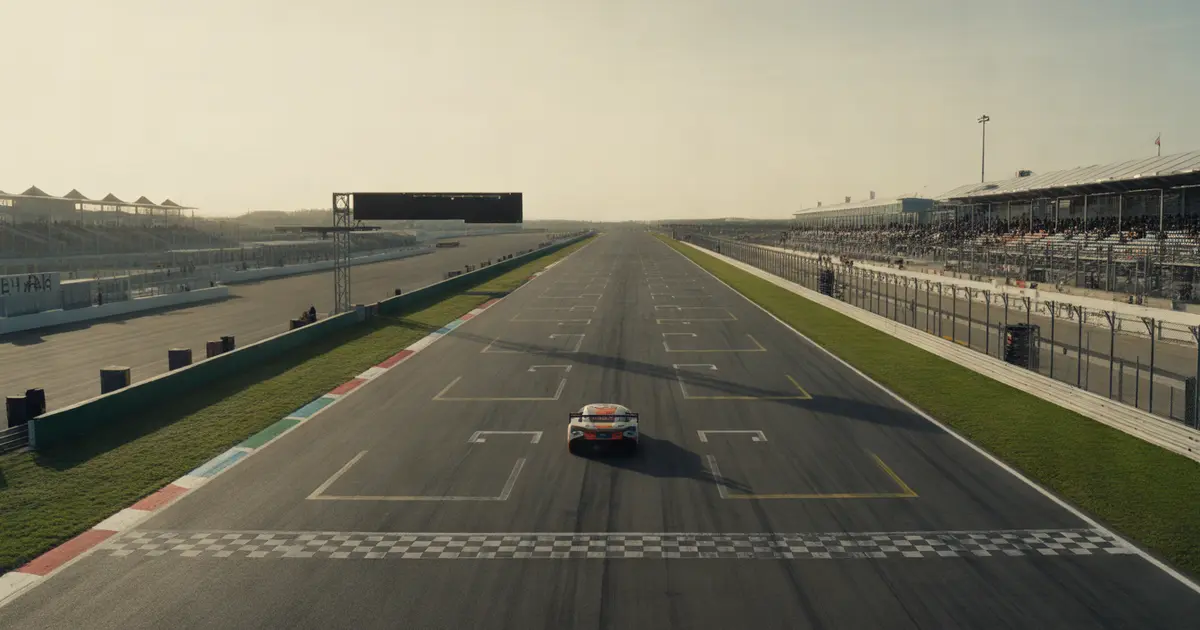
The right side on a double file standing start depends on turn 1's direction, not personal preference. See how to read the track and confirm the choice in the data.
The quick answer: it depends on turn 1
Choose the side that gives you the cleanest angle into the first corner after the start straight. If turn 1 turns right, the right side of the grid arrives with less steering input and less risk of getting squeezed from the outside. If it turns left, the opposite is true.
This means there is no fixed “good” side. The right side changes from track to track, because it depends on the geometry of turn 1, not on personal preference or on what worked at the previous track.
How to read turn 1 before the green flag
Right-hand turn 1
Whoever starts on the right enters the braking zone on the inside, grabs the apex without crossing the track, and closes the door on anyone arriving from the outside. Whoever starts on the left has to convert the angle and gives up space exactly at the point of the race with the most contact.
Left-hand turn 1
The logic flips. The left side arrives aligned with the apex. The right side has to cross the track and loses reaction time under braking, because it is defending and turning at the same time.
Inside side vs outside side: what each one gives you
| Factor | Side favored by turn 1 | Opposite side |
|---|---|---|
| Braking angle | Straight, direct to the apex | Has to cross the track |
| Defending position | Closes the door inside with no effort | Depends on free lateral space |
| Contact risk | Low, by holding the line | High, if trying to pass outside |
What else matters in the decision, besides turn 1
- Track surface condition: one side of the track may have more rubber off the racing line or more dust, which changes grip regardless of the corner.
- Kerb at the exit: one side of the grid may start right on top of a tall kerb, which delays traction even with the right entry angle.
- Grid position: the further back you start, the less turn 1 matters and the more it matters not to get trapped in the middle of the pack under braking.
- Corner sequence: if turn 2 requires a side swap, the right side for turn 1 may leave you poorly positioned two seconds later.
- Car alongside: against an aggressive driver, the inside line is worth more for defending than for the angle itself.
Step by step to decide before the grid closes
- Look at the track map and identify the direction of the first corner after the start line.
- Mark the favored side, right for a right-hand corner, left for a left-hand corner.
- Check your grid position, because an odd or even number already defines which side of the double file you start from.
- Watch the formation lap to check for kerbs, dirt, or marks off the normal racing line.
- Decide your real priority, winning the angle at turn 1 or simply not getting isolated in the middle of the pack.
- 1Reading the map
Identify the direction of turn 1 before the grid closes.
- 2Favored side
Mark which side enters aligned with that corner's apex.
- 3Formation lap
Check kerbs, dirt, and real grip on the chosen side.
- 4Start braking zone
Defend the inside line as soon as the car alongside tries to close it.
Common mistakes when choosing a side
The most common one is choosing out of habit: always preferring the side where you race better at other tracks, without looking at that specific track's turn 1. This leaves you on the unfavorable side for a good share of your starts.
Another mistake is treating the start as a matter of reaction and clutch work alone, ignoring that the grid side already decides part of the outcome before the lights go out.
How to validate the choice with data, not feeling
After the race, compare your position at turn 1 with the car that started beside you. Look at entry speed, braking point, and steering input in the first 200 meters, the three channels worth checking first on any lap.
Laptics records this telemetry automatically every session and splits turn 1 by entry, middle, and exit phase. That takes the comparison out of memory and puts it on the chart.
If you lost a position even while on the right side, the problem was not the corner: it was reaction, clutch, or a late braking point. Separating the two causes keeps you from training the wrong thing.
The right side in theory loses to sloppy execution in practice. Choosing the side well only pays off if the braking and the defending come together too.
When the rule changes
In cars with strong rear-wheel traction and little downforce, the exit of turn 1 matters more than the entry angle, because the side that exits clean gains more than the side that enters first. In GT3 cars and prototypes, with more aero load, the entry angle decides more, because the speed difference between the two sides is larger.
Tracks with an uphill start or with turn 1 very close to the start line give less reaction time to correct a bad side. In these cases, priority becomes safety: do not fight for the angle if the space is already closed.
Practical summary
Before any race with a double file standing start, check the direction of turn 1 and mentally mark the favored side. During the formation lap, watch the physical condition of the track on that side. After the race, confirm in the data whether the loss was positioning or execution.
This is part of what separates drivers who gain free positions at the start from those who lose them for free, one of the points that comes up most in the 1500 to 2000 iRating range discussed in what unlocks the next range.
Frequently asked questions
Is the inside side always better on a double file standing start?
No. It is only better when it matches the direction of turn 1; on tracks where the corner turns the other way, the outside side is the one that enters clean.
How do you know the direction of turn 1 before the race?
Look at the track map or pay attention during the formation lap to the first change of direction after the start line.
Does the grid side matter more than reaction at the start?
Both matter. A bad reaction cancels out any side advantage, and a bad side reduces the gain from a perfect reaction.
Does this change between iRacing, ACC, and GT7?
The logic of turn 1 is the same in all three; what changes is how the car behaves under braking and traction, which matters more or less depending on the category.
Is it worth giving up the favored side to avoid a kerb or dirt?
Sometimes yes, especially if the kerb delays exit traction more than the entry angle makes up for.
How do I confirm whether I lost time from the wrong side or from an execution error?
Compare braking point and entry speed in the data with the car that started beside you; if they are similar, the cause was positioning, not execution.
Does this also apply to single file standing starts?
Partially. The principle of turn 1's direction still applies, but the side battle changes because there is no line partner alongside you.
Want to see this in your own telemetry?
Explore Laptics telemetry analysis