%20--%3e%3cdefs%3e%3cstyle%3e%20.st0%20{%20fill:%20%23ff1230;%20}%20.st1%20{%20fill:%20%23fff;%20}%20%3c/style%3e%3c/defs%3e%3cpath%20class='st0'%20d='M49.77,34.93l3.47-5.3,23.2-5.86,4.03-6.07-23.14,5.83,3.55-5.33,23.17-5.84,3.96-6.05-23.07,5.8,3.59-5.52-23.16,5.83,3.68-5.68-19.8,4.98c-2.49.63-4.65,2.16-6.07,4.3l-1.81,2.75,20-5.03c.7-.18,1.49-.1,1.75.21.21.25.09,1.12-.24,1.61l-1.85,2.7-19.34,4.87c-2.48.62-4.64,2.15-6.06,4.29l-1.82,2.75,20.12-5.04c.7-.18,1.53.11,1.64.48.09.31-.06,1.12-.4,1.6l-1.79,2.51-19.21,4.82c-2.51.63-4.69,2.19-6.11,4.36l-1.75,2.69,20.19-5.08c1.67-.25,1.96.77,1.1,2.08l-1.9,2.89,19.51-4.94c1.49-.38,2.88,0,1.87,1.62l-1.88,3.01,24.65-6.19,3.01-5.82-23.07,5.79ZM60.94,13.54c.53-.13,1.35.11,1.52.37.19.28-.02,1.14-.37,1.66l-1.73,2.56-22.57,5.67,3.51-5.31,19.64-4.95ZM30.19,35.24l3.49-5.33,19.75-4.95c1.34-.34,1.92.7,1.23,1.76l-1.83,2.83-22.65,5.7Z'/%3e%3cpath%20class='st1'%20d='M236.44,40.24l22.56-33.95h10.5l-22.56,33.95h-10.5Z'/%3e%3cpath%20class='st1'%20d='M368.54,15.18l5.9-8.88h-52.48l-5.64,8.49-3.45,5.19-5.01,7.54h0s40.4,0,40.4,0l-2.82,4.24h-72.13c-2.23,0-3.07-1.46-1.87-3.27l9.11-13.71h29.5l5.95-8.49h-40.31l-5.64,8.49-9.61,14.46c-.36.55-.67,1.08-.92,1.61-.15.31-.28.61-.39.9-1.52,4.06.3,7.25,4.69,8.2.48.1.99.18,1.54.23.44.04.9.06,1.38.06h85.14l8.46-12.73,5.24-7.89h-40.45l2.95-4.44h40.45Z'/%3e%3cpath%20class='st1'%20d='M198.16,6.32c-.19,0-.37-.03-.56-.03h-60.45l-37.03,26.63h-19.71l18.01-26.63h-10.5l-17.48,26.31c-2.17,3.27.17,7.64,4.09,7.64h28.01l37.22-25.46h6.27l-16.92,25.46h10.51l16.92-25.46h27.83l-.02.04h7.11c1.89.18,2.56,1.55,1.44,3.23l-1.3,1.96c-1.2,1.8-3.98,3.27-6.21,3.27h-25.26l-11.28,16.98h10.5l5.64-8.49h15.69c.48,0,.96-.02,1.45-.06.61-.05,1.22-.12,1.84-.23,5.65-.95,11.72-4.14,15.59-8.2.02-.02.04-.04.06-.06.74-.78,5.18-7.47,5.57-8.39h17.48l-16.94,25.49h10.51l16.94-25.49h14.98l5.65-8.5h-55.64Z'/%3e%3c/svg%3e)
Copa Fusca in Automobilista 2: Rear-Wheel Drive With Zero Electronics
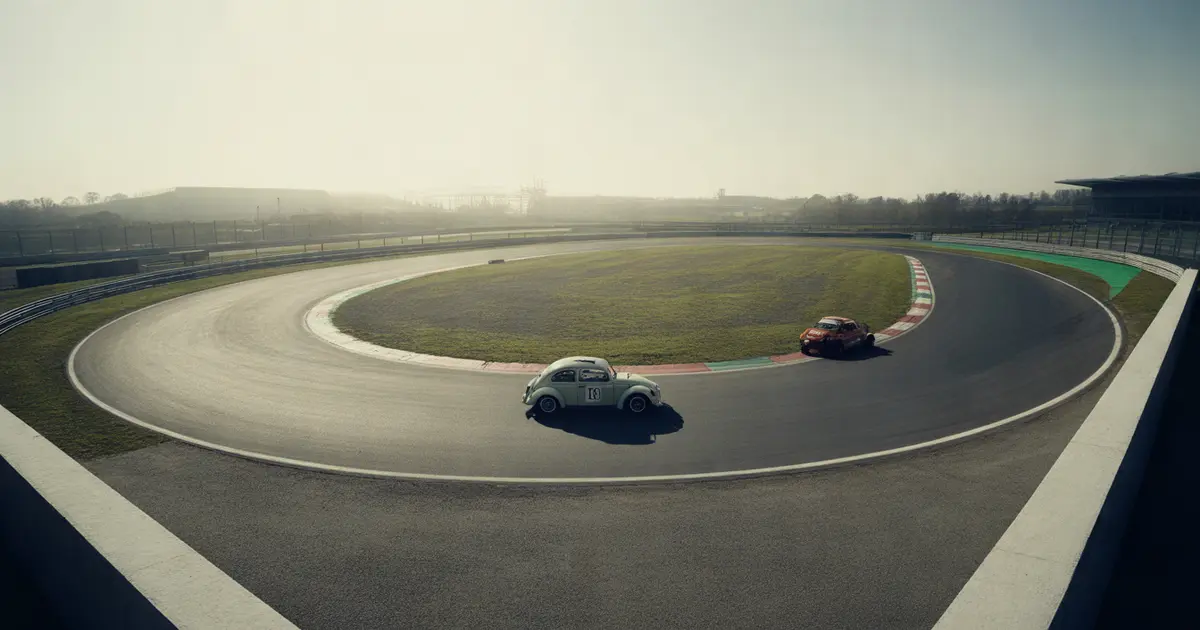
No ABS, no traction control, and the engine behind the rear axle: see where Copa Fusca punishes pedal mistakes and how to train for it in AMS2.
No ABS, no traction control, no electronic differential: in the Copa Fusca category in Automobilista 2, the driver’s foot is the only management system that exists. Lap time doesn’t come from power — the engine is weak — it comes from how hard you can brake without locking up and how cleanly you can exit a corner without spinning the car on its own inertia.
That changes what’s worth training. In a car with electronics, you make a mistake and the system hides part of it. In the Beetle, the mistake shows up whole, right away, and usually ends up sideways.
Why this car punishes so hard
The Beetle has its engine behind the rear axle, not just rear-wheel drive. That shifts the center of mass behind the axle that’s holding the corner, creating a pendulum effect: when the rear starts to go, it doesn’t go slowly, it accelerates the slide.
Add narrow tires, little aerodynamic load, and suspension that works through generous travel. The result is a car that’s sensitive to the rhythm of your brake entry and to how smoothly you release the throttle mid-corner.
Where the time is really lost
It’s not on the straight. It’s in the transitions. Here’s the parallel between symptom and most likely cause in this car:
| Symptom | Likely cause |
|---|---|
| Rear breaks loose when releasing the brake | Brake released too fast, not matching the steering |
| Car locks the front under heavy braking | Abrupt brake application, no ramp-up |
| Oversteer when lifting off the throttle | Sudden lift-off in a medium-speed corner |
| Understeer on exit | Throttle applied too early for the steering angle |
Without ABS, locking the front wheel costs more time than braking too early, and in the Beetle that difference is even more visible because there’s no system hiding the lock-up. The tire locks, the corner is lost, and the data shows it clearly.
- 1Entry
Brake pressure ramped up, never a step, to avoid locking the front
- 2Peak
Holds the maximum sustainable pressure just before the lock-up limit
- 3Release
Releases the brake in the same proportion as the wheel starts turning
- 4Transition
Car points with minimal residual brake, ready for throttle
The corner exit is the most expensive point
With so little power, you might imagine the exit forgives mistakes. It doesn’t. Any residual steering angle left while you apply throttle turns into traction oversteer, because there’s no electronic control cutting torque to save you.
The principle is the same one that already applies to another light car without driver aids: the gain in a slow corner comes from unwinding the wheel before accelerating, not accelerating before unwinding the wheel. In the Beetle this is even stricter, because the rear-mounted engine pushes the rear out if the steering angle is still high.
How to train this tomorrow
Running ten laps trying to go faster won’t help. Isolating the phase that’s costing time and repeating only that phase will. A simple plan for a thirty-minute session:
- Isolated braking: pick two heavy-braking corners and repeat only the entry, ignoring the exit, until you feel the lock-up limit without looking at the graph.
- Progressive release: in the same corner, train releasing the brake in proportion to how much the wheel is turning, not all at once.
- Controlled lift-off: in a medium-speed corner, practice lifting off the throttle gradually, never an abrupt release.
- Throttle application: on exit, wait for the car to point before adding throttle, even if it feels slow.
- Lap comparison: after each block, compare the training lap with the previous one in the same corner to confirm the adjustment stuck.
Step two of this plan is literally the subject of how to release the brake in proportion to steering, and it’s worth reading before heading to the track, because the Beetle gives no second chance when that proportion is wrong.
Common mistake: confusing a slow car with an easy car
A lot of drivers treat a low-power car as a lower-risk car and relax their braking. It’s the opposite in the Beetle: since there’s no electronics holding anything back, braking or traction mistakes show up raw in lap time, with no filter.
Another common mistake is trying to correct lift-off oversteer by countersteering late. Without ABS and without TC, the correction needs to come the instant the rear starts moving, not a second later.
In the Beetle, the car doesn’t correct you. You correct the car — and you only get one chance per corner to do it right.
How to confirm in the data whether the adjustment worked
After training the plan above, the right question isn’t “was the lap faster”, it’s “was the specific phase faster and more repeatable”. Look at the brake entry, the point where throttle returns, and the steering angle in the same section across three consecutive laps.
If the corner time varies little across those three laps, the adjustment stuck. If it varies a lot, the problem wasn’t isolated technique, it was braking reference — it’s worth reviewing which three channels to look at first in telemetry before insisting on the same drill.
Where Laptics fits in
Laptics records telemetry automatically while you drive the Copa Fusca in Automobilista 2 and compares your laps by corner phase, showing where the brake, steering, and throttle cost time on each pass. The Driver DNA helps you see whether the same lift-off or brake-release mistake repeats across different tracks.
This doesn’t replace the foot training described above. It confirms, with data, whether tomorrow’s drill is actually changing the lap or just changing the feeling.
Practical summary
- Braking: train the isolated entry ramp before thinking about a full fast lap.
- Brake release: release in proportion to the steering, never all at once.
- Lift-off: be gradual in medium-speed corners, the rear-mounted engine doesn’t forgive an abrupt release.
- Exit: wait for the car to point before adding throttle.
- Validation: compare the same phase across three consecutive laps to confirm repeatability, not just speed.
Frequently asked questions
Does Copa Fusca have ABS in Automobilista 2?
No. The car reproduces the total absence of electronic aids, so wheel lock-up depends entirely on the driver’s modulation.
Why does the Beetle oversteer so much when lifting off the throttle?
The engine sits behind the rear axle, which amplifies the weight transfer effect when the throttle is released abruptly.
Is it worth using a stiffer setup to stabilize the rear?
It helps somewhat, but it doesn’t replace the technique of gradual brake release and lift-off, which is where most time is lost.
Does low power mean a traction mistake costs little?
No. Without traction control, excess steering angle combined with early throttle still pulls the car off line, even with little torque.
How do I know if the exit problem is braking or steering?
Compare the brake pressure channel with the steering angle in the same corner across different laps; whichever phase varies most shows where to focus.
Is Copa Fusca a good car for training brake modulation?
Yes, precisely because there’s no ABS hiding the lock-up, which forces the driver to feel the tire’s real limit.
Does Laptics record Copa Fusca telemetry automatically?
Yes, the app runs in the background during the Automobilista 2 session and uploads the data with no manual export.
Want to see this in your own telemetry?
I want to train with real data