%20--%3e%3cdefs%3e%3cstyle%3e%20.st0%20{%20fill:%20%23ff1230;%20}%20.st1%20{%20fill:%20%23fff;%20}%20%3c/style%3e%3c/defs%3e%3cpath%20class='st0'%20d='M49.77,34.93l3.47-5.3,23.2-5.86,4.03-6.07-23.14,5.83,3.55-5.33,23.17-5.84,3.96-6.05-23.07,5.8,3.59-5.52-23.16,5.83,3.68-5.68-19.8,4.98c-2.49.63-4.65,2.16-6.07,4.3l-1.81,2.75,20-5.03c.7-.18,1.49-.1,1.75.21.21.25.09,1.12-.24,1.61l-1.85,2.7-19.34,4.87c-2.48.62-4.64,2.15-6.06,4.29l-1.82,2.75,20.12-5.04c.7-.18,1.53.11,1.64.48.09.31-.06,1.12-.4,1.6l-1.79,2.51-19.21,4.82c-2.51.63-4.69,2.19-6.11,4.36l-1.75,2.69,20.19-5.08c1.67-.25,1.96.77,1.1,2.08l-1.9,2.89,19.51-4.94c1.49-.38,2.88,0,1.87,1.62l-1.88,3.01,24.65-6.19,3.01-5.82-23.07,5.79ZM60.94,13.54c.53-.13,1.35.11,1.52.37.19.28-.02,1.14-.37,1.66l-1.73,2.56-22.57,5.67,3.51-5.31,19.64-4.95ZM30.19,35.24l3.49-5.33,19.75-4.95c1.34-.34,1.92.7,1.23,1.76l-1.83,2.83-22.65,5.7Z'/%3e%3cpath%20class='st1'%20d='M236.44,40.24l22.56-33.95h10.5l-22.56,33.95h-10.5Z'/%3e%3cpath%20class='st1'%20d='M368.54,15.18l5.9-8.88h-52.48l-5.64,8.49-3.45,5.19-5.01,7.54h0s40.4,0,40.4,0l-2.82,4.24h-72.13c-2.23,0-3.07-1.46-1.87-3.27l9.11-13.71h29.5l5.95-8.49h-40.31l-5.64,8.49-9.61,14.46c-.36.55-.67,1.08-.92,1.61-.15.31-.28.61-.39.9-1.52,4.06.3,7.25,4.69,8.2.48.1.99.18,1.54.23.44.04.9.06,1.38.06h85.14l8.46-12.73,5.24-7.89h-40.45l2.95-4.44h40.45Z'/%3e%3cpath%20class='st1'%20d='M198.16,6.32c-.19,0-.37-.03-.56-.03h-60.45l-37.03,26.63h-19.71l18.01-26.63h-10.5l-17.48,26.31c-2.17,3.27.17,7.64,4.09,7.64h28.01l37.22-25.46h6.27l-16.92,25.46h10.51l16.92-25.46h27.83l-.02.04h7.11c1.89.18,2.56,1.55,1.44,3.23l-1.3,1.96c-1.2,1.8-3.98,3.27-6.21,3.27h-25.26l-11.28,16.98h10.5l5.64-8.49h15.69c.48,0,.96-.02,1.45-.06.61-.05,1.22-.12,1.84-.23,5.65-.95,11.72-4.14,15.59-8.2.02-.02.04-.04.06-.06.74-.78,5.18-7.47,5.57-8.39h17.48l-16.94,25.49h10.51l16.94-25.49h14.98l5.65-8.5h-55.64Z'/%3e%3c/svg%3e)
How to Tell If You Brake Later or Softer Than the Reference
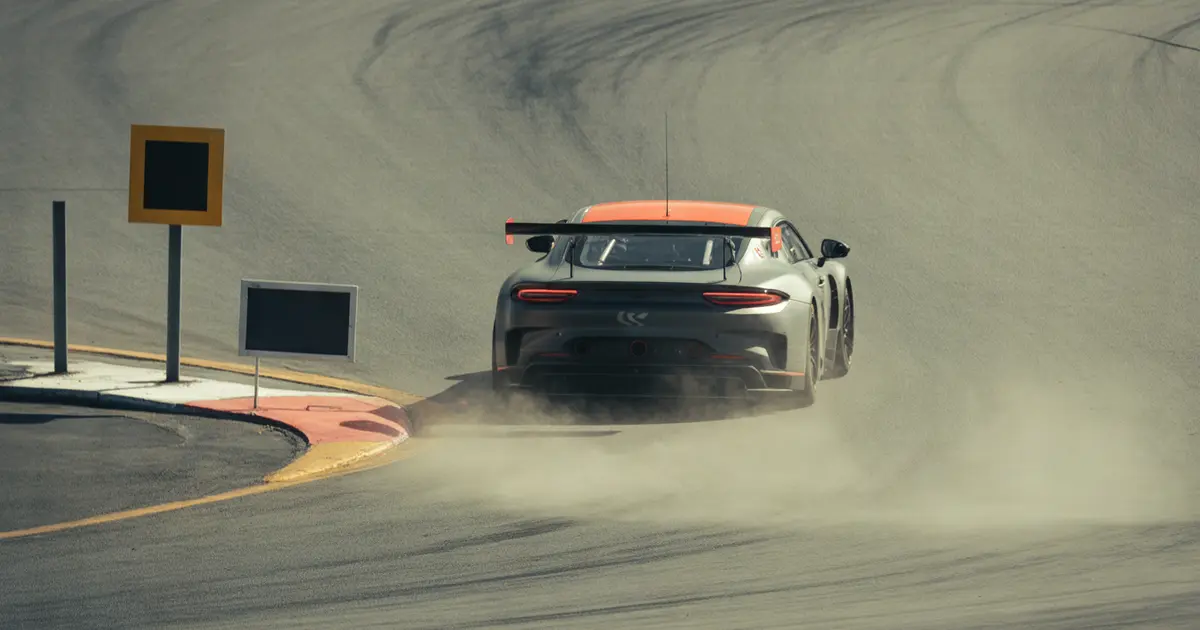
Braking late and braking soft look the same on the clock, but they are different mistakes. See how to tell them apart on the brake graph before you change your style.
You find out by comparing two data points on the same graph: the meter where the brake is applied and the peak pressure right after that. If the application point is similar to the reference but the peak pressure is lower, the problem is applied force, not timing.
Both mistakes cost similar time on the final clock, but they call for opposite fixes. Mixing one up with the other is why practice stalls even after repeating the same corner a hundred times.
Why both mistakes look the same in lap time
Braking 10 meters earlier and braking with 15% less peak pressure can produce the same time loss in the same corner. The overall delta doesn’t tell them apart. It only shows that you arrived behind.
That’s why looking only at the time delta and the meter where it shows up isn’t enough here. You need to open the brake channel and overlay your lap with the reference corner by corner.
The two channels that answer the question
Two traces solve the diagnosis when overlaid on the same distance scale:
- Application point: the meter where the pressure curve leaves zero and starts to rise. If your point comes after the reference’s, you’re braking late.
- Peak pressure: the highest value the curve reaches right after the application point. If your peak is lower than the reference’s in the same stretch, you’re braking soft.
Both can happen together. It’s more common than it seems: drivers who brake late out of insecurity also apply less force, because they’re compensating for the delay with caution.
How to tell them apart on the graph, step by step
- Align the laps by the same distance reference, not by time, or else any 1-meter offset already distorts the visual reading.
- Mark the exact meter where the reference driver’s pressure curve leaves zero.
- Mark the same point on your lap and measure the difference in meters. This isolates the timing component.
- Compare both pressure peaks in the second right after the application point, ignoring timing for a moment.
- Classify the error: delayed braking point, peak deficit, or both combined in the same corner.
Quick table: symptom on the clock vs. cause on the graph
| Symptom | Likely cause | Where to look |
|---|---|---|
| Loses time on entry, arrives fine at the apex | Delayed braking point | Start of the brake trace |
| Loses time on entry, car feels stable | Low peak pressure | First second after the application point |
| Loses time and feels oversteer | Peak too high, not too low | Plateau of the brake curve |
Common mistakes when reading this graph
Some mistakes show up often in drivers who are starting to compare brake traces:
- Comparing against the wrong reference speed: using someone’s best lap on a different fuel or tire setup distorts the expected peak.
- Ignoring tire condition: a cold or already worn tire changes the possible peak pressure without it being a driving mistake.
- Looking only at the peak and forgetting the concept of maximum brake pressure, which is rarely 100% even for fast drivers.
- Confusing trail braking with soft braking, when in fact the gradual release is intentional and not a lack of initial force.
How this changes by car and by track
Cars with factory ABS, like GT3s in the sims, tolerate a high peak without locking up, so the reference usually shows pressure that’s more constant and closer to the limit. Cars without ABS demand a finer reading of the plateau, because excess locks the wheel before any real gain — locking the front costs more time than braking early, and that shows up directly in the trace.
A track with long braking zones, like a straight followed by a 90-degree corner, better separates the timing error from the force error, because there are more meters for the peak to settle before the apex. A short braking zone mixes both signals and requires comparing several sectors of the same corner, not just the start.
What to do when the comparison doesn’t add up
Sometimes the brake trace looks identical to the reference and the time still falls behind. In that case the problem isn’t in the braking — it’s in the next phase.
Check whether the real loss is in the rotation or the exit, not the entry. Reading the brake trace to find the error on entry only works if the entry is indeed where the time disappears.
Braking late and braking soft cost similar time, but they call for opposite practice: one needs courage at the point, the other needs confidence in the force.
Where Laptics fits into this diagnosis
Laptics’ corner-phase analysis overlays your brake trace with a reference lap automatically, with nothing to export by hand. It marks the application meter and the peak pressure side by side, cutting out the manual alignment work described above.
If you’d rather skip the spreadsheet, you can compare two laps directly in the app and see exactly which of the two points — timing or force — holds the difference.
Practical summary
Before changing your braking point in the next session, confirm which of the two mistakes you actually have:
- If the delay is in the meter, the practice is to build a visual reference for the point, not to apply more force.
- If the delay is in pressure, the practice is confidence in the pedal, not changing where you brake.
- If both show up together, fix the point first — the force tends to adjust on its own once the timing is already right.
Frequently asked questions
Can I see this without telemetry, just by feel on the wheel?
It’s hard to separate the two mistakes by feel alone, because both create the same sensation of arriving late at the apex. The pressure-by-distance graph is the reliable way to tell them apart.
If I brake at the same meter as the reference, am I already doing it right?
Not necessarily. You could be hitting the right point and still lose time from low peak pressure right after the application.
Is low peak pressure always a mistake?
No. Cold tires, a dirty track, or a high fuel load reduce the possible peak without that being a driving flaw.
Which reference should I use for comparison: my own best lap or another driver’s?
Your own best lap is already useful for spotting inconsistency between attempts. Using another driver helps you see a performance ceiling you haven’t reached yet.
Does a car with ABS change this diagnosis?
It changes the risk of testing higher pressure, since ABS prevents lockup. But the way you read the graph — application point and peak — stays the same.
What if the brake trace is identical and the time still falls behind?
In that case the loss is probably in the rotation or the corner exit, not in the braking itself.
Want to see this in your own telemetry?
Compare my braking with a reference