%20--%3e%3cdefs%3e%3cstyle%3e%20.st0%20{%20fill:%20%23ff1230;%20}%20.st1%20{%20fill:%20%23fff;%20}%20%3c/style%3e%3c/defs%3e%3cpath%20class='st0'%20d='M49.77,34.93l3.47-5.3,23.2-5.86,4.03-6.07-23.14,5.83,3.55-5.33,23.17-5.84,3.96-6.05-23.07,5.8,3.59-5.52-23.16,5.83,3.68-5.68-19.8,4.98c-2.49.63-4.65,2.16-6.07,4.3l-1.81,2.75,20-5.03c.7-.18,1.49-.1,1.75.21.21.25.09,1.12-.24,1.61l-1.85,2.7-19.34,4.87c-2.48.62-4.64,2.15-6.06,4.29l-1.82,2.75,20.12-5.04c.7-.18,1.53.11,1.64.48.09.31-.06,1.12-.4,1.6l-1.79,2.51-19.21,4.82c-2.51.63-4.69,2.19-6.11,4.36l-1.75,2.69,20.19-5.08c1.67-.25,1.96.77,1.1,2.08l-1.9,2.89,19.51-4.94c1.49-.38,2.88,0,1.87,1.62l-1.88,3.01,24.65-6.19,3.01-5.82-23.07,5.79ZM60.94,13.54c.53-.13,1.35.11,1.52.37.19.28-.02,1.14-.37,1.66l-1.73,2.56-22.57,5.67,3.51-5.31,19.64-4.95ZM30.19,35.24l3.49-5.33,19.75-4.95c1.34-.34,1.92.7,1.23,1.76l-1.83,2.83-22.65,5.7Z'/%3e%3cpath%20class='st1'%20d='M236.44,40.24l22.56-33.95h10.5l-22.56,33.95h-10.5Z'/%3e%3cpath%20class='st1'%20d='M368.54,15.18l5.9-8.88h-52.48l-5.64,8.49-3.45,5.19-5.01,7.54h0s40.4,0,40.4,0l-2.82,4.24h-72.13c-2.23,0-3.07-1.46-1.87-3.27l9.11-13.71h29.5l5.95-8.49h-40.31l-5.64,8.49-9.61,14.46c-.36.55-.67,1.08-.92,1.61-.15.31-.28.61-.39.9-1.52,4.06.3,7.25,4.69,8.2.48.1.99.18,1.54.23.44.04.9.06,1.38.06h85.14l8.46-12.73,5.24-7.89h-40.45l2.95-4.44h40.45Z'/%3e%3cpath%20class='st1'%20d='M198.16,6.32c-.19,0-.37-.03-.56-.03h-60.45l-37.03,26.63h-19.71l18.01-26.63h-10.5l-17.48,26.31c-2.17,3.27.17,7.64,4.09,7.64h28.01l37.22-25.46h6.27l-16.92,25.46h10.51l16.92-25.46h27.83l-.02.04h7.11c1.89.18,2.56,1.55,1.44,3.23l-1.3,1.96c-1.2,1.8-3.98,3.27-6.21,3.27h-25.26l-11.28,16.98h10.5l5.64-8.49h15.69c.48,0,.96-.02,1.45-.06.61-.05,1.22-.12,1.84-.23,5.65-.95,11.72-4.14,15.59-8.2.02-.02.04-.04.06-.06.74-.78,5.18-7.47,5.57-8.39h17.48l-16.94,25.49h10.51l16.94-25.49h14.98l5.65-8.5h-55.64Z'/%3e%3c/svg%3e)
Time delta: how to know exactly where you lost time
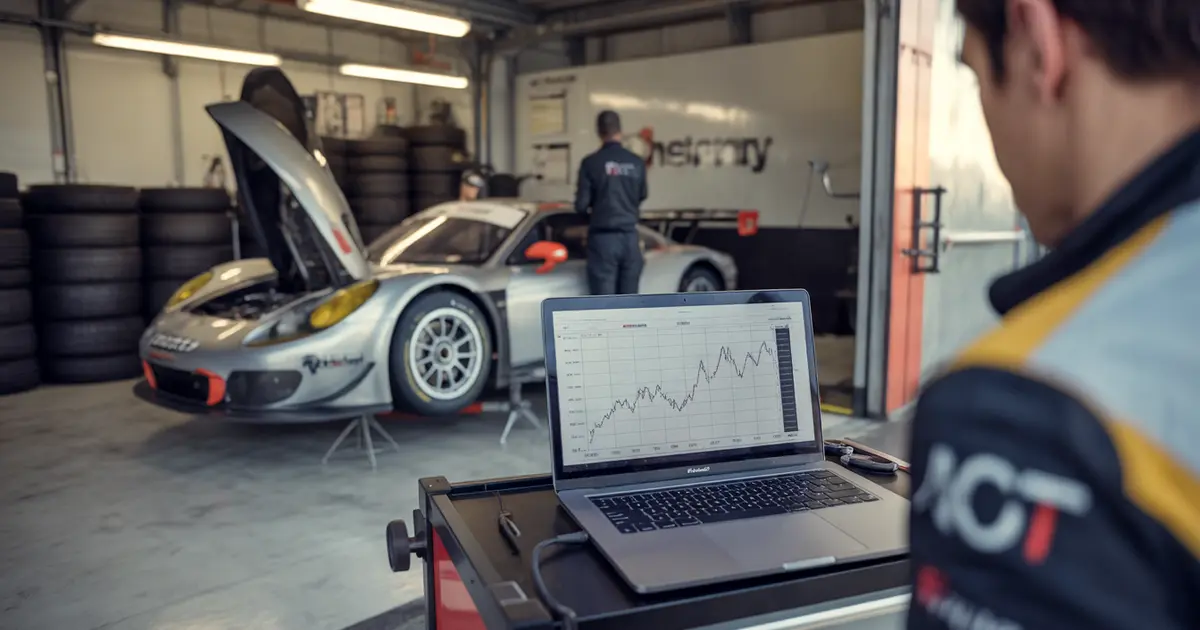
The delta isn't just the final number of the lap. It's the slope of the line, meter by meter, showing where time was gained or lost — and what to do with that information tomorrow.
Time delta shows, meter by meter, the accumulated difference between your lap and a reference lap. The exact point of loss isn't the final value on the graph: it's where the line changes slope, climbing faster than the rest of the trace.
That seems obvious until you open the actual graph and see a line full of small ripples. Most drivers just look at the number at the end of the lap and stop there. The diagnosis is in the middle of the road, not in the total.
What the slope really tells you
A flat delta means you're at the same pace as the reference in that section. It doesn't matter if the accumulated value is at +0.3s or -0.1s: what matters is whether the line is climbing, dropping, or staying flat.
- Line climbing: you're losing time at that specific point, even if the lap total is still positive.
- Line dropping: you're gaining time there, which helps confirm an adjustment that worked.
- Flat line: a neutral section. Not worth training that part right now.
Anyone comparing the accumulated value at the end of each sector misses the target. The sector can close positive because you gained on the straight and hid a real loss in the previous corner.
Which reference to use
The delta is only useful if the comparison is fair. A different car, a different setup, or a track with different grip creates noise that looks like a driving error and isn't.
- Your best lap of the session: shows where the current lap fell short against your own ceiling, in the same car and under the same conditions.
- Composite ideal lap (best sectors): the sum of the best sections you've already driven separately, useful for seeing the theoretical limit before looking for an external reference.
- A faster driver's lap: good for comparing driving style, but only works if the car and setup are equivalent.
Without this prior check, the delta points to an error that doesn't exist. To build this comparison without opening a spreadsheet, see how to compare two of your own laps without opening a spreadsheet.
How to read it by corner phase
Braking
A climb right at the start of the braking zone usually points to a late braking point or lower initial pressure than the reference.
Rotation
If the line climbs after the apex rather than before it, the problem is usually in the car's rotation, not the brake. This is the most commonly misdiagnosed section, detailed in why you lose time in the rotation phase and not in braking.
Traction and exit
A climb on the following straight, rather than in the corner itself, usually means the loss happened on exit and only became visible further ahead, because of accumulated speed effect.
| Section of the line | Symptom | Likely cause |
|---|---|---|
| Start of braking | Sharp, short climb | Late braking point |
| Post-apex | Smooth, long climb | Rotation too slow |
| Following straight | Gradually growing climb | Traction lost on previous exit |
The common mistake when reading the delta
Two mistakes come up often. The first is judging the delta from a single lap: traffic noise, wind, or clipping a curb can distort the entire section.
The second is comparing against a reference from a different car or condition, thinking it's a driving error when it's actually context. Always confirm over three or four consecutive laps before drawing a conclusion about a specific section.
The delta doesn't point to a driving error. It points to where to look for the error — the cause still needs to be confirmed in the brake, steering, and throttle traces at that exact point.
How this changes by car and by track
In high-downforce cars, small rotation variations in a fast corner create disproportionate climbs in the delta, because the speed loss there is paid for throughout the entire following straight.
On tracks with long straights, the delay effect between error and symptom becomes more evident: the climb in the line appears hundreds of meters after the corner where the error actually began. Drivers who identify the corner that costs the most time in the lap do so before looking for the exact cause inside it, and this order avoids an inverted diagnosis.
How Laptics fits into this
The app records telemetry automatically while you drive and compares laps by corner phase, showing how much time each input costs within the section, not just across the whole sector. Driver DNA helps you see whether that loss pattern repeats in other similar corners, rather than being an isolated error from that one lap.
Practical summary
Look at the slope of the line, not the accumulated value. Confirm the reference before trusting the section. Repeat across several laps before training a specific correction tomorrow.
Frequently asked questions
Does a negative delta always mean I'm driving well?
Not necessarily. The accumulated value can be negative even with a real loss hidden in the middle of the section, if you gained time before or after it.
Can I use another driver's lap as a delta reference?
Only if the car and setup are equivalent. Otherwise, the delta shows a difference in car performance, not driving performance.
Why does the delta oscillate so much within a single lap?
Small variations from traffic, wind, or a curb are already enough to create noise. Confirm the pattern across several laps before training on top of it.
Does the delta show the cause of the error or just the location?
It shows the location. The cause — brake, steering, or throttle — needs to be confirmed by looking at the other channels at that exact point.
Is it worth comparing delta between different sessions?
Only if the track conditions and the car are the same. Different grip from one session to another distorts the comparison.
What should I do when the delta climbs only on the straight, with no corner there?
The loss usually started in the previous corner, on exit or traction, and only became visible once speed built up on the following straight.
Want to see this in your own telemetry?
I want to see where I'm losing time in my lap