%20--%3e%3cdefs%3e%3cstyle%3e%20.st0%20{%20fill:%20%23ff1230;%20}%20.st1%20{%20fill:%20%23fff;%20}%20%3c/style%3e%3c/defs%3e%3cpath%20class='st0'%20d='M49.77,34.93l3.47-5.3,23.2-5.86,4.03-6.07-23.14,5.83,3.55-5.33,23.17-5.84,3.96-6.05-23.07,5.8,3.59-5.52-23.16,5.83,3.68-5.68-19.8,4.98c-2.49.63-4.65,2.16-6.07,4.3l-1.81,2.75,20-5.03c.7-.18,1.49-.1,1.75.21.21.25.09,1.12-.24,1.61l-1.85,2.7-19.34,4.87c-2.48.62-4.64,2.15-6.06,4.29l-1.82,2.75,20.12-5.04c.7-.18,1.53.11,1.64.48.09.31-.06,1.12-.4,1.6l-1.79,2.51-19.21,4.82c-2.51.63-4.69,2.19-6.11,4.36l-1.75,2.69,20.19-5.08c1.67-.25,1.96.77,1.1,2.08l-1.9,2.89,19.51-4.94c1.49-.38,2.88,0,1.87,1.62l-1.88,3.01,24.65-6.19,3.01-5.82-23.07,5.79ZM60.94,13.54c.53-.13,1.35.11,1.52.37.19.28-.02,1.14-.37,1.66l-1.73,2.56-22.57,5.67,3.51-5.31,19.64-4.95ZM30.19,35.24l3.49-5.33,19.75-4.95c1.34-.34,1.92.7,1.23,1.76l-1.83,2.83-22.65,5.7Z'/%3e%3cpath%20class='st1'%20d='M236.44,40.24l22.56-33.95h10.5l-22.56,33.95h-10.5Z'/%3e%3cpath%20class='st1'%20d='M368.54,15.18l5.9-8.88h-52.48l-5.64,8.49-3.45,5.19-5.01,7.54h0s40.4,0,40.4,0l-2.82,4.24h-72.13c-2.23,0-3.07-1.46-1.87-3.27l9.11-13.71h29.5l5.95-8.49h-40.31l-5.64,8.49-9.61,14.46c-.36.55-.67,1.08-.92,1.61-.15.31-.28.61-.39.9-1.52,4.06.3,7.25,4.69,8.2.48.1.99.18,1.54.23.44.04.9.06,1.38.06h85.14l8.46-12.73,5.24-7.89h-40.45l2.95-4.44h40.45Z'/%3e%3cpath%20class='st1'%20d='M198.16,6.32c-.19,0-.37-.03-.56-.03h-60.45l-37.03,26.63h-19.71l18.01-26.63h-10.5l-17.48,26.31c-2.17,3.27.17,7.64,4.09,7.64h28.01l37.22-25.46h6.27l-16.92,25.46h10.51l16.92-25.46h27.83l-.02.04h7.11c1.89.18,2.56,1.55,1.44,3.23l-1.3,1.96c-1.2,1.8-3.98,3.27-6.21,3.27h-25.26l-11.28,16.98h10.5l5.64-8.49h15.69c.48,0,.96-.02,1.45-.06.61-.05,1.22-.12,1.84-.23,5.65-.95,11.72-4.14,15.59-8.2.02-.02.04-.04.06-.06.74-.78,5.18-7.47,5.57-8.39h17.48l-16.94,25.49h10.51l16.94-25.49h14.98l5.65-8.5h-55.64Z'/%3e%3c/svg%3e)
Maximum brake pressure: why 100% is rarely ideal
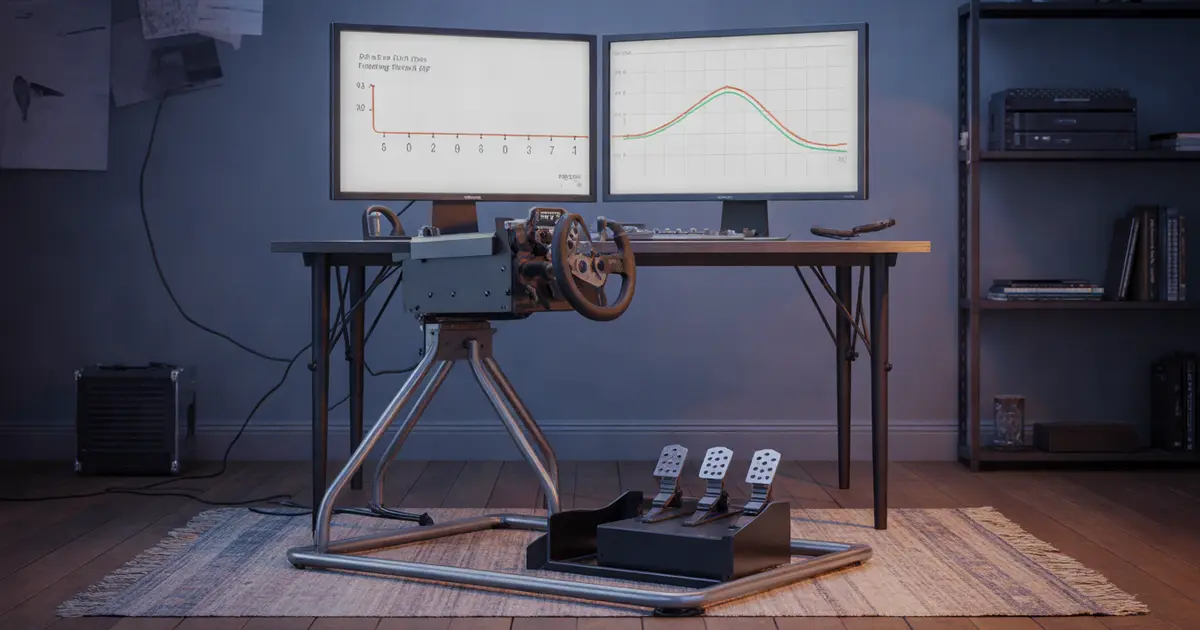
Flooring the brake pedal isn't the same as braking fast. Learn where the tire's grip peak sits, when 100% actually works, and how to find your ideal pressure by reading the data.
Maximum brake pressure almost always sits above the point where the tire delivers the most grip. Past that point, pressing harder doesn't slow the car down faster: it locks the wheel or triggers the ABS, and you lose time.
The right value varies with the car, tire temperature, the track's grip level at that moment, and the brake bias set in your setup. There's no universal number — there's a process to find yours, corner by corner.
What happens to the tire once you pass the peak
A tire's braking grip curve rises with slip up to a peak and then drops. While pedal pressure increases within that range, deceleration follows along. Past the peak, more pressure produces more slip and less grip — the wheel locks or skids, and deceleration stops increasing.
In a car without ABS this shows up as pure lockup: the wheel stops spinning before the car stops. In a car with ABS, the system modulates pressure on its own to keep you near the peak, but each modulation cycle costs a bit of raw deceleration compared to a driver who nails the peak manually.
Why the peak almost always sits below 100%
Maximum pedal pressure is the physical limit of your push, not the limit of the tire. In most sessions, the grip peak shows up well before that limit.
- Cold tire: the grip peak is lower, so the ideal pressure drops — common on the first laps of a stint or right after a safety car.
- Low-grip track: low track evolution reduces available grip even before you touch the brake.
- Poorly set brake bias: concentrates too much load on the front axle and triggers lockup early, even with moderate pressure.
- Low aerodynamic load: slow corners or cars with little downforce reach the grip peak with less pressure, because there's less vertical load pushing the tire into the asphalt.
The exceptions: when pushing hard is the right move
There are situations where pressing near 100% is, in fact, the fastest option.
- Long straight with a hot tire and a high-grip track: a well-calibrated ABS absorbs the excess with no noticeable cost.
- Chicane where the car is already nearly stopped: the risk of locking up matters less than guaranteeing maximum deceleration at that instant.
- Extreme downforce car in a high-speed corner: aerodynamic load pushes the grip peak upward, close to the pedal's physical limit — that's the case for a car with extreme downforce and braking that changes everything.
How to find your ideal pressure in the data
You can't feel this precisely from the seat. You can see it on the graph.
- Open brake pressure and longitudinal deceleration together: compare both curves on the same corner, and take the chance to review how to read the brake trace and find the error on entry.
- Mark where deceleration stops following pressure: that point is the tire's plateau at that specific moment.
- Check front wheel speed: if it drops below the car's speed, that's pure lockup, not a smooth plateau.
- Repeat the same corner with a cold tire and a hot tire: note whether the plateau shifts between the two situations.
- Adjust the maximum pressure you apply, or the bias: aim just below the identified plateau, not at the physical limit of your push.
- 1Initial pressure
A quick press up to the point where the tire still accepts more load.
- 2Grip peak
Maximum pressure the tire can hold without losing deceleration.
- 3Plateau or lockup
Pressure above the peak: the wheel locks or ABS kicks in, with no real gain.
- 4Trail-braking modulation
Gradual release as the car rotates toward the apex.
Wheel feedback vs. cause in the data
The same symptom can have different causes. The table below helps you avoid guessing.
| Symptom | Likely cause |
|---|---|
| Lockup on entry | Pressure above the peak, tire still cold |
| High pressure with no deceleration gain | Grip plateau or ABS absorbing the excess |
| Lockup disappears after two or three laps | Tire and track warmed up, peak rose |
| Lockup only in one specific corner | Brake bias shifting load to the wrong axle there |
Common mistake when reading this channel
The common mistake is treating every lockup as “high pressure.” Sometimes it's a cold tire, sometimes it's bias, sometimes the track just hasn't rubbered in yet — and each cause calls for a different fix. It's also worth reviewing why locking the front wheel costs more time than braking early before touching the setup.
The right pressure isn't the highest you can apply. It's the highest the tire accepts before the grip peak, at that specific moment on track.
How to confirm this with Laptics
Laptics' corner-phase analysis separates braking, rotation, and exit, showing how much time each phase cost compared to your reference lap. This helps you see whether the lockup is a one-off or repeats every lap — a trait that shows up in using the brake without relying on aggressive ABS also applies to anyone running without ABS in any simulator. If you also adjust tire pressure as part of your setup, it's worth reviewing how to adjust pressure by operating temperature, since a cold tire changes where the peak sits.
Practical summary
- Stop aiming for 100%: aim for the grip plateau of each corner, which changes with tire and track.
- Test cold and hot tires separately: note whether the ideal pressure changes between the two.
- Use the data before the setup: confirm whether the lockup comes from pressure, bias, or temperature before touching any adjustment.
Frequently asked questions
Is 100% brake pressure always wrong?
No. With a hot tire, a high-grip track, and a well-calibrated ABS, 100% can be the fastest option. What's wrong is using 100% as a fixed target without checking the data.
How do I know my ideal pressure without telemetry?
You can feel lockup through sound and steering wheel vibration, but it's imprecise. The pressure-versus-deceleration graph shows the plateau clearly.
Does ABS change this reasoning?
Yes. With ABS the system modulates pressure near the peak automatically, so pushing hard costs less time than in a car without ABS.
Does a cold tire need more or less pressure?
Less. A cold tire has a lower grip peak, so the same pressure that worked with a hot tire already goes past the ideal point.
Does brake bias affect the usable maximum pressure?
Yes. A bias set too far forward triggers front lockup earlier even with moderate pressure, reducing the maximum pressure you can use without locking up.
Does this apply equally to GT3 and formula cars?
No. Cars with more downforce reach the grip peak at higher pressure in fast corners, because aerodynamic load increases the available grip.
Is pedal pressure the same as the system's hydraulic pressure?
Not exactly. The force you apply to the pedal passes through setup adjustments, like bias and gain, before becoming actual pressure at the calipers.
Want to see this in your own telemetry?
Analyze my braking with telemetry