%20--%3e%3cdefs%3e%3cstyle%3e%20.st0%20{%20fill:%20%23ff1230;%20}%20.st1%20{%20fill:%20%23fff;%20}%20%3c/style%3e%3c/defs%3e%3cpath%20class='st0'%20d='M49.77,34.93l3.47-5.3,23.2-5.86,4.03-6.07-23.14,5.83,3.55-5.33,23.17-5.84,3.96-6.05-23.07,5.8,3.59-5.52-23.16,5.83,3.68-5.68-19.8,4.98c-2.49.63-4.65,2.16-6.07,4.3l-1.81,2.75,20-5.03c.7-.18,1.49-.1,1.75.21.21.25.09,1.12-.24,1.61l-1.85,2.7-19.34,4.87c-2.48.62-4.64,2.15-6.06,4.29l-1.82,2.75,20.12-5.04c.7-.18,1.53.11,1.64.48.09.31-.06,1.12-.4,1.6l-1.79,2.51-19.21,4.82c-2.51.63-4.69,2.19-6.11,4.36l-1.75,2.69,20.19-5.08c1.67-.25,1.96.77,1.1,2.08l-1.9,2.89,19.51-4.94c1.49-.38,2.88,0,1.87,1.62l-1.88,3.01,24.65-6.19,3.01-5.82-23.07,5.79ZM60.94,13.54c.53-.13,1.35.11,1.52.37.19.28-.02,1.14-.37,1.66l-1.73,2.56-22.57,5.67,3.51-5.31,19.64-4.95ZM30.19,35.24l3.49-5.33,19.75-4.95c1.34-.34,1.92.7,1.23,1.76l-1.83,2.83-22.65,5.7Z'/%3e%3cpath%20class='st1'%20d='M236.44,40.24l22.56-33.95h10.5l-22.56,33.95h-10.5Z'/%3e%3cpath%20class='st1'%20d='M368.54,15.18l5.9-8.88h-52.48l-5.64,8.49-3.45,5.19-5.01,7.54h0s40.4,0,40.4,0l-2.82,4.24h-72.13c-2.23,0-3.07-1.46-1.87-3.27l9.11-13.71h29.5l5.95-8.49h-40.31l-5.64,8.49-9.61,14.46c-.36.55-.67,1.08-.92,1.61-.15.31-.28.61-.39.9-1.52,4.06.3,7.25,4.69,8.2.48.1.99.18,1.54.23.44.04.9.06,1.38.06h85.14l8.46-12.73,5.24-7.89h-40.45l2.95-4.44h40.45Z'/%3e%3cpath%20class='st1'%20d='M198.16,6.32c-.19,0-.37-.03-.56-.03h-60.45l-37.03,26.63h-19.71l18.01-26.63h-10.5l-17.48,26.31c-2.17,3.27.17,7.64,4.09,7.64h28.01l37.22-25.46h6.27l-16.92,25.46h10.51l16.92-25.46h27.83l-.02.04h7.11c1.89.18,2.56,1.55,1.44,3.23l-1.3,1.96c-1.2,1.8-3.98,3.27-6.21,3.27h-25.26l-11.28,16.98h10.5l5.64-8.49h15.69c.48,0,.96-.02,1.45-.06.61-.05,1.22-.12,1.84-.23,5.65-.95,11.72-4.14,15.59-8.2.02-.02.04-.04.06-.06.74-.78,5.18-7.47,5.57-8.39h17.48l-16.94,25.49h10.51l16.94-25.49h14.98l5.65-8.5h-55.64Z'/%3e%3c/svg%3e)
Aquaplaning: How to Feel It and How to React
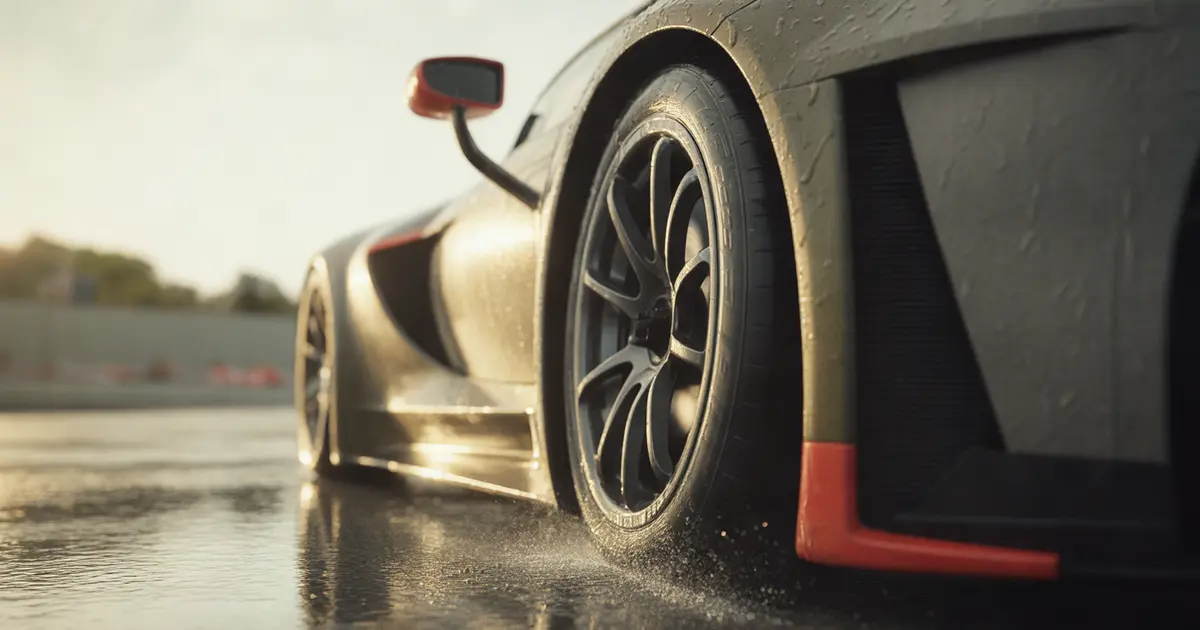
Aquaplaning feels like a sudden void in the wheel and the pedal. The right reaction is not to correct — it is to release and wait for the tire to find the asphalt again.
Aquaplaning feels like a sudden void: the steering wheel loses weight, the brake pedal loses resistance, and the car stops obeying for a fraction of a second. The right reaction is almost never to correct — it is to release whatever input you are applying, keep the car straight, and wait for the tire to find the asphalt again.
The rest of this article covers why this happens, where you feel it first, and what changes between braking, turning, and accelerating on top of water.
What you feel first
Aquaplaning is not a single event. It is a loss of contact that shows up differently depending on which phase of the corner the car is in.
- On the steering wheel: the steering goes light, with almost no return torque, because the front tire has stopped scraping the ground and is sliding on a sheet of water.
- On the brake pedal: deceleration disappears for an instant, even with the same pressure applied, and the ABS may start cycling earlier than usual.
- On the throttle: the rear lets go without the progressive warning you get on dry asphalt — it slips all at once, because the rear tire has also lost its contact layer.
The common point is the absence of gradual warning. On dry asphalt, the tire warns you before the limit breaks. In aquaplaning, the warning is the event itself.
The three phases where it shows up
Braking
This is the most dangerous phase because the natural reflex is to press harder when the car does not slow down. That is the opposite of what the tire needs: more pressure does not help a tire that is no longer touching the asphalt, it only delays its return. The same logic applies to why locking the front wheel costs more time than braking early — in the rain, the cost of insisting is even higher.
Corner — entry and mid-corner
If aquaplaning happens with the wheel already turned, the car tends to go straight, in the direction it had before losing grip. Correcting with more steering at that instant does not change the trajectory, because there is no friction for the correction to act on. It only delays recovery once the tire bites again.
Traction on exit
Here the symptom looks more like a classic spin, only more abrupt. The throttle needs to be treated as a precision instrument, not an on-off switch.
- 1Loss of contact
Steering wheel or pedal suddenly lose resistance.
- 2Release the input
Reduce brake pressure or bring the steering back, without adding correction.
- 3Wait for the return
Hold the trajectory until torque or deceleration comes back.
- 4Gradual resumption
Reapply brake or steering little by little, tire still unstable.
How to react, in order
There is no recovery maneuver for aquaplaning — there is only not making it worse. The car will regain grip on its own. The question is what your foot and hand are doing when that happens.
- Release the input that caused the slide: if it was the brake, reduce pressure; if it was the steering, bring the wheel back toward center; never increase an input that is already not working.
- Keep the car on the trajectory it already had: do not try to correct toward the ideal line during the slide, because there is no friction available for that.
- Wait for the return of torque on the wheel or deceleration on the pedal: that is the signal the tire has found asphalt again.
- Resume the original input gradually: go back to the brake or the steering little by little, because the tire that just regained grip is not yet at a stable limit.
- Re-evaluate the line on the next lap: if the aquaplaning came from the same point, the problem is not reflex — it is the route.
Common mistake: confusing it with wet-tire understeer
Many drivers treat every slide in the rain as aquaplaning. It is not. Wet-tire understeer is progressive and predictable; aquaplaning is sudden and without warning.
| Sign | Aquaplaning | Wet understeer |
|---|---|---|
| Onset | Abrupt, no warning | Gradual, with growing torque loss |
| Steering | Suddenly goes light | Gets lighter little by little |
| Correction | Release and wait | Reduce steering and speed |
Treating common understeer as if it were aquaplaning makes the driver release the car too much in situations where there was still grip to work with. Treating aquaplaning as common understeer makes the driver insist on a correction that does not exist.
How this changes by car and by track
A heavier car with a narrower front tire aquaplanes earlier under braking, because the same sheet of water has to be cut by less contact area. A car with high downforce suffers less in fast corners, because the aerodynamic load helps keep the tire pinned even with a film of water — but it loses that advantage as soon as speed drops.
The track matters as much as the car. Low drainage points collect water differently than the corner right next to them, and the dynamic rain behavior in Automobilista 2 makes that very clear: intensity changes point by point, not just lap by lap. On tracks like that, it is worth looking for an alternative line that avoids the zones of heaviest buildup instead of insisting on the dry line.
Aquaplaning is not corrected in the moment — it is avoided on the next lap, by adjusting where you step into the water and how you arrive at it.
How to validate it in the data after the session
Reflex is hard to trust from memory. The data shows whether you really released the input or corrected by instinct — and that becomes clear once you know which three channels to check first in telemetry: steering angle, brake pressure, and wheel angular speed.
A steering angle spike followed by an opposite correction, at the same point on the track, on different laps, is the classic pattern of reflex reaction to aquaplaning. If the pattern always repeats at the same spot, the problem is the line, not the reflex.
Laptics records telemetry automatically while you drive and compares your laps phase by phase through each corner, showing where the gesture cost time. In the rain, this helps separate what was a bad reaction from what was a poorly chosen point on the track — without requiring you to extract or export anything manually.
Practical summary
- Felt the void on the wheel or the pedal? Release the current input, do not increase it.
- Is the car going straight despite the steering? Wait, do not correct further.
- Did the rear let go without warning on the throttle? Lift smoothly, never abruptly.
- Did it always happen at the same point? Change the route next lap, not just the reaction.
Frequently asked questions
Does aquaplaning happen more under braking or in corners?
More common under braking, because the sheet of water forms on the straight and the front tire is the first to lose contact. In corners it depends on the depth of water pooled at that point.
Doesn't releasing the brake completely during aquaplaning cost the car time?
It costs less time than locking up or sliding more than necessary. The goal is to regain grip quickly, not to hold brake pressure at any cost.
Does ABS prevent aquaplaning?
No. ABS prevents lockup, but it does not recreate grip when the tire is riding on a film of water. It only helps the recovery, once contact returns.
Does a wet tire completely prevent aquaplaning?
It reduces the risk because it channels water better, but it does not eliminate it. Above a certain speed and water depth, any tire loses contact.
Can you train the reaction to aquaplaning on purpose?
Yes, by repeating the same wet point on track several times until releasing-and-waiting becomes automatic, instead of reacting by instinct to correct.
Does Laptics record rain sessions automatically?
Yes, capture is automatic in iRacing, Assetto Corsa, and ACC on PC, and over the network in Gran Turismo 7 and F1 25, with nothing to export manually.
Want to see this in your own telemetry?
I want to analyze my rain laps