%20--%3e%3cdefs%3e%3cstyle%3e%20.st0%20{%20fill:%20%23ff1230;%20}%20.st1%20{%20fill:%20%23fff;%20}%20%3c/style%3e%3c/defs%3e%3cpath%20class='st0'%20d='M49.77,34.93l3.47-5.3,23.2-5.86,4.03-6.07-23.14,5.83,3.55-5.33,23.17-5.84,3.96-6.05-23.07,5.8,3.59-5.52-23.16,5.83,3.68-5.68-19.8,4.98c-2.49.63-4.65,2.16-6.07,4.3l-1.81,2.75,20-5.03c.7-.18,1.49-.1,1.75.21.21.25.09,1.12-.24,1.61l-1.85,2.7-19.34,4.87c-2.48.62-4.64,2.15-6.06,4.29l-1.82,2.75,20.12-5.04c.7-.18,1.53.11,1.64.48.09.31-.06,1.12-.4,1.6l-1.79,2.51-19.21,4.82c-2.51.63-4.69,2.19-6.11,4.36l-1.75,2.69,20.19-5.08c1.67-.25,1.96.77,1.1,2.08l-1.9,2.89,19.51-4.94c1.49-.38,2.88,0,1.87,1.62l-1.88,3.01,24.65-6.19,3.01-5.82-23.07,5.79ZM60.94,13.54c.53-.13,1.35.11,1.52.37.19.28-.02,1.14-.37,1.66l-1.73,2.56-22.57,5.67,3.51-5.31,19.64-4.95ZM30.19,35.24l3.49-5.33,19.75-4.95c1.34-.34,1.92.7,1.23,1.76l-1.83,2.83-22.65,5.7Z'/%3e%3cpath%20class='st1'%20d='M236.44,40.24l22.56-33.95h10.5l-22.56,33.95h-10.5Z'/%3e%3cpath%20class='st1'%20d='M368.54,15.18l5.9-8.88h-52.48l-5.64,8.49-3.45,5.19-5.01,7.54h0s40.4,0,40.4,0l-2.82,4.24h-72.13c-2.23,0-3.07-1.46-1.87-3.27l9.11-13.71h29.5l5.95-8.49h-40.31l-5.64,8.49-9.61,14.46c-.36.55-.67,1.08-.92,1.61-.15.31-.28.61-.39.9-1.52,4.06.3,7.25,4.69,8.2.48.1.99.18,1.54.23.44.04.9.06,1.38.06h85.14l8.46-12.73,5.24-7.89h-40.45l2.95-4.44h40.45Z'/%3e%3cpath%20class='st1'%20d='M198.16,6.32c-.19,0-.37-.03-.56-.03h-60.45l-37.03,26.63h-19.71l18.01-26.63h-10.5l-17.48,26.31c-2.17,3.27.17,7.64,4.09,7.64h28.01l37.22-25.46h6.27l-16.92,25.46h10.51l16.92-25.46h27.83l-.02.04h7.11c1.89.18,2.56,1.55,1.44,3.23l-1.3,1.96c-1.2,1.8-3.98,3.27-6.21,3.27h-25.26l-11.28,16.98h10.5l5.64-8.49h15.69c.48,0,.96-.02,1.45-.06.61-.05,1.22-.12,1.84-.23,5.65-.95,11.72-4.14,15.59-8.2.02-.02.04-.04.06-.06.74-.78,5.18-7.47,5.57-8.39h17.48l-16.94,25.49h10.51l16.94-25.49h14.98l5.65-8.5h-55.64Z'/%3e%3c/svg%3e)
Dynamic Weather in Automobilista 2: How Rain Intensity Really Changes
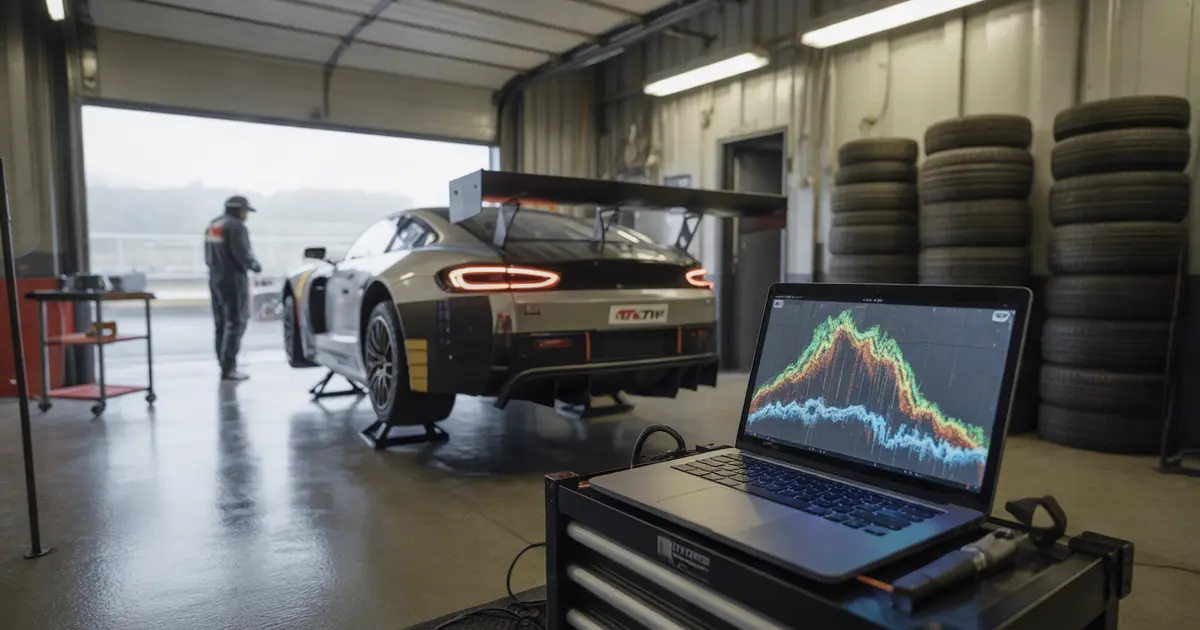
AMS2's weather engine simulates rain cells moving across the track, not a fixed level. Learn how to read this before choosing tyres and setup.
In Automobilista 2, rain changes intensity because Reiza's weather engine simulates precipitation cells moving across the track, not a fixed value applied to the entire map. This means two corners on the same circuit can be in different rain stages at the same instant, with one sector drier and another already flooded.
The practical effect is that tyre strategy and racing line don't stay fixed during the stint. They shift along with the rain cell, and drivers who don't track this lose time trying to apply the previous lap's read to a track that is no longer the same.
What the Weather Engine Really Simulates
AMS2's dynamic weather system doesn't switch between light and heavy rain like a toggle. It calculates the position and movement of precipitation cells across the map, and the intensity you feel depends on where the track sits relative to that cell at that exact moment.
This produces three effects that show up together but come from different sources:
- Instant intensity: how much is falling right now, which changes visibility and the spray behind the car ahead.
- Water accumulation: what has already fallen and hasn't drained yet, concentrated in low points of the track and off the dry line.
- Grip evolution: the rubber laid down that water washes off, reducing grip even after the rain has passed.
Separating these three factors is the first step to avoid treating it's raining as a single piece of data.
Where Water Pools Matters More Than Total Volume
Two sessions with the same amount of rain can require completely different setups and lines, because water doesn't distribute evenly. Low points on the track hold puddles even after intensity drops, while uphill sections drain quickly.
This changes where aquaplaning happens first. A fast corner with little lateral camber becomes the critical point of the lap precisely because the water has nowhere to go, even if the rest of the track is already drying.
In dynamic rain, the right question isn't how hard it's raining, it's where the water still hasn't drained.
The Radar Replaces Guesswork
AMS2 shows a rain forecast in intensity layers, with the cell moving over time. Ignoring this radar and choosing tyres based only on what's falling right now is the most common way to get the pit call wrong.
You can anticipate three scenarios just by checking the radar before the pit:
- Cell approaching: intensity will rise over the next few minutes, so switching to wet tyres pays off even if the track is still dry right now.
- Cell passing: rain is already at its peak and about to drop off, so it's worth holding on with your current tyres a little longer and letting the track dry before switching.
- Stationary cell: intensity fluctuates without a clear movement pattern, and here the risk of switching too early is greater than the risk of waiting.
This reading is similar to the logic of finding the alternative line on a wet track, just applied to the pit decision instead of the line through the corner.
Symptom in the Car, Cause in the Weather
When the car's behavior changes in dynamic rain, it's worth checking the cause before touching the setup. Not every loss of grip in the rain is a driving error.
| Symptom | Likely Cause | What to Do |
|---|---|---|
| Rear steps out in one corner only | Local water pooling off the line | Move the line, not the setup |
| Grip suddenly improves after a slow lap | Rain cell has moved away | Reassess compound at the next pit |
| Spray reduces visibility even without rain | Residual water kicked up by another car | Increase following distance on straights |
This table only works if you can tell apart what's track and what's tyre. Grip evolution on a dry track follows a different logic, explained in how the track gains grip session by session, and it's worth understanding the difference before blaming the setup.
- 1Cell approaching
Radar shows intensity rising over the next few minutes.
- 2Peak intensity
Water accumulates in low points of the track.
- 3Cell passing
Intensity drops, but accumulation hasn't drained yet.
- 4Track drying
Racing line clears first, off-line areas are still wet.
How This Varies by Car and by Track
A car with more downforce handles the intensity transition better, because aerodynamic load helps offset the loss of mechanical grip in shallow water. A light car with little wing feels the change more abruptly, especially under braking.
A track with pronounced elevation changes concentrates water at specific points and creates well-defined risk zones. A flatter track distributes water more evenly, so dynamic rain behaves more predictably throughout the lap.
Tyre pressure also needs a different criterion on a wet track, because operating temperature doesn't rise the same way. The reasoning behind adjusting pressure based on tyre operating temperature still applies in the rain, but the temperature targets are different.
How to Validate This in Your Own Data
You can't rely solely on the feeling that the track has changed. The way to confirm it is to compare laps on the same section at different moments in the session and see where the time difference actually shows up.
- Compare the same corner across laps separated by minutes and see if the time loss is concentrated at a specific point on the track.
- Look at minimum speed before looking at the full lap time, because that's where aquaplaning shows up first.
- Mark the time of the intensity change on the radar and cross-reference it with the moment your lap time shifted to a new level.
If the time loss is spread across the whole lap, it's setup or compound. If it's concentrated in a single corner, it's standing water, and changing the setup won't fix it. In long no-stop stints, this distinction also helps plan tyre management for a no-stop race when rain arrives mid-stint.
Where Laptics Fits In
Laptics records telemetry automatically while you drive, including rain sessions, and the corner-phase analysis shows exactly where time was lost. This helps separate standing water at a specific corner from a driving error repeated throughout the lap.
Race Vault stores these rain sessions for later comparison, when the same track comes up again under different conditions. It's diagnostics, not weather forecasting or automatic setup adjustment.
Practical Summary
Dynamic rain in AMS2 isn't a single intensity level: it's a cell on the move, with water that takes time to drain from specific points on the track.
- Check the radar before deciding on the pit, not just the current intensity.
- Separate symptom from cause before touching the setup after a loose corner.
- Confirm in the data whether the time loss is at one corner or spread across the lap.
Frequently asked questions
Does rain in Automobilista 2 follow a fixed pattern in each session?
No. The engine simulates precipitation cells that move, so intensity varies by section of the track and by time within the session.
Can you predict when the rain will increase?
Yes, the radar shows the cell moving before it arrives, and that reading is more reliable than looking only at the current intensity.
Does water accumulate the same way on every track?
No. Tracks with more pronounced elevation changes concentrate water at specific low points, while flatter circuits distribute rain more evenly.
Why does the car lose grip in just one corner, even in light rain?
It's usually local water pooling off the racing line, not a setup problem. Moving your line through the corner tends to fix it before you touch the car.
Does the AMS2 wet tyre react the same way at any intensity?
No. The operating temperature range changes with intensity, and pressure calibrated for a dry track doesn't work in the rain.
Can you practice dynamic rain outside of online races?
Yes, practice mode lets you set up weather progression and repeat the same scenario as many times as needed.
Does Laptics automatically adjust the setup for rain?
No. Laptics shows where time was lost in the telemetry, but the setup adjustment remains the driver's decision.
Want to see this in your own telemetry?
Analyze my rain laps