%20--%3e%3cdefs%3e%3cstyle%3e%20.st0%20{%20fill:%20%23ff1230;%20}%20.st1%20{%20fill:%20%23fff;%20}%20%3c/style%3e%3c/defs%3e%3cpath%20class='st0'%20d='M49.77,34.93l3.47-5.3,23.2-5.86,4.03-6.07-23.14,5.83,3.55-5.33,23.17-5.84,3.96-6.05-23.07,5.8,3.59-5.52-23.16,5.83,3.68-5.68-19.8,4.98c-2.49.63-4.65,2.16-6.07,4.3l-1.81,2.75,20-5.03c.7-.18,1.49-.1,1.75.21.21.25.09,1.12-.24,1.61l-1.85,2.7-19.34,4.87c-2.48.62-4.64,2.15-6.06,4.29l-1.82,2.75,20.12-5.04c.7-.18,1.53.11,1.64.48.09.31-.06,1.12-.4,1.6l-1.79,2.51-19.21,4.82c-2.51.63-4.69,2.19-6.11,4.36l-1.75,2.69,20.19-5.08c1.67-.25,1.96.77,1.1,2.08l-1.9,2.89,19.51-4.94c1.49-.38,2.88,0,1.87,1.62l-1.88,3.01,24.65-6.19,3.01-5.82-23.07,5.79ZM60.94,13.54c.53-.13,1.35.11,1.52.37.19.28-.02,1.14-.37,1.66l-1.73,2.56-22.57,5.67,3.51-5.31,19.64-4.95ZM30.19,35.24l3.49-5.33,19.75-4.95c1.34-.34,1.92.7,1.23,1.76l-1.83,2.83-22.65,5.7Z'/%3e%3cpath%20class='st1'%20d='M236.44,40.24l22.56-33.95h10.5l-22.56,33.95h-10.5Z'/%3e%3cpath%20class='st1'%20d='M368.54,15.18l5.9-8.88h-52.48l-5.64,8.49-3.45,5.19-5.01,7.54h0s40.4,0,40.4,0l-2.82,4.24h-72.13c-2.23,0-3.07-1.46-1.87-3.27l9.11-13.71h29.5l5.95-8.49h-40.31l-5.64,8.49-9.61,14.46c-.36.55-.67,1.08-.92,1.61-.15.31-.28.61-.39.9-1.52,4.06.3,7.25,4.69,8.2.48.1.99.18,1.54.23.44.04.9.06,1.38.06h85.14l8.46-12.73,5.24-7.89h-40.45l2.95-4.44h40.45Z'/%3e%3cpath%20class='st1'%20d='M198.16,6.32c-.19,0-.37-.03-.56-.03h-60.45l-37.03,26.63h-19.71l18.01-26.63h-10.5l-17.48,26.31c-2.17,3.27.17,7.64,4.09,7.64h28.01l37.22-25.46h6.27l-16.92,25.46h10.51l16.92-25.46h27.83l-.02.04h7.11c1.89.18,2.56,1.55,1.44,3.23l-1.3,1.96c-1.2,1.8-3.98,3.27-6.21,3.27h-25.26l-11.28,16.98h10.5l5.64-8.49h15.69c.48,0,.96-.02,1.45-.06.61-.05,1.22-.12,1.84-.23,5.65-.95,11.72-4.14,15.59-8.2.02-.02.04-.04.06-.06.74-.78,5.18-7.47,5.57-8.39h17.48l-16.94,25.49h10.51l16.94-25.49h14.98l5.65-8.5h-55.64Z'/%3e%3c/svg%3e)
Is Trail Braking Making You Slower? How to Check the Data
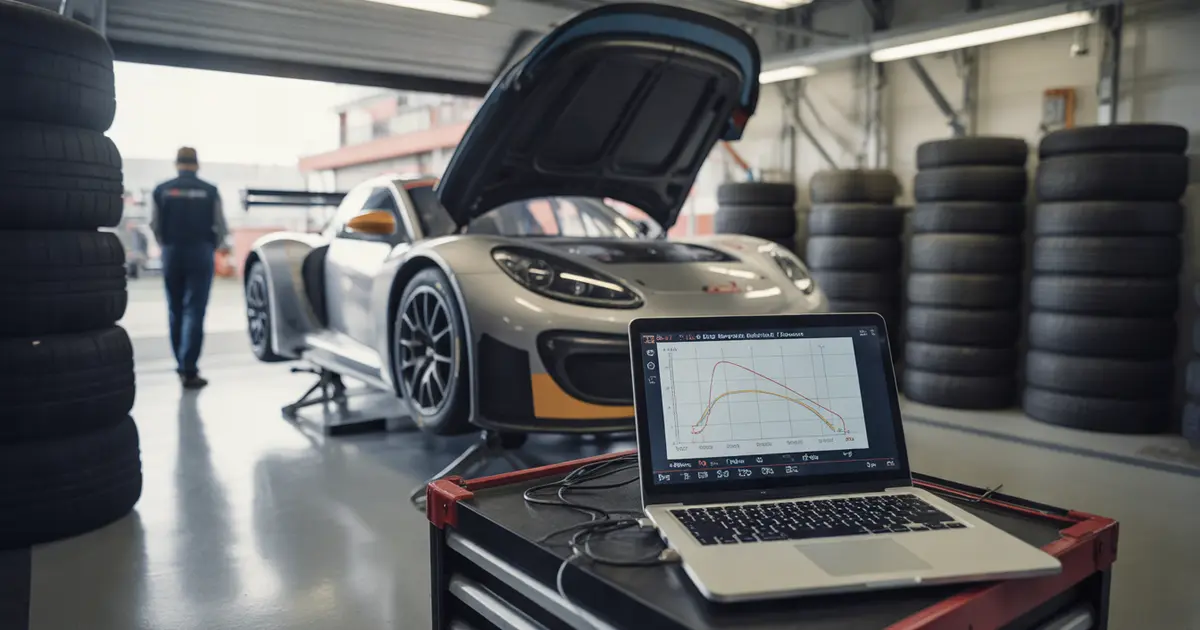
Slow trail braking is a classic mistake that feels smooth on the wheel but costs real time. See exactly which channel to check in telemetry to confirm it.
Trail braking is making you slower when brake release doesn’t keep pace with steering input: you bleed off pressure too slowly, holding brake past the point where the front tyre should already be free to rotate the car. The way to confirm it isn’t by feel at the wheel — it’s by overlaying the brake channel and the steering channel on the same graph, corner by corner, against a reference lap.
You can feel smooth and still be losing time. The data doesn’t lie here: it shows exactly where the pressure should have been dropping and didn’t.
What to look at first on the graph
Open the brake pressure channel and the steering angle channel on the same screen, using the same distance scale. What matters isn’t the brake peak, it’s the slope of the drop after the peak, compared to how much the wheel is turning in that same stretch.
If the wheel is already turning a lot and brake pressure is still high and nearly flat, the car is being held more than it needs. That takes load off the front at the wrong moment and delays rotation.
Three signs that trail braking is costing you time
- Brake plateau mid-corner: pressure stops dropping for a stretch and stays flat while the wheel is already turning — a sign you’re “holding” the car instead of letting it rotate.
- Delayed apex versus the reference car: comparing both laps, your apex happens a few metres later, even with similar entry speed.
- Steering correction right after releasing the brake: if steering input jumps as soon as brake pressure hits zero, the car wasn’t rotating enough while you were still braking.
This third sign is the easiest to mistake for “the car is just like that.” But it’s exactly the kind of pattern that repeats across several corners, and that the data points out corner by corner when you look at the full lap.
How to isolate the right phase in the data
- Pick a reference corner where you know the lap was good, ideally your best lap of the session.
- Overlay the brake channel and the steering channel from that lap with the lap you want to investigate, using distance as the X axis.
- Mark the point where steering passes 20% of its travel and check how much brake pressure still remains at that point in both laps.
- Compare the slope of the brake drop between peak and zero — a slower drop usually costs rotation time.
- Check the time delta exactly at corner exit, not entry, because that’s where the effect shows up.
Trail braking isn’t about how much brake you carry. It’s about how much you release per degree of steering.
Common mistake: confusing late braking with slow trail braking
Many drivers see they’re losing time on entry and assume they need to brake later. Sometimes the brake point is correct and the problem is just the release. Braking later on top of a bad release only makes the plateau worse.
Before touching the brake point, confirm whether the pressure drop tracks the steering. If it doesn’t, the gain is in releasing better, not braking later. That’s the kind of distinction that separates losing time in rotation from losing time in the braking itself — and they’re different corrections on the wheel.
How this changes by car and by track
The same brake plateau costs different amounts of time depending on the car. A car with more aero load forgives more; a light car on narrow tyres exposes the mistake immediately.
| Car | Typical symptom | What to look at |
|---|---|---|
| GT3 with wing | Short plateau, almost unnoticeable in lap time | Exit delta in slow second-gear corners |
| Light car without wing | Visible understeer as soon as brake is released | Steering correction right after pressure hits zero |
| High-downforce single-seater | Late rotation, but similar final speed | Corner radius comparison, not just speed |
Track also changes the weight of the mistake. In long, constant-radius corners, a brake plateau costs little because steering is already nearly stable. In chicanes and ramp-entry corners, the same mistake shows up on every direction change — and adds up fast across the sector.
Validating with your own data
Confirming this by eye, lap after lap, is hard to keep consistent. Laptics records telemetry automatically while you drive — on iRacing, Assetto Corsa and ACC on PC, and on Gran Turismo 7 and F1 25 over the network — and the analysis compares your laps by corner phase, showing where brake and steering stop moving together.
That removes the part of hunting for the right spot on the graph: the report already points to the phase that cost time, so you can focus on testing the release, not chasing the point in the replay. If the pattern repeats across several tracks, the Driver DNA helps show whether it’s a trait of yours, not an isolated case from one corner.
It’s also worth watching front tyre wear alongside this: holding the brake too long through rotation is one of the ways to speed up early front tyre wear, and the two symptoms often show up together.
What to train tomorrow
Pick two or three corners where the plateau showed up and train only the release, without changing the brake point. Release a bit earlier relative to the steering input and compare the exit delta, not the entry delta. If you need a reference for how the ratio between brake and steering should behave, it’s worth reviewing how to release the brake in proportion to steering before heading back out.
Frequently asked questions
How do I know if it’s trail braking or a wrong brake point?
Check whether brake pressure is still high once steering has passed 20% of its travel. If so, it’s a slow release; if the brake point itself is too late, the problem shows up earlier, at the deceleration peak.
Does slow trail braking always cost time?
It depends on the car and the corner. On a high-aero car with a long-radius corner the cost is small; on a light car and in chicanes the effect shows up fast in the exit delta.
Which telemetry channel shows this best?
The overlay of brake pressure with steering angle, using distance as the axis. Speed alone doesn’t show the plateau clearly.
Does releasing the brake faster always improve lap time?
Not necessarily. Releasing too fast makes the car lose front load too early and understeer on entry. The goal is proportion, not release speed.
Does this change between a dry and a wet track?
Yes, in the wet the release window is smaller and the plateau costs more because the tyre has less grip margin to absorb the mistake.
Does Laptics show this automatically?
The analysis compares your laps by corner phase and flags where brake and steering stop moving together, without having to export any file manually.
Want to see this in your own telemetry?
Analyze my laps with Laptics