%20--%3e%3cdefs%3e%3cstyle%3e%20.st0%20{%20fill:%20%23ff1230;%20}%20.st1%20{%20fill:%20%23fff;%20}%20%3c/style%3e%3c/defs%3e%3cpath%20class='st0'%20d='M49.77,34.93l3.47-5.3,23.2-5.86,4.03-6.07-23.14,5.83,3.55-5.33,23.17-5.84,3.96-6.05-23.07,5.8,3.59-5.52-23.16,5.83,3.68-5.68-19.8,4.98c-2.49.63-4.65,2.16-6.07,4.3l-1.81,2.75,20-5.03c.7-.18,1.49-.1,1.75.21.21.25.09,1.12-.24,1.61l-1.85,2.7-19.34,4.87c-2.48.62-4.64,2.15-6.06,4.29l-1.82,2.75,20.12-5.04c.7-.18,1.53.11,1.64.48.09.31-.06,1.12-.4,1.6l-1.79,2.51-19.21,4.82c-2.51.63-4.69,2.19-6.11,4.36l-1.75,2.69,20.19-5.08c1.67-.25,1.96.77,1.1,2.08l-1.9,2.89,19.51-4.94c1.49-.38,2.88,0,1.87,1.62l-1.88,3.01,24.65-6.19,3.01-5.82-23.07,5.79ZM60.94,13.54c.53-.13,1.35.11,1.52.37.19.28-.02,1.14-.37,1.66l-1.73,2.56-22.57,5.67,3.51-5.31,19.64-4.95ZM30.19,35.24l3.49-5.33,19.75-4.95c1.34-.34,1.92.7,1.23,1.76l-1.83,2.83-22.65,5.7Z'/%3e%3cpath%20class='st1'%20d='M236.44,40.24l22.56-33.95h10.5l-22.56,33.95h-10.5Z'/%3e%3cpath%20class='st1'%20d='M368.54,15.18l5.9-8.88h-52.48l-5.64,8.49-3.45,5.19-5.01,7.54h0s40.4,0,40.4,0l-2.82,4.24h-72.13c-2.23,0-3.07-1.46-1.87-3.27l9.11-13.71h29.5l5.95-8.49h-40.31l-5.64,8.49-9.61,14.46c-.36.55-.67,1.08-.92,1.61-.15.31-.28.61-.39.9-1.52,4.06.3,7.25,4.69,8.2.48.1.99.18,1.54.23.44.04.9.06,1.38.06h85.14l8.46-12.73,5.24-7.89h-40.45l2.95-4.44h40.45Z'/%3e%3cpath%20class='st1'%20d='M198.16,6.32c-.19,0-.37-.03-.56-.03h-60.45l-37.03,26.63h-19.71l18.01-26.63h-10.5l-17.48,26.31c-2.17,3.27.17,7.64,4.09,7.64h28.01l37.22-25.46h6.27l-16.92,25.46h10.51l16.92-25.46h27.83l-.02.04h7.11c1.89.18,2.56,1.55,1.44,3.23l-1.3,1.96c-1.2,1.8-3.98,3.27-6.21,3.27h-25.26l-11.28,16.98h10.5l5.64-8.49h15.69c.48,0,.96-.02,1.45-.06.61-.05,1.22-.12,1.84-.23,5.65-.95,11.72-4.14,15.59-8.2.02-.02.04-.04.06-.06.74-.78,5.18-7.47,5.57-8.39h17.48l-16.94,25.49h10.51l16.94-25.49h14.98l5.65-8.5h-55.64Z'/%3e%3c/svg%3e)
Interlagos: The Junção Hill and the Early-Throttle Mistake
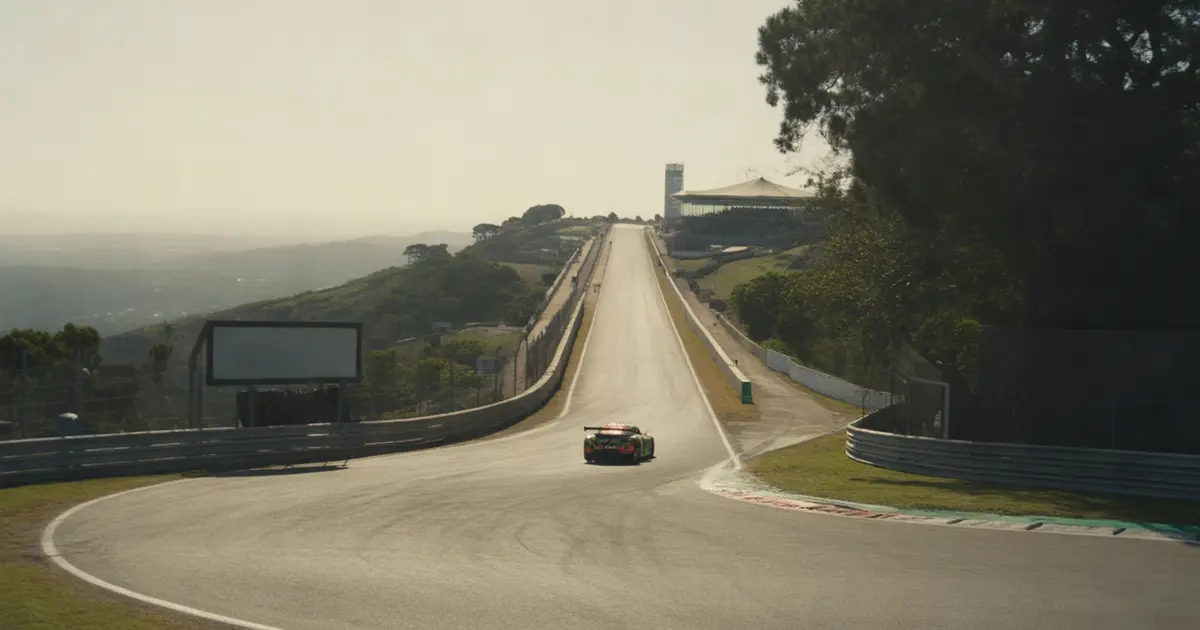
On the Junção hill at Interlagos, getting on the throttle early costs traction and time down the track's longest straight. Here's how to confirm it in your data and what to train next.
Getting on the throttle early on the Junção hill at Interlagos costs time because the throttle input lands while the car is still rotating: the rear tire receives power on top of lateral load, and the result is either power oversteer or exit understeer that pushes you wide of the ideal line. In both cases, the straight that follows — the longest on the track — receives less baseline speed, and that deficit carries through to the next braking zone.
Why this particular corner punishes so much
Junção is a tight, second-gear corner, with the track climbing right at the exit. That combination is deceptive: the uphill grade helps shift weight onto the rear axle, which normally favors traction, but only once the car is already pointed straight. While the steering wheel still has angle on it, the rear tire splits grip between lateral and longitudinal forces — leaving little left over for acceleration.
Drivers who get on the throttle early here usually do it out of reflex: the feeling of losing time mid-corner pushes the foot toward the pedal before it's time. The problem is that the car has no idea you're in a hurry.
What “early” actually means
It's not about the lap clock — it's about the steering angle still present when the throttle begins to open. The right reopening point is tied to the actual rotation point of a tight-radius corner: only after the car has passed it is there rear grip left over for traction without a lateral cost.
Getting on the throttle early with the wheel nearly straight, even if it looks early on the clock, isn't the same mistake — that's actually correct. The mistake lies in opening the pedal while there's still real steering angle in your hands.
How to confirm this in your data
The diagnosis doesn't depend on opinion. Compare two laps, one fast and one average, looking at three channels together: steering angle, throttle position, and speed. If the throttle rises before the wheel starts returning to center, the mistake is confirmed.
- Mark the visual apex of Junção on the distance graph and note the steering angle at that exact point.
- Find where the throttle trace crosses 20% opening and compare it to the steering angle at the same meter mark.
- Repeat for your reference lap and measure the distance, in meters, between the two reopening points.
- Check the speed entering the pit straight: that's the final result of the gesture, not the cause.
This kind of reading gets faster once you already know which three channels to look at first in your telemetry; here the focus shifts slightly, because the decisive channel is the crossover between steering and throttle, not either one in isolation.
Symptom in the car vs. cause in the data
| What you feel | What probably happened |
|---|---|
| Rear steps out slightly on exit | Throttle opened while the wheel still had load |
| Car pushes wide, without sliding | Early throttle took load off the front |
| Feels slow, but delta is positive | The mistake is in another phase, not the exit |
How this changes by car
In rear-wheel-drive, high-power GT3 cars, the cost of early throttle is immediate: the differential locks the axle and the car reacts within tenths. In front-wheel-drive or less powerful cars, the effect is subtler — it turns into exit understeer, and you only notice it through the delta, not through any scary sensation.
This is similar to what happens in slow corners with lightweight cars, as described in why you lose time at the exit of a slow corner: the footwork mistake shows up first in lost time, only later in the car's visible behavior.
The gain from fixing the gesture also depends on the rear tire's condition: a degraded tire tolerates less timing error between steering and throttle than a fresh one does.
What to train tomorrow
- Isolate Junção in short sessions of 10 to 15 laps, without worrying about the rest of the track.
- Delay throttle opening by half a meter at a time and watch the effect on exit speed, not on feel.
- Compare overlaid steering and throttle traces every few laps, not just at the end of the session.
- Treat the pit straight as part of the corner: the time it shows is the verdict on what you did at Junção.
At Junção, the throttle doesn't correct the corner — it only collects the bill for whatever the steering wheel is still doing.
Where Laptics helps with this diagnosis
The Laptics app records telemetry automatically while you drive in iRacing, Assetto Corsa, ACC, GT7, or F1 25, and the AI analysis compares your laps phase by phase, showing exactly how much time the early-throttle habit cost specifically at the Junção exit. This saves you the work of overlaying graphs manually after every training block, something the millisecond cost of every footwork mistake in your lap explains in more detail.
Practical summary
If Junção is costing you time, check the crossover between steering and throttle first, before touching the setup. The fix is in the gesture, not the car — and lap time only comes back once the timing is right.
Frequently asked questions
How do I know if I'm getting on the throttle early at Junção and not in another phase?
Compare overlaid steering and throttle traces on the same distance graph. If the throttle rises before the wheel starts returning to center, that's the mistake.
Is the early-throttle mistake always oversteer?
No. In front-wheel-drive cars or with a degraded tire, the same mistake shows up as exit understeer rather than a loose rear.
Is it worth adjusting the setup before fixing the gesture?
No. Changing the differential or spring rates without fixing the timing just masks the problem, and it returns as soon as the tire's condition changes.
Does the uphill section change the ideal throttle point?
Yes, it favors traction, but only once the car is already pointed straight. Before that, the uphill grade doesn't make up for leftover steering angle.
Does this mistake show up the same way in GT3 and in less powerful cars?
No. In rear-wheel-drive GT3 cars the effect is immediate and visible; in less powerful cars it becomes subtle understeer that only shows up in the delta.
How much time does this mistake cost per lap?
It depends on the car, the tire, and how early the throttle opens. You can't generalize a number without measuring it in your own data.
Do I need advanced telemetry to notice this?
No. Two channels are enough: steering angle and throttle position overlaid on the same distance graph.
Want to see this in your own telemetry?
See where you're losing time at Junção