%20--%3e%3cdefs%3e%3cstyle%3e%20.st0%20{%20fill:%20%23ff1230;%20}%20.st1%20{%20fill:%20%23fff;%20}%20%3c/style%3e%3c/defs%3e%3cpath%20class='st0'%20d='M49.77,34.93l3.47-5.3,23.2-5.86,4.03-6.07-23.14,5.83,3.55-5.33,23.17-5.84,3.96-6.05-23.07,5.8,3.59-5.52-23.16,5.83,3.68-5.68-19.8,4.98c-2.49.63-4.65,2.16-6.07,4.3l-1.81,2.75,20-5.03c.7-.18,1.49-.1,1.75.21.21.25.09,1.12-.24,1.61l-1.85,2.7-19.34,4.87c-2.48.62-4.64,2.15-6.06,4.29l-1.82,2.75,20.12-5.04c.7-.18,1.53.11,1.64.48.09.31-.06,1.12-.4,1.6l-1.79,2.51-19.21,4.82c-2.51.63-4.69,2.19-6.11,4.36l-1.75,2.69,20.19-5.08c1.67-.25,1.96.77,1.1,2.08l-1.9,2.89,19.51-4.94c1.49-.38,2.88,0,1.87,1.62l-1.88,3.01,24.65-6.19,3.01-5.82-23.07,5.79ZM60.94,13.54c.53-.13,1.35.11,1.52.37.19.28-.02,1.14-.37,1.66l-1.73,2.56-22.57,5.67,3.51-5.31,19.64-4.95ZM30.19,35.24l3.49-5.33,19.75-4.95c1.34-.34,1.92.7,1.23,1.76l-1.83,2.83-22.65,5.7Z'/%3e%3cpath%20class='st1'%20d='M236.44,40.24l22.56-33.95h10.5l-22.56,33.95h-10.5Z'/%3e%3cpath%20class='st1'%20d='M368.54,15.18l5.9-8.88h-52.48l-5.64,8.49-3.45,5.19-5.01,7.54h0s40.4,0,40.4,0l-2.82,4.24h-72.13c-2.23,0-3.07-1.46-1.87-3.27l9.11-13.71h29.5l5.95-8.49h-40.31l-5.64,8.49-9.61,14.46c-.36.55-.67,1.08-.92,1.61-.15.31-.28.61-.39.9-1.52,4.06.3,7.25,4.69,8.2.48.1.99.18,1.54.23.44.04.9.06,1.38.06h85.14l8.46-12.73,5.24-7.89h-40.45l2.95-4.44h40.45Z'/%3e%3cpath%20class='st1'%20d='M198.16,6.32c-.19,0-.37-.03-.56-.03h-60.45l-37.03,26.63h-19.71l18.01-26.63h-10.5l-17.48,26.31c-2.17,3.27.17,7.64,4.09,7.64h28.01l37.22-25.46h6.27l-16.92,25.46h10.51l16.92-25.46h27.83l-.02.04h7.11c1.89.18,2.56,1.55,1.44,3.23l-1.3,1.96c-1.2,1.8-3.98,3.27-6.21,3.27h-25.26l-11.28,16.98h10.5l5.64-8.49h15.69c.48,0,.96-.02,1.45-.06.61-.05,1.22-.12,1.84-.23,5.65-.95,11.72-4.14,15.59-8.2.02-.02.04-.04.06-.06.74-.78,5.18-7.47,5.57-8.39h17.48l-16.94,25.49h10.51l16.94-25.49h14.98l5.65-8.5h-55.64Z'/%3e%3c/svg%3e)
Where the Real Rotation Point Sits in a Tight-Radius Corner
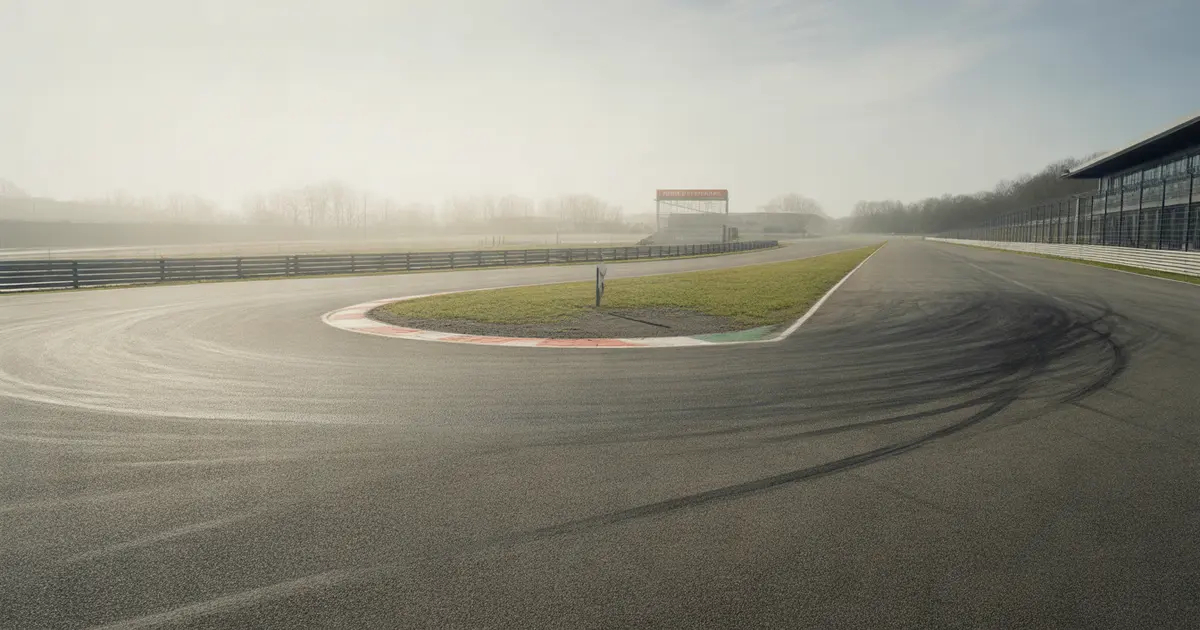
In a tight-radius corner, the point where the car actually turns is not the point where you feel like cranking the wheel. See where it really is and how to find it in your own data.
The real rotation point is where front-axle load is still high enough for the car to turn without extra steering input — this usually happens near the end of trail braking, just before the geometric apex. It is not the point where you feel like turning the wheel as the corner closes in on the screen.
In a tight-radius corner, the gap between the “visual” point and the real point is larger than in a fast corner. That is where most drivers between 1,500 and 3,000 iRating lose time without noticing, because the car still completes the corner — just slower.
Why the visual point deceives you in a tight-radius corner
The tighter the radius, the earlier your brain wants to turn the wheel. It is a natural reaction: the corner “seems” to demand immediate steering right after the braking peak.
The problem is that, at that instant, the car still has weight concentrated on the front axle because of braking. Turning too early adds steering to a braking phase that has not yet freed the front tyre to do both things at once.
What defines the real point
The rotation point is not fixed on the asphalt. It shifts as three factors change from lap to lap:
- Front-axle load: the more brake pressure still present, the earlier the front tyre accepts steering input without sliding.
- Entry speed: entering faster pushes the rotation point later, because weight transfer takes longer to complete.
- Front tyre condition: a hotter or more worn tyre shrinks the window in which the car accepts steering input without understeering.
- Brake setup and bias: more front bias moves the point earlier; more rear bias delays it.
This is, in practice, the transition between the braking phase and the rotation phase. Drivers who still confuse the two tend to lose time exactly at this junction — not in the braking itself, as shown in why you lose time in the rotation phase, not in braking.
- 1Braking
Maximum pressure applied, load transfers to the front axle.
- 2Transition
Brake starts releasing while front load still supports the tyre.
- 3Rotation
Steering rises consistently, car turns without additional correction.
- 4Apex
Slowest point of the corner, steering at its cycle maximum.
- 5Exit traction
Steering decreases, throttle comes in, front tyre already freed.
The common mistake: turning before the load arrives
The most common symptom in a tight-radius corner is steering applied early and in excess, followed by a correction mid-corner. The car understeers, the driver adds more steering, and exit speed drops because the front tyre is already at its limit when it should still have grip in reserve for traction.
This pattern is described in detail in how to identify and fix excess steering on entry. It is worth comparing your steering trace with your brake trace in the tight-radius corners of the track you drive most.
How to validate this in your own data
Overlay three channels on the same corner: brake pressure, steering angle, and speed. The real rotation point is where the steering starts rising consistently while the brake is still applied, but already decreasing — not at the braking peak.
If your steering rises before brake pressure starts to drop, you are turning before the load arrives. If the steering only rises after the brake is fully released, you are losing time on the other side: turning too late and stretching out the corner.
Releasing the brake in the right proportion to the steering is what connects the two phases without losing time. This fine adjustment is detailed in how to release the brake in proportion to steering.
How this changes by car
The rotation point does not behave the same in every car. Aerodynamic load, weight distribution, and front-axle response shift where the transition happens.
| Car/category | Where it tends to sit | Why |
|---|---|---|
| GT3 with downforce | Later, near the apex | Aerodynamic load keeps front grip for longer |
| Formula without a wide wing | Earlier than the GT3 | Less low-speed downforce, load depends only on braking |
| Light front-wheel drive | Earlier and more sensitive | Front axle handles braking and traction in the same phase |
How to train this tomorrow
- Choose a tight-radius corner you already know well, preferably one that appears on more than one track in your calendar.
- Record five laps in a row focusing only on that corner, without worrying about the rest of the track.
- Compare the steering channel with the brake channel lap by lap and mark the point where steering starts rising consistently.
- Adjust one lap at a time, slightly delaying the start of the turn without changing the braking point.
- Check exit speed on the speed channel: if it rises without the apex getting wider, the new point is right.
The rotation point is not where you want to turn. It is where the car can already turn without asking the tyre for more than it has to give.
Where telemetry comes in
Isolating this instant requires looking at braking, steering, and speed together, corner by corner, not the whole lap at once. Laptics’ corner-phase analysis compares your attempts on the same corner and shows in which segment — braking, rotation, or exit — the lost time is, without needing to build this comparison manually every session.
Practical summary
In a tight-radius corner, the real rotation point is tied to front-axle load, not to the visual sense that “it is already time to turn”. To find yours, overlay brake and steering on the same graph and look for where the transition happens without a correction afterward.
Frequently asked questions
Is the rotation point the same in every tight-radius corner?
No. It changes with entry speed, front tyre condition, and brake setup, so it varies lap to lap and car to car.
Does turning the wheel later always improve lap time?
Not necessarily. Turning too late stretches out the corner and delays exit traction just as much as turning too early causes understeer.
How can I tell if I am turning too early without looking at telemetry?
If you feel the car pushing (understeer) right after the braking peak and need to correct with more steering mid-corner, that is a strong sign.
Can setup change the rotation point without me changing my driving style?
Yes. More front brake bias tends to move the point earlier; more rear bias tends to delay it, with the same driving input.
Does this apply the same way to GT3 and Formula cars?
The logic is the same, but the timing changes: cars with more low-speed downforce sustain front load longer and accept rotation later.
Which telemetry channel shows this most clearly?
Overlaying brake pressure and steering angle on the same corner, looking at where the steering starts rising relative to the brake drop.
Want to see this in your own telemetry?
I want to see my corners by phase