%20--%3e%3cdefs%3e%3cstyle%3e%20.st0%20{%20fill:%20%23ff1230;%20}%20.st1%20{%20fill:%20%23fff;%20}%20%3c/style%3e%3c/defs%3e%3cpath%20class='st0'%20d='M49.77,34.93l3.47-5.3,23.2-5.86,4.03-6.07-23.14,5.83,3.55-5.33,23.17-5.84,3.96-6.05-23.07,5.8,3.59-5.52-23.16,5.83,3.68-5.68-19.8,4.98c-2.49.63-4.65,2.16-6.07,4.3l-1.81,2.75,20-5.03c.7-.18,1.49-.1,1.75.21.21.25.09,1.12-.24,1.61l-1.85,2.7-19.34,4.87c-2.48.62-4.64,2.15-6.06,4.29l-1.82,2.75,20.12-5.04c.7-.18,1.53.11,1.64.48.09.31-.06,1.12-.4,1.6l-1.79,2.51-19.21,4.82c-2.51.63-4.69,2.19-6.11,4.36l-1.75,2.69,20.19-5.08c1.67-.25,1.96.77,1.1,2.08l-1.9,2.89,19.51-4.94c1.49-.38,2.88,0,1.87,1.62l-1.88,3.01,24.65-6.19,3.01-5.82-23.07,5.79ZM60.94,13.54c.53-.13,1.35.11,1.52.37.19.28-.02,1.14-.37,1.66l-1.73,2.56-22.57,5.67,3.51-5.31,19.64-4.95ZM30.19,35.24l3.49-5.33,19.75-4.95c1.34-.34,1.92.7,1.23,1.76l-1.83,2.83-22.65,5.7Z'/%3e%3cpath%20class='st1'%20d='M236.44,40.24l22.56-33.95h10.5l-22.56,33.95h-10.5Z'/%3e%3cpath%20class='st1'%20d='M368.54,15.18l5.9-8.88h-52.48l-5.64,8.49-3.45,5.19-5.01,7.54h0s40.4,0,40.4,0l-2.82,4.24h-72.13c-2.23,0-3.07-1.46-1.87-3.27l9.11-13.71h29.5l5.95-8.49h-40.31l-5.64,8.49-9.61,14.46c-.36.55-.67,1.08-.92,1.61-.15.31-.28.61-.39.9-1.52,4.06.3,7.25,4.69,8.2.48.1.99.18,1.54.23.44.04.9.06,1.38.06h85.14l8.46-12.73,5.24-7.89h-40.45l2.95-4.44h40.45Z'/%3e%3cpath%20class='st1'%20d='M198.16,6.32c-.19,0-.37-.03-.56-.03h-60.45l-37.03,26.63h-19.71l18.01-26.63h-10.5l-17.48,26.31c-2.17,3.27.17,7.64,4.09,7.64h28.01l37.22-25.46h6.27l-16.92,25.46h10.51l16.92-25.46h27.83l-.02.04h7.11c1.89.18,2.56,1.55,1.44,3.23l-1.3,1.96c-1.2,1.8-3.98,3.27-6.21,3.27h-25.26l-11.28,16.98h10.5l5.64-8.49h15.69c.48,0,.96-.02,1.45-.06.61-.05,1.22-.12,1.84-.23,5.65-.95,11.72-4.14,15.59-8.2.02-.02.04-.04.06-.06.74-.78,5.18-7.47,5.57-8.39h17.48l-16.94,25.49h10.51l16.94-25.49h14.98l5.65-8.5h-55.64Z'/%3e%3c/svg%3e)
GT7: Why Sport Mode Demands a Different Style Than Offline
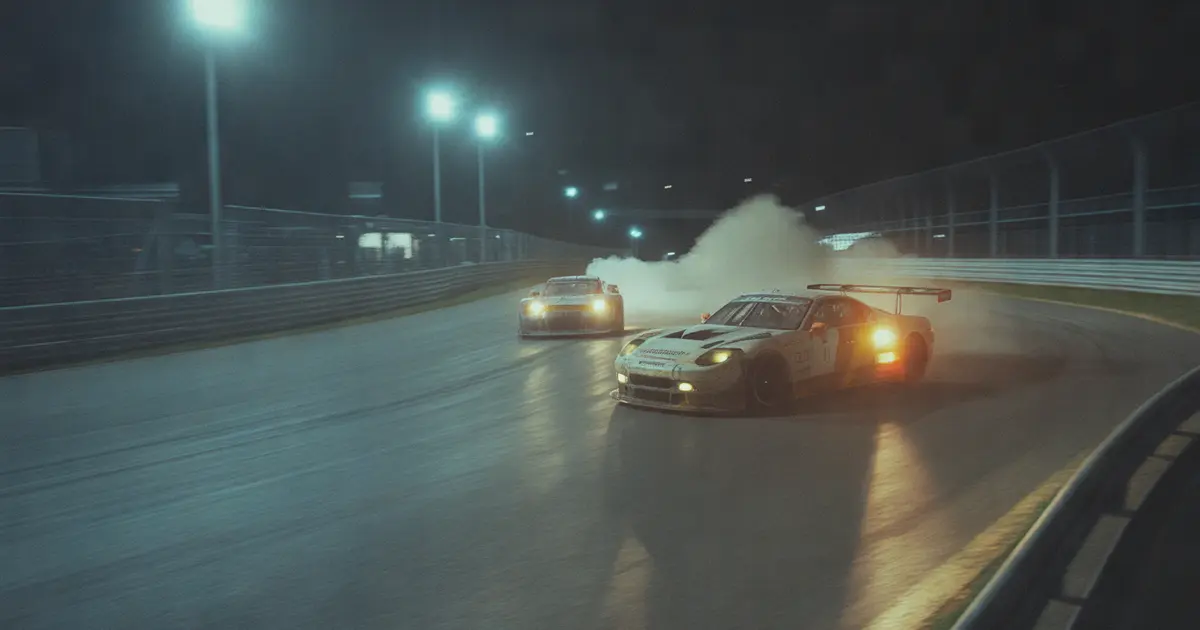
Sport Mode combines tires, fuel, traffic, and Safety Rating in the same lap — factors Time Trial never tests. See where the style changes and how to train for it.
The direct answer
Sport Mode calls for a different style because it combines tire wear, fuel management, traffic, and Safety Rating within the same lap — factors that Time Trial and offline practice never test. Driving fast alone trains the perfect lap; racing against eleven real cars trains the sustainable lap.
The gap isn’t subtle. It’s why a driver who’s fast in Time Trial can jump into Sport Mode and come out slower than before, without understanding why.
What offline practice never tests
In Time Trial, every lap stands alone: fresh tires, an empty track, no consequence for a mistake beyond your own lap time. In Sport Mode, five elements enter the equation at once:
- Tire degradation across the stint, which shifts your braking point and the traction window on corner exit.
- Fuel management, which decides whether you can push from start to finish or need to save pace.
- Traffic and dirty air, which strip away your visual reference and change your braking relative to the car ahead.
- Contact risk, which costs Safety Rating and can cost the entire race over one careless touch.
- Reading your rival, which forces real-time decisions between attacking and holding position.
None of these five show up in a Time Trial session. That’s why the style that works there doesn’t transfer on its own.
Solo practice vs racing: what changes
| Aspect | Practice / Time Trial | Sport Mode |
|---|---|---|
| Lap goal | Lowest possible time | Sustainable stint average |
| Tires | Always at peak | Degrade lap by lap |
| Fuel | Irrelevant | Decides when to push |
| Contact | Zero cost | Costs SR and position |
| Racing line | Single, optimized | Shifts with a car alongside |
Tires and fuel ask for a different rhythm
In Time Trial the tire never truly falls off. In Sport Mode it does, and the braking point that was perfect on lap 1 already needs adjusting by lap 5. Drivers who only train single laps learn to attack the limit of a fresh tire, not to manage the limit of a worn one.
That’s exactly the topic of tire management in a no-stop race: the right style is variable, not fixed. It starts more conservative, stabilizes mid-stint, and opens up room to attack again near the end, once fuel weighs less.
Traffic changes the line you trained alone
The ideal Time Trial line assumes an empty track. With a car alongside, it stops being ideal: dirty air shifts the braking point, a rival in the corner zone forces a more defensive trajectory, and overtaking means giving up a few tenths of the pure line in exchange for position.
This also shows up at the start, where your opening style has to shift on its own: how to avoid losing three positions in the first 200 meters deals with exactly this balance between driving fast and driving alongside other cars.
Safety Rating is part of your lap time
Offline, a mistake costs tenths. In Sport Mode, a touch costs SR, and low SR pushes you into rougher grids and worse races. That changes your braking decisions: entering the first wheel-to-wheel moment with a bit less confidence is faster over the weekend than risking an incident that tanks your safety rating.
A driver who’s fast in practice but slow in the race is almost always carrying Time Trial pace into Sport Mode without adjusting for tires, fuel, and risk.
Common mistake: taking your qualifying lap into the race
Qualifying in GT7 is also an isolated lap, fresh tires, no rival alongside. Carrying that same starting pace all the way to the finish is the most common mistake made by drivers who are already fast but never climb positions in Sport Mode.
- Simulate the whole stint in practice, not just single laps, to feel the real tire drop-off before the race.
- Separate your starting pace from your mid-race pace, because tires and fuel are no longer the same.
- Leave extra margin at the first contact-prone corner, since a mistake here costs SR, not just time.
- Treat SR as a performance metric, on the same level as lap time.
- Save your attack for the end of the stint, when the car is lighter and the tire has stabilized.
How to confirm this in your own data
The way to tell if you’re carrying practice pace into the race is to compare laps by phase: braking, rotation, and traction on lap 1 against lap 10 of the same stint. If the drop is sudden rather than gradual, your opening pace was too high for the tire to hold.
This kind of comparison is the starting point behind how to improve your GT7 lap time with telemetry: looking only at the final time isn’t enough, you need to see which phase of the corner is where the lap is losing time. Laptics captures your GT7 session automatically over the network, with no manual export, and compares laps by phase to show exactly where time went missing during the stint.
Another useful signal is the consistency between your best lap and your average lap during the race — the subject of how to reduce the gap between your best lap and your average lap. In Sport Mode, that gap matters more than a single isolated fast lap.
Practical summary
Separate your qualifying practice from your race practice: one chases the peak, the other chases the sustainable average. Review your data by stint, not by isolated lap, and treat contact risk as part of your lap time, not as a random incident.
Frequently asked questions
Why am I fast in Time Trial but lose positions in Sport Mode?
Because Time Trial never tests tire degradation, fuel, or traffic. The pace that works in an isolated lap is usually too high to sustain across an entire stint.
Should I only practice fast laps or simulate the whole race?
Both serve different purposes. Fast laps train the car’s limit; simulating the full stint trains the tire and fuel management Sport Mode demands.
Should Safety Rating change my braking style?
Yes. Contact costs SR and can cost the whole race, so it’s worth leaving a bit more margin in the first corners where real battles happen.
How do I know if I’m losing time to tire degradation?
Compare the braking, rotation, and traction of lap 1 with the same phases on a lap mid-stint. A sudden drop points to an opening pace that was too high for the tire.
Does the style adjustment change by car in GT7?
Yes. Cars with more rear degradation need a more conservative pace early in the stint; more stable cars tolerate steady attack for more laps.
Does Laptics work with GT7?
Yes. Capture happens automatically over the network during the session, with no manual export, and the analysis compares laps by corner phase.
Want to see this in your own telemetry?
Try Laptics for GT7