%20--%3e%3cdefs%3e%3cstyle%3e%20.st0%20{%20fill:%20%23ff1230;%20}%20.st1%20{%20fill:%20%23fff;%20}%20%3c/style%3e%3c/defs%3e%3cpath%20class='st0'%20d='M49.77,34.93l3.47-5.3,23.2-5.86,4.03-6.07-23.14,5.83,3.55-5.33,23.17-5.84,3.96-6.05-23.07,5.8,3.59-5.52-23.16,5.83,3.68-5.68-19.8,4.98c-2.49.63-4.65,2.16-6.07,4.3l-1.81,2.75,20-5.03c.7-.18,1.49-.1,1.75.21.21.25.09,1.12-.24,1.61l-1.85,2.7-19.34,4.87c-2.48.62-4.64,2.15-6.06,4.29l-1.82,2.75,20.12-5.04c.7-.18,1.53.11,1.64.48.09.31-.06,1.12-.4,1.6l-1.79,2.51-19.21,4.82c-2.51.63-4.69,2.19-6.11,4.36l-1.75,2.69,20.19-5.08c1.67-.25,1.96.77,1.1,2.08l-1.9,2.89,19.51-4.94c1.49-.38,2.88,0,1.87,1.62l-1.88,3.01,24.65-6.19,3.01-5.82-23.07,5.79ZM60.94,13.54c.53-.13,1.35.11,1.52.37.19.28-.02,1.14-.37,1.66l-1.73,2.56-22.57,5.67,3.51-5.31,19.64-4.95ZM30.19,35.24l3.49-5.33,19.75-4.95c1.34-.34,1.92.7,1.23,1.76l-1.83,2.83-22.65,5.7Z'/%3e%3cpath%20class='st1'%20d='M236.44,40.24l22.56-33.95h10.5l-22.56,33.95h-10.5Z'/%3e%3cpath%20class='st1'%20d='M368.54,15.18l5.9-8.88h-52.48l-5.64,8.49-3.45,5.19-5.01,7.54h0s40.4,0,40.4,0l-2.82,4.24h-72.13c-2.23,0-3.07-1.46-1.87-3.27l9.11-13.71h29.5l5.95-8.49h-40.31l-5.64,8.49-9.61,14.46c-.36.55-.67,1.08-.92,1.61-.15.31-.28.61-.39.9-1.52,4.06.3,7.25,4.69,8.2.48.1.99.18,1.54.23.44.04.9.06,1.38.06h85.14l8.46-12.73,5.24-7.89h-40.45l2.95-4.44h40.45Z'/%3e%3cpath%20class='st1'%20d='M198.16,6.32c-.19,0-.37-.03-.56-.03h-60.45l-37.03,26.63h-19.71l18.01-26.63h-10.5l-17.48,26.31c-2.17,3.27.17,7.64,4.09,7.64h28.01l37.22-25.46h6.27l-16.92,25.46h10.51l16.92-25.46h27.83l-.02.04h7.11c1.89.18,2.56,1.55,1.44,3.23l-1.3,1.96c-1.2,1.8-3.98,3.27-6.21,3.27h-25.26l-11.28,16.98h10.5l5.64-8.49h15.69c.48,0,.96-.02,1.45-.06.61-.05,1.22-.12,1.84-.23,5.65-.95,11.72-4.14,15.59-8.2.02-.02.04-.04.06-.06.74-.78,5.18-7.47,5.57-8.39h17.48l-16.94,25.49h10.51l16.94-25.49h14.98l5.65-8.5h-55.64Z'/%3e%3c/svg%3e)
Toyota GR86: What Changes vs the MX-5
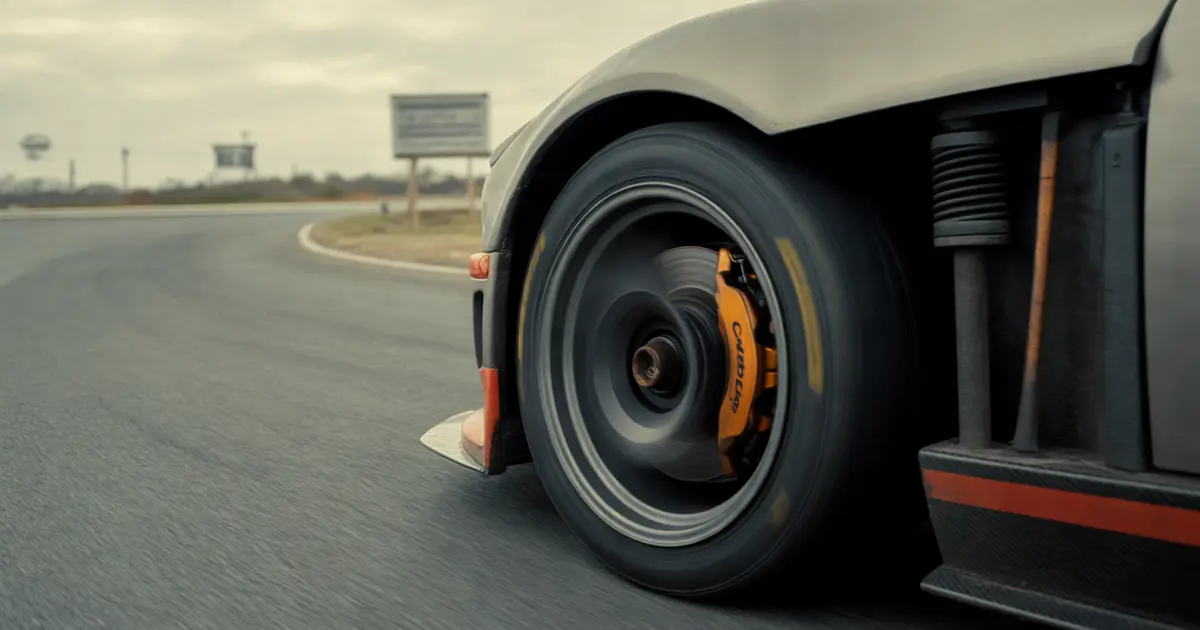
GR86 and MX-5 are the two most common rear-wheel-drive chassis in GT simracing. See what changes in weight, power, and the throttle window on exit.
The GR86 weighs more and delivers significantly more power than the MX-5, so the difference isn't about the corner itself — it's about the throttle window on exit and the anticipation of braking. The MX-5 forgives pedal mistakes because it has too little torque to break the rear end; the GR86 doesn't forgive, because it has more than enough power to do exactly that.
Both are rear-wheel drive, independent suspension, and narrow tires for the GT standard. But the GR86's greater mass changes load transfer in every phase, and that reshuffles where you gain and where you lose time.
The core difference: weight and power, not the track layout
The MX-5 runs light and with little power. Its limit is traction in slow corners and essentially zero aerodynamic efficiency — almost everything is mechanical. The GR86, on the other hand, has a more robust boxer engine, more weight over the axle, and more horsepower to manage on exit.
This means the same mistake costs different time in each car. Accelerating too early in the MX-5 costs rhythm. Accelerating too early in the GR86 costs the rear end.
Braking: the point isn't the same
More mass braking means more braking distance and more load transfer to the front axle. In the GR86 you need to start braking a little earlier than you would in the MX-5 for the same corner, because the car's inertia pushes the rotation point further forward.
That doesn't mean braking harder — it means braking with more anticipation and releasing the pedal more progressively, because the incoming front load is greater. To see this in the data, it's worth comparing the braking point against a reference and checking whether the delta shows up before or after trail braking.
Corner exit: the throttle window gets narrower
In the MX-5, the throttle tolerates a quick opening because there isn't enough torque to break rear grip in most slow corners. In the GR86 that tolerance drops. The opening needs to be more gradual, especially in tight-radius corners where the car is still rotating.
This is the most visible adjustment for anyone switching from one car to the other: the foot that worked in the MX-5 generates power oversteer in the GR86.
- Exit modulation: in the GR86, full throttle needs to wait until the car is more aligned, because excess torque in a corner that isn't yet straightened out breaks the rear end.
- Brake anticipation: the GR86's greater mass requires starting the brake a bit earlier to keep the same rotation point as the MX-5.
- Load transfer: the GR86 carries more weight on the front axle under heavy braking, which changes the feeling of available grip on entry.
- Grip in fast corners: the GR86's wider tire sustains higher mid-corner speed, but that only shows up if the load transition is smooth.
Direct comparison
| Characteristic | MX-5 | GR86 |
|---|---|---|
| Power | Low | High |
| Weight | Light | Heavier |
| Main limit | Traction in slow corners | Throttle management on exit |
The common mistake in the transition
Anyone who has driven the MX-5 a lot tends to bring the same foot pattern to the GR86: throttle open early, because in the MX-5 that almost never cost anything. In the GR86 this habit shows up in the data as recurring power oversteer in the same corners, usually the tight-radius ones or those with an uphill exit.
The way to confirm this isn't a feeling, it's the throttle channel crossed with the steering channel. If full opening happens before the wheel is nearly centered, the car is being asked to do two things at once — rotate and put down power — and that's where the rear end lets go.
This same reasoning applies to anyone who has already studied how to gain time in the MX-5 without relying on power: the principle of smoothness still holds, only the margin for error gets smaller.
Where this shows up in the lap
Compare the two laps by corner phase, not by total time. Braking, mid-corner, and exit carry different weights in each car, and a gain on the GR86's exit might hide a loss on entry that you wouldn't notice just looking at the stopwatch.
- Isolate the exit phase: look at the throttle channel from the minimum speed point to full opening, and note at what steering angle this happens.
- Compare against a reference lap: if another driver opens the throttle with the wheel straighter, measure how many degrees of difference exist in your case.
- Adjust one detail at a time: delay full opening in a specific corner and see if lap time improves before generalizing to the whole track.
- Repeat for braking: if the brake point hasn't changed from the MX-5 to the GR86, you're probably braking too late for the car's weight.
The more powerful car doesn't forgive the same foot that worked in the lighter car — technique has to change along with the machine.
How to validate this in your data
To confirm whether the problem is really early throttle opening, you need to see the throttle and steering channels side by side, phase by phase, not just the time delta. Laptics' AI analysis compares your laps in the GR86 and the MX-5 and shows exactly which phase of the corner cost time in each gesture, including the exact moment the throttle opens relative to steering angle.
This also helps separate driving habit from the car's limit — something similar to what's discussed in why the loss is usually in the rotation phase and not in braking.
Practical summary
GR86 and MX-5 share rear-wheel-drive geometry, but weight and power change the margin for error in every phase. Treat the GR86 with more brake anticipation and more patience on the throttle, and check the data to see if your foot is still calibrated for the lighter car.
Frequently asked questions
Is the GR86 faster than the MX-5 on a lap?
Generally yes, due to more power and a wider tire, but the driving limit changes: the GR86 requires more precision on exit to not lose the gain to power oversteer.
Does trail braking technique change between the two cars?
The principle is the same, but the proportion changes: the heavier GR86 needs a slightly more gradual brake release because of the greater load transferred to the front.
Why do I get oversteer in the GR86 that I never had in the MX-5?
It's usually throttle opening too early while the car is still rotating. In the MX-5 this doesn't break the rear end due to lack of torque; in the GR86, it does.
Does the base setup change a lot between GR86 and MX-5?
The setup principles are similar, but the absolute values change due to the different weight and power; it's worth reviewing the four main adjustments with every car change.
Is it worth training in the MX-5 before moving to the GR86?
It helps build smooth inputs, but it doesn't replace specific training for the GR86's throttle window, which is narrower.
How do I know if I'm braking late in the GR86?
Compare your braking point against a reliable reference in the same corner; if the point hasn't changed from the MX-5, you're probably braking late for the GR86's weight.
Want to see this in your own telemetry?
Compare my GR86 and MX-5 laps