%20--%3e%3cdefs%3e%3cstyle%3e%20.st0%20{%20fill:%20%23ff1230;%20}%20.st1%20{%20fill:%20%23fff;%20}%20%3c/style%3e%3c/defs%3e%3cpath%20class='st0'%20d='M49.77,34.93l3.47-5.3,23.2-5.86,4.03-6.07-23.14,5.83,3.55-5.33,23.17-5.84,3.96-6.05-23.07,5.8,3.59-5.52-23.16,5.83,3.68-5.68-19.8,4.98c-2.49.63-4.65,2.16-6.07,4.3l-1.81,2.75,20-5.03c.7-.18,1.49-.1,1.75.21.21.25.09,1.12-.24,1.61l-1.85,2.7-19.34,4.87c-2.48.62-4.64,2.15-6.06,4.29l-1.82,2.75,20.12-5.04c.7-.18,1.53.11,1.64.48.09.31-.06,1.12-.4,1.6l-1.79,2.51-19.21,4.82c-2.51.63-4.69,2.19-6.11,4.36l-1.75,2.69,20.19-5.08c1.67-.25,1.96.77,1.1,2.08l-1.9,2.89,19.51-4.94c1.49-.38,2.88,0,1.87,1.62l-1.88,3.01,24.65-6.19,3.01-5.82-23.07,5.79ZM60.94,13.54c.53-.13,1.35.11,1.52.37.19.28-.02,1.14-.37,1.66l-1.73,2.56-22.57,5.67,3.51-5.31,19.64-4.95ZM30.19,35.24l3.49-5.33,19.75-4.95c1.34-.34,1.92.7,1.23,1.76l-1.83,2.83-22.65,5.7Z'/%3e%3cpath%20class='st1'%20d='M236.44,40.24l22.56-33.95h10.5l-22.56,33.95h-10.5Z'/%3e%3cpath%20class='st1'%20d='M368.54,15.18l5.9-8.88h-52.48l-5.64,8.49-3.45,5.19-5.01,7.54h0s40.4,0,40.4,0l-2.82,4.24h-72.13c-2.23,0-3.07-1.46-1.87-3.27l9.11-13.71h29.5l5.95-8.49h-40.31l-5.64,8.49-9.61,14.46c-.36.55-.67,1.08-.92,1.61-.15.31-.28.61-.39.9-1.52,4.06.3,7.25,4.69,8.2.48.1.99.18,1.54.23.44.04.9.06,1.38.06h85.14l8.46-12.73,5.24-7.89h-40.45l2.95-4.44h40.45Z'/%3e%3cpath%20class='st1'%20d='M198.16,6.32c-.19,0-.37-.03-.56-.03h-60.45l-37.03,26.63h-19.71l18.01-26.63h-10.5l-17.48,26.31c-2.17,3.27.17,7.64,4.09,7.64h28.01l37.22-25.46h6.27l-16.92,25.46h10.51l16.92-25.46h27.83l-.02.04h7.11c1.89.18,2.56,1.55,1.44,3.23l-1.3,1.96c-1.2,1.8-3.98,3.27-6.21,3.27h-25.26l-11.28,16.98h10.5l5.64-8.49h15.69c.48,0,.96-.02,1.45-.06.61-.05,1.22-.12,1.84-.23,5.65-.95,11.72-4.14,15.59-8.2.02-.02.04-.04.06-.06.74-.78,5.18-7.47,5.57-8.39h17.48l-16.94,25.49h10.51l16.94-25.49h14.98l5.65-8.5h-55.64Z'/%3e%3c/svg%3e)
Goiânia: the 180-degree corner that defines lap time
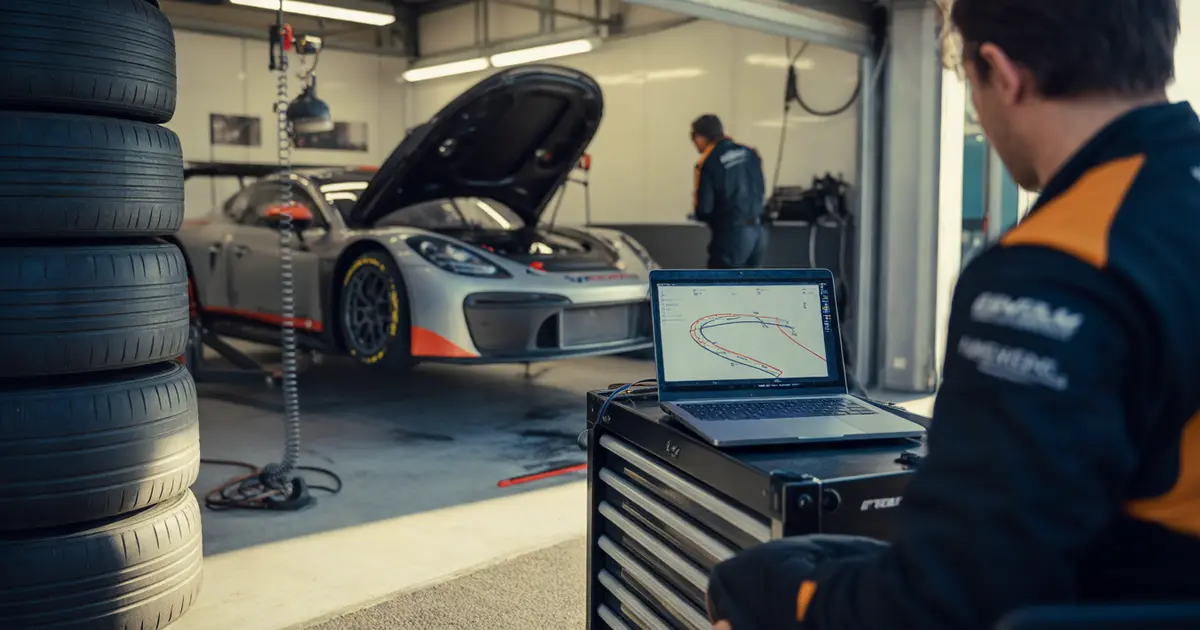
At the Goiânia circuit, the 180-degree hairpin packs braking, minimum radius, and exit traction into a single corner. Understand where time escapes and how to train this specific phase.
Goiânia’s 180-degree corner defines the lap time because it’s the only point on the track where hard braking, a minimum radius, and exit traction happen in sequence, with no breathing room between phases. Getting any one of the three wrong costs more time there than in any other corner on the circuit.
This isn’t an opinion about the track. It’s a consequence of the layout: the hairpin comes right after a fast section and feeds straight into a long straight. Whatever you do in those few seconds multiplies all the way to the next braking zone.
Why this corner concentrates so much time
In normal corners, a braking mistake and a traction mistake are separate problems. In Goiânia’s hairpin they’re the same problem: the wrong entry speed already compromises the radius, and the wrong radius already compromises exit traction.
This explains why drivers with similar lap times can have completely different diagnoses in this corner. One loses on entry, another loses on exit, and the stopwatch shows the same penalty.
The three phases that decide the outcome
Splitting the corner into phases helps you see where time actually escapes, instead of treating “the hairpin” as a single block.
- 1Braking
Speed loss before the minimum radius; brake point is sensitive due to the fast entry.
- 2Rotation
Turning mid-corner; steering applied too early disguises understeer as a normal corner.
- 3Traction
Throttle pickup that feeds the main straight and amplifies any delay.
Braking
The brake point here is more sensitive than in fast corners because the car enters at high speed and needs to shed a lot of it before the minimum radius. Braking too early leaves time on the table; braking too late forces a rear correction mid-corner.
Rotation
This is the phase most easily missed. The car turns, but it turns slowly — and the driver compensates with more steering, not less brake. The result is understeer disguised as a “normal” corner. To understand this specific pattern, it’s worth reviewing why you lose time in the rotation phase and not in braking.
Exit traction
Since the hairpin’s exit feeds the main straight, any delay in getting on the throttle multiplies over hundreds of meters. This phase is where lost time becomes most visible on the clock, even when the cause lies further back, at the entry.
Where the most common mistake shows up
The three mistakes below feel similar behind the wheel, but have different causes in the data.
| Symptom | Likely cause | Affected phase |
|---|---|---|
| Car “pushes” mid-corner | Steering applied too early relative to speed | Rotation |
| Rear steps out on brake release | Brake release too fast for the steering applied | Entry/mid-corner |
| Main straight always slower than expected | Throttle applied late or too progressively | Exit |
If the symptom is a loose rear on pedal release, the problem usually isn’t the brake itself, but the ratio between brake release and steering input. This is the classic case covered in how to release the brake in proportion to the steering.
Setup changes that affect behavior there
Before touching setup, confirm the mistake is a technique issue, not a car issue. That said, some changes matter more in this corner than elsewhere on the track:
- Brake balance further rearward helps rotate the car on entry, but increases the risk of instability on release if the driver doesn’t adjust accordingly.
- Softer front anti-roll bar gives more rotation mechanics mid-corner, useful when the symptom is persistent understeer in the rotation phase.
- Differential with more power lock delivers more predictable exit traction, at the cost of some rotation on corner entry.
- Rear tire pressure outside the operating window explains symptoms that look like setup issues but are actually temperature issues — worth checking before any other change.
Setup compensates for a tendency, it doesn’t replace technique. If the mistake is in the input, changing setup just moves the symptom to another phase of the corner.
How to deliberately train this corner
Training “the whole lap” at Goiânia dilutes your focus. For this specific corner, a short routine works better:
- Isolate the entry by doing five to eight laps just watching the brake point and the corner’s minimum speed, without worrying about the rest of the track.
- Test two brake points — one earlier, one later — and compare the minimum speed reached at each, not just the lap time.
- Lock in the brake point that gave the lowest minimum speed without instability and start varying only the pedal release.
- Mark the throttle point in meters before the apex and try to bring it forward in small increments, backing off if the rear reacts.
- Go back to the full lap only after the exit is consistent for at least five laps in a row.
This kind of isolated training is more efficient than repeating the whole track without a hypothesis to test. The full method is detailed in how to apply deliberate practice in real sim racing.
How to confirm in the data what’s costing you time
Feeling where you lose time and measuring where you lose time are different things. The sensation of “I rotated well” doesn’t confirm the radius you actually took, or the real steering angle.
Laptics’ corner-phase analysis compares your laps and shows, across braking, rotation, and exit, how much time each input cost you in this specific hairpin — without requiring you to export anything, since capture happens automatically while you drive.
In a corner that mixes braking, minimum radius, and traction in the same sequence, the gain doesn’t come from driving “harder”. It comes from knowing which of the three phases is actually costing you time before training the next one.
If the question is broader — which corner on the track weighs most on total lap time, not just the hairpin — the diagnosis starts in how to know exactly which corner is costing you the most time on your lap.
Practical summary
Goiânia’s 180-degree corner punishes any mistake in a chain reaction: bad braking becomes bad rotation, which becomes bad exit. Train the three phases separately, confirm in the data which one is your biggest loss, and only then adjust setup.
Frequently asked questions
Why does Goiânia’s hairpin cost more time than other corners on the track?
Because braking, minimum radius, and exit traction happen there in direct sequence, and the exit feeds the main straight. A mistake in any phase multiplies through the other two.
Is it better to brake earlier or later in this corner?
It depends on the minimum corner speed you can hold without instability. Test both points and compare the speed at the apex, not just the lap time.
Does changing the brake balance fix understeer in this corner?
It can help, but first confirm whether the understeer comes from steering applied too early. Setup compensates for a tendency, it doesn’t fix a wrong input.
How do I know if I’m losing time on entry or exit in this corner?
By comparing the minimum corner speed between laps and the point where the throttle is reapplied. Phase-by-phase telemetry data shows this more precisely than the feel of driving.
Is it worth training just this corner in isolation?
Yes, especially when the mistake shifts phase from lap to lap. Isolating the corner keeps the rest of the track from diluting your training focus.
Does rear tire pressure affect behavior in this specific corner?
Yes, because exit traction depends on the rear tire’s operating temperature. Pressure outside the ideal window can look like a setup problem when it’s actually a temperature problem.
Want to see this in your own telemetry?
Analyze my telemetry at Goiânia