%20--%3e%3cdefs%3e%3cstyle%3e%20.st0%20{%20fill:%20%23ff1230;%20}%20.st1%20{%20fill:%20%23fff;%20}%20%3c/style%3e%3c/defs%3e%3cpath%20class='st0'%20d='M49.77,34.93l3.47-5.3,23.2-5.86,4.03-6.07-23.14,5.83,3.55-5.33,23.17-5.84,3.96-6.05-23.07,5.8,3.59-5.52-23.16,5.83,3.68-5.68-19.8,4.98c-2.49.63-4.65,2.16-6.07,4.3l-1.81,2.75,20-5.03c.7-.18,1.49-.1,1.75.21.21.25.09,1.12-.24,1.61l-1.85,2.7-19.34,4.87c-2.48.62-4.64,2.15-6.06,4.29l-1.82,2.75,20.12-5.04c.7-.18,1.53.11,1.64.48.09.31-.06,1.12-.4,1.6l-1.79,2.51-19.21,4.82c-2.51.63-4.69,2.19-6.11,4.36l-1.75,2.69,20.19-5.08c1.67-.25,1.96.77,1.1,2.08l-1.9,2.89,19.51-4.94c1.49-.38,2.88,0,1.87,1.62l-1.88,3.01,24.65-6.19,3.01-5.82-23.07,5.79ZM60.94,13.54c.53-.13,1.35.11,1.52.37.19.28-.02,1.14-.37,1.66l-1.73,2.56-22.57,5.67,3.51-5.31,19.64-4.95ZM30.19,35.24l3.49-5.33,19.75-4.95c1.34-.34,1.92.7,1.23,1.76l-1.83,2.83-22.65,5.7Z'/%3e%3cpath%20class='st1'%20d='M236.44,40.24l22.56-33.95h10.5l-22.56,33.95h-10.5Z'/%3e%3cpath%20class='st1'%20d='M368.54,15.18l5.9-8.88h-52.48l-5.64,8.49-3.45,5.19-5.01,7.54h0s40.4,0,40.4,0l-2.82,4.24h-72.13c-2.23,0-3.07-1.46-1.87-3.27l9.11-13.71h29.5l5.95-8.49h-40.31l-5.64,8.49-9.61,14.46c-.36.55-.67,1.08-.92,1.61-.15.31-.28.61-.39.9-1.52,4.06.3,7.25,4.69,8.2.48.1.99.18,1.54.23.44.04.9.06,1.38.06h85.14l8.46-12.73,5.24-7.89h-40.45l2.95-4.44h40.45Z'/%3e%3cpath%20class='st1'%20d='M198.16,6.32c-.19,0-.37-.03-.56-.03h-60.45l-37.03,26.63h-19.71l18.01-26.63h-10.5l-17.48,26.31c-2.17,3.27.17,7.64,4.09,7.64h28.01l37.22-25.46h6.27l-16.92,25.46h10.51l16.92-25.46h27.83l-.02.04h7.11c1.89.18,2.56,1.55,1.44,3.23l-1.3,1.96c-1.2,1.8-3.98,3.27-6.21,3.27h-25.26l-11.28,16.98h10.5l5.64-8.49h15.69c.48,0,.96-.02,1.45-.06.61-.05,1.22-.12,1.84-.23,5.65-.95,11.72-4.14,15.59-8.2.02-.02.04-.04.06-.06.74-.78,5.18-7.47,5.57-8.39h17.48l-16.94,25.49h10.51l16.94-25.49h14.98l5.65-8.5h-55.64Z'/%3e%3c/svg%3e)
MX-5: How to Use the Draft in a Full-Grid Race
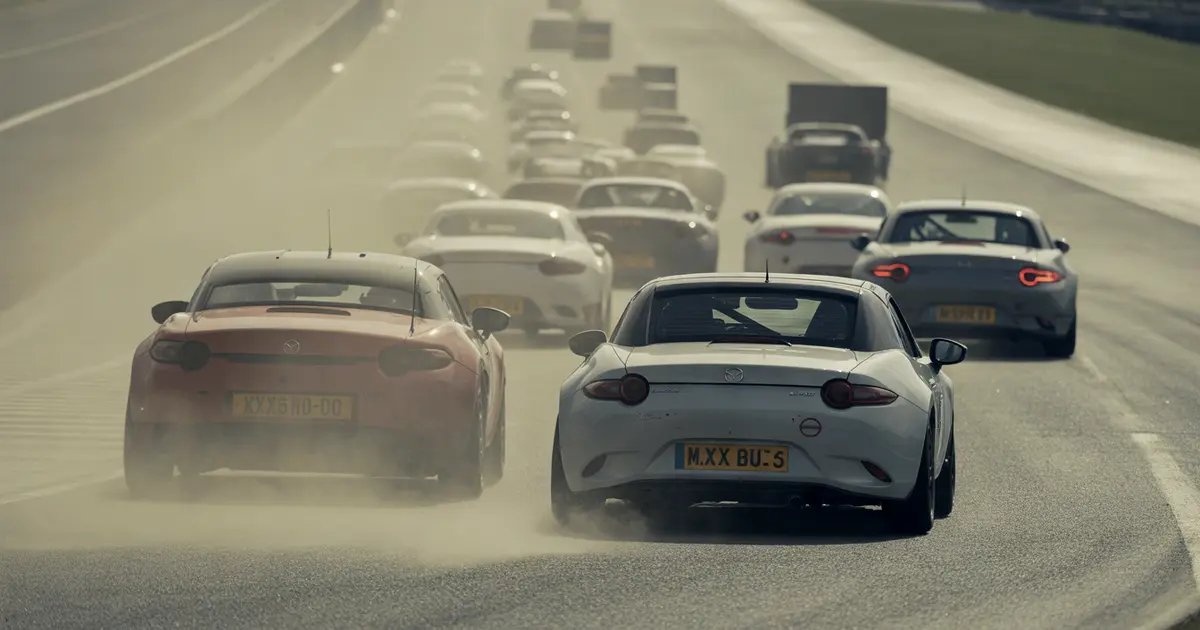
In the MX-5, the draft matters more than in any GT3: power is low and drag weighs proportionally more. See where to tuck in, when to pull out, and the mistake that costs you a position in a full grid.
Draft matters more in the MX-5 than in any GT3 because power is low and aerodynamic drag weighs proportionally more at top speed. Tucking in behind the car ahead on a long straight can push your car above the speed range the engine alone would deliver — but it only works if you know when to leave the tow and when it turns into contact risk.
Why the draft matters more in this car
The MX-5 has little power and little downforce. Air resistance dominates straight-line time in a way that doesn’t happen in a 500-horsepower car with a big wing. Taking that drag off your shoulders, even for two or three seconds, changes your entry speed into the next corner.
In GT3 the draft helps you overtake. In the MX-5 it helps you avoid losing a position just from being isolated on track. Running alone in this car, in a full grid, means giving up an advantage that is available for free.
Where the gain really shows up
It is not on just any straight. The gain is bigger on long straights, where the car behind has time to convert clean air into real speed before the next braking point.
- Main straight: this is where the draft returns the most lap time, because the speed difference builds up longer before the braking point.
- Slow-corner exit followed by a straight: tucking in on exit and holding the tow through initial acceleration makes up for the traction this car lacks, a topic also covered in why you lose time on slow-corner exits.
- Short straights between fast corners: the gain exists, but it is too small to justify drafting too close before a braking zone.
The full-grid problem: dirty air in corners
Draft on a straight helps. Draft inside a corner does not. With several MX-5s close together, the dirty air from the car ahead arrives loose in the next corner and takes a bit of balance away from yours, even without much downforce at stake — the effect is more about rear stability than aerodynamic load.
This is different from what happens in a GT3, where dirty air measurably steals downforce. In the MX-5 the effect is subtler, but it shows up as a loose rear an instant before the apex, right after you have left the tow.
How to position the car in the draft
- Enter the straight already aligned: do not correct your lateral line behind the car ahead, because that pulls you out of the center of the tow and gives back some of the drag.
- Stay in the tow until halfway down the straight: the goal is gaining speed without spending extra throttle; leaving too early gives the gain back.
- Leave the tow before the braking point: braking inside the dirty-air cone of the car ahead changes pedal feel and pushes your braking point back without warning.
- Decide the overtake with a full car-length margin: in a full grid, with several MX-5s close together, any last-second decision turns into side contact.
- Check your mirror again as soon as you leave the tow: whoever was coming up behind you was drafting too, and may be faster than they look.
Common mistake: staying too long and losing the window
The most common mistake in a full grid is not using too little draft. It is staying in the draft too long and losing the clean braking window. The driver gains speed on the straight but arrives at the corner without a braking reference, because the air from the car ahead changed pedal feel in the final third.
This shows up in the data as a later-than-normal braking point, followed by a bigger brake spike to compensate. If this repeats every time you are in the draft, the problem is not the corner: it is the moment you let go of the tow.
Draft earns time on the straight. What decides the position is the instant you leave it before braking.
Symptom vs. cause
| Symptom | Likely cause |
|---|---|
| Late brake and bigger spike | Left the tow too late |
| Loose rear at the next apex | Corner dirty air, not straight-line dirty air |
| Gained the straight but lost the corner | Corrected lateral line inside the tow |
How to validate it in the data
Compare speed on the same straight across two laps: one where you were drafting and one where you ran isolated. The difference shows how much the draft was actually worth on that specific stretch, car, and track — there is no fixed number that applies to every grid.
Also look at the braking point right after the tow ends. If it varies lap to lap with no relation to side traffic, the adjustment is in the moment you leave the dirty air, not in the setup.
Anyone who already uses corner-phase analysis knows this kind of comparison gets clearer by looking at where each lap loses and gains time, rather than looking at the whole lap at once — it is the same reasoning behind how to compare two of your laps without opening a spreadsheet.
Start and restarts count too
A full MX-5 grid usually means a tight start and frequent restarts after a yellow flag. The draft in the first few meters decides who gets ahead of the pack and who stays stuck behind a train of identical cars, a subject covered in restart after a yellow flag and where the positions are.
In the first 200 meters the mistake is not about draft, it is about lateral positioning before the first corner, as described in start: how not to lose three positions in the first 200 meters.
Where Laptics comes in
Laptics’ corner-phase analysis shows at which point of the lap braking time changed between a drafting lap and an isolated lap. You can compare both sessions without building a spreadsheet, and see whether the brake delay in the draft is systematic or occasional.
Practical summary
In the MX-5, draft is a straight-line tool, not a cornering one. Tuck in early, hold your line, leave before braking, and decide overtakes with margin. If your braking point shifts every time you are in the draft, that is tomorrow’s practice focus, not the setup.
Frequently asked questions
Does draft pay off more in the MX-5 than in a GT3?
Proportionally yes, because power is low and air drag weighs more at top speed. The absolute gain depends on the straight and how closely you managed to draft.
What is the best straight to use the draft on in the MX-5?
The main straight and any long straight after a slow corner pay off most, because they give time to convert clean air into speed before the next braking point.
Why do I brake later when I am in the draft and miss the corner?
The dirty air from the car ahead changes pedal feel near corner entry. The fix is leaving the tow before the braking point, not moving the braking point itself.
Does draft help in corners in the MX-5?
Not the same way it does on a straight. Inside a corner, dirty air tends to loosen the rear near the apex, even though the car has little downforce.
How do I know if I am leaving the draft too early or too late?
Compare the braking point of the same corner on laps with and without nearby traffic. If it varies a lot lap to lap, you are deciding when to leave the tow at the last second.
Does draft help save tires and brakes in the MX-5?
Yes, less engine effort on the straight slightly reduces overall thermal load, but the main, measurable effect is on entry speed into the next corner.
Does Laptics show the draft effect in telemetry?
Corner-phase analysis compares laps and shows where the braking point changed, which helps reveal whether the delay in the draft is systematic.
Want to see this in your own telemetry?
Explore Laptics