%20--%3e%3cdefs%3e%3cstyle%3e%20.st0%20{%20fill:%20%23ff1230;%20}%20.st1%20{%20fill:%20%23fff;%20}%20%3c/style%3e%3c/defs%3e%3cpath%20class='st0'%20d='M49.77,34.93l3.47-5.3,23.2-5.86,4.03-6.07-23.14,5.83,3.55-5.33,23.17-5.84,3.96-6.05-23.07,5.8,3.59-5.52-23.16,5.83,3.68-5.68-19.8,4.98c-2.49.63-4.65,2.16-6.07,4.3l-1.81,2.75,20-5.03c.7-.18,1.49-.1,1.75.21.21.25.09,1.12-.24,1.61l-1.85,2.7-19.34,4.87c-2.48.62-4.64,2.15-6.06,4.29l-1.82,2.75,20.12-5.04c.7-.18,1.53.11,1.64.48.09.31-.06,1.12-.4,1.6l-1.79,2.51-19.21,4.82c-2.51.63-4.69,2.19-6.11,4.36l-1.75,2.69,20.19-5.08c1.67-.25,1.96.77,1.1,2.08l-1.9,2.89,19.51-4.94c1.49-.38,2.88,0,1.87,1.62l-1.88,3.01,24.65-6.19,3.01-5.82-23.07,5.79ZM60.94,13.54c.53-.13,1.35.11,1.52.37.19.28-.02,1.14-.37,1.66l-1.73,2.56-22.57,5.67,3.51-5.31,19.64-4.95ZM30.19,35.24l3.49-5.33,19.75-4.95c1.34-.34,1.92.7,1.23,1.76l-1.83,2.83-22.65,5.7Z'/%3e%3cpath%20class='st1'%20d='M236.44,40.24l22.56-33.95h10.5l-22.56,33.95h-10.5Z'/%3e%3cpath%20class='st1'%20d='M368.54,15.18l5.9-8.88h-52.48l-5.64,8.49-3.45,5.19-5.01,7.54h0s40.4,0,40.4,0l-2.82,4.24h-72.13c-2.23,0-3.07-1.46-1.87-3.27l9.11-13.71h29.5l5.95-8.49h-40.31l-5.64,8.49-9.61,14.46c-.36.55-.67,1.08-.92,1.61-.15.31-.28.61-.39.9-1.52,4.06.3,7.25,4.69,8.2.48.1.99.18,1.54.23.44.04.9.06,1.38.06h85.14l8.46-12.73,5.24-7.89h-40.45l2.95-4.44h40.45Z'/%3e%3cpath%20class='st1'%20d='M198.16,6.32c-.19,0-.37-.03-.56-.03h-60.45l-37.03,26.63h-19.71l18.01-26.63h-10.5l-17.48,26.31c-2.17,3.27.17,7.64,4.09,7.64h28.01l37.22-25.46h6.27l-16.92,25.46h10.51l16.92-25.46h27.83l-.02.04h7.11c1.89.18,2.56,1.55,1.44,3.23l-1.3,1.96c-1.2,1.8-3.98,3.27-6.21,3.27h-25.26l-11.28,16.98h10.5l5.64-8.49h15.69c.48,0,.96-.02,1.45-.06.61-.05,1.22-.12,1.84-.23,5.65-.95,11.72-4.14,15.59-8.2.02-.02.04-.04.06-.06.74-.78,5.18-7.47,5.57-8.39h17.48l-16.94,25.49h10.51l16.94-25.49h14.98l5.65-8.5h-55.64Z'/%3e%3c/svg%3e)
How to Set Stint Duration in a 6-Hour Race
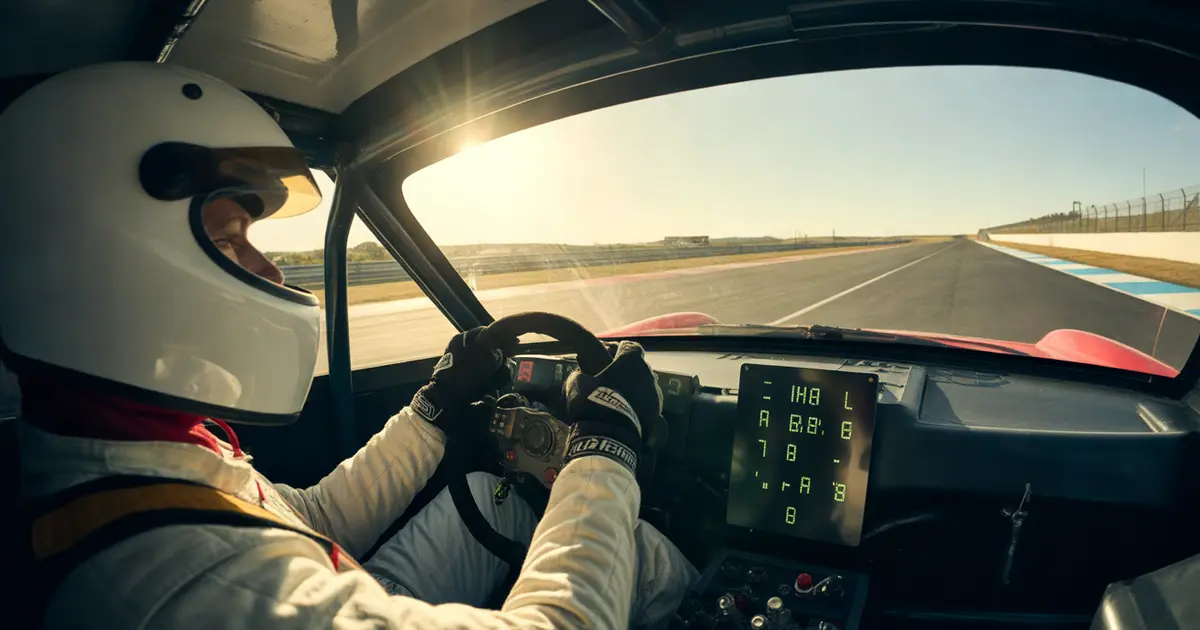
Stint duration isn’t a fixed number of minutes. It’s the smallest of three limits: fuel, tires, and fatigue. See how to find out which one decides in your car.
Stint duration in a 6-hour race is defined by the smallest of three limits: fuel range, tire life, and driver fatigue. In practice, one of these three cuts the stint short before the other two — and the job of preparation is to find out which one, for your car and for your track.
That changes the question. Instead of asking “how many minutes does a stint last”, the right question is “what will force me to stop first”. The answer changes by car, by tire compound, and by track temperature.
Fuel is the ceiling, not the target
The fuel calculation gives you the maximum limit: average consumption per lap, tank capacity, safety margin for a safety car. That’s simple arithmetic, and most drivers already do it well.
The mistake is treating that number as the real stint duration. It’s a ceiling. If the tire or the body can’t hold out long enough to reach it, fuel never becomes the deciding factor — it only defines how far you could go, not how far you should go.
Tires: when they cut before the tank does
In a GT3 car with a medium compound, on an abrasive track with strong track evolution, tires usually cut the stint short before fuel does. The symptom is a consistent drop in pace, not an isolated mistake.
To tell the two apart, look at the lap-time trace within the stint: if the curve drops gradually and steadily, it’s tire degradation. If it drops and comes back, it’s a driving error or traffic. This kind of reading becomes clearer when you compare it with how to make tires last without losing lap time against what you’re measuring in your own session.
Pressure and temperature change the math
The tire window isn’t fixed between tracks or even between sessions on the same weekend. A hotter track shrinks the window; badly set pressure at the start of the stint speeds up the drop-off. It’s worth reviewing how to adjust tire pressure for operating temperature before locking in the stint duration in the team’s plan.
Fatigue: the factor the spreadsheet won’t show
Fuel and tires are objective data. Fatigue doesn’t show up on any telemetry graph — but it shows up in lap time, with a delay.
The classic sign is a braking mistake that wasn’t there in the stint’s early laps: a later brake point, an isolated lock-up, running off at a corner that had been clean for an hour. That’s fatigue, not tire degradation.
If you’re racing a 6-hour event solo, fatigue enters the stint-planning equation the same way it does in a relay-style race — except without the option of swapping drivers.
How to build the real stint window
- Calculate the fuel ceiling using average consumption from clean race laps, not from a qualifying lap.
- Run a reference stint in race setup until the tire actually drops off, even if that means stopping before the tank runs dry.
- Mark where the pace drops consistently, not where you made a single mistake; that’s the real tire window.
- Compare it with your attention limit, noting from which lap braking errors start reappearing.
- Use the smallest of the three numbers as the default stint duration, with a safety margin for a safety car.
Common mistakes when setting the stint
- Copying another car’s window: tire degradation and consumption vary by model and compound, so another team’s number rarely fits.
- Ignoring track evolution: a track that gains grip over the session changes the pace possible within the same stint; see how this plays out in preparing for your first endurance race.
- Setting the stint by the best moment: using the fastest lap as a consumption reference leaves fuel short at the end of the race.
- Not testing the full stint in practice: without running the entire window before the race, real tire degradation only shows up when it’s too late to adjust strategy.
Symptom in the data vs. likely cause
| Symptom | Most likely cause |
|---|---|
| Gradual, steady drop | Tire degradation |
| Isolated mistake, then normal again | Traffic or one-off lapse |
| Later braking every lap | Driver fatigue |
The ideal stint isn’t the longest the car can take. It’s the longest you can repeat without losing pace.
How to validate this with data, not guesswork
Setting stint length by feel costs positions in the second half of the race. The way to validate it is comparing lap-by-lap pace within the same stint and isolating exactly where the drop begins.
Laptics records telemetry automatically during the session — in iRacing, Assetto Corsa, and ACC on PC, and in Gran Turismo 7 and F1 25 over the network — and its AI analysis shows, phase by phase of the lap, where time is being lost within the stint. This helps separate tire degradation from driving error without relying on a manual spreadsheet. For teams, it’s worth aligning this with the driver-swap procedure agreed with the team, since the stint window changes depending on who’s in the car.
Practical summary
Calculate the fuel ceiling, test the full stint until the tire really drops off, and mark the lap from which your own attention starts to fail. Use the smallest of the three numbers to set the default duration, with margin for the unexpected.
Frequently asked questions
Which factor usually decides stint duration first?
It depends on the car and track, but in GT3 cars on an abrasive track with a medium compound, tires usually cut the stint short before fuel does. In lighter cars with durable tires, driver fatigue may decide first.
Should I calculate the stint from the fastest lap or the average?
From the average of clean race laps, never from a qualifying lap. Using the fastest lap as a consumption reference leaves the tank short at the end of the stint.
How do I tell a pace drop caused by tires from one caused by fatigue?
Tire degradation shows up as a gradual, steady drop in lap time. Fatigue shows up as a specific braking mistake that wasn’t there in the early laps.
Does the stint window change between sessions on the same weekend?
Yes. Track temperature and grip evolution change tire degradation, so the window tested in practice may not hold the same way in the race.
Is it worth using the same stint duration as another team or car?
Not recommended. Consumption and degradation vary by car model and tire compound, so copying a ready-made number usually produces a stint longer or shorter than what’s safe.
Do I need to test the full stint before the race?
Yes, at least once. Without running the complete window in practice, the real pace drop only shows up during the race, when it’s too late to adjust strategy.
Want to see this in your own telemetry?
Discover Laptics