%20--%3e%3cdefs%3e%3cstyle%3e%20.st0%20{%20fill:%20%23ff1230;%20}%20.st1%20{%20fill:%20%23fff;%20}%20%3c/style%3e%3c/defs%3e%3cpath%20class='st0'%20d='M49.77,34.93l3.47-5.3,23.2-5.86,4.03-6.07-23.14,5.83,3.55-5.33,23.17-5.84,3.96-6.05-23.07,5.8,3.59-5.52-23.16,5.83,3.68-5.68-19.8,4.98c-2.49.63-4.65,2.16-6.07,4.3l-1.81,2.75,20-5.03c.7-.18,1.49-.1,1.75.21.21.25.09,1.12-.24,1.61l-1.85,2.7-19.34,4.87c-2.48.62-4.64,2.15-6.06,4.29l-1.82,2.75,20.12-5.04c.7-.18,1.53.11,1.64.48.09.31-.06,1.12-.4,1.6l-1.79,2.51-19.21,4.82c-2.51.63-4.69,2.19-6.11,4.36l-1.75,2.69,20.19-5.08c1.67-.25,1.96.77,1.1,2.08l-1.9,2.89,19.51-4.94c1.49-.38,2.88,0,1.87,1.62l-1.88,3.01,24.65-6.19,3.01-5.82-23.07,5.79ZM60.94,13.54c.53-.13,1.35.11,1.52.37.19.28-.02,1.14-.37,1.66l-1.73,2.56-22.57,5.67,3.51-5.31,19.64-4.95ZM30.19,35.24l3.49-5.33,19.75-4.95c1.34-.34,1.92.7,1.23,1.76l-1.83,2.83-22.65,5.7Z'/%3e%3cpath%20class='st1'%20d='M236.44,40.24l22.56-33.95h10.5l-22.56,33.95h-10.5Z'/%3e%3cpath%20class='st1'%20d='M368.54,15.18l5.9-8.88h-52.48l-5.64,8.49-3.45,5.19-5.01,7.54h0s40.4,0,40.4,0l-2.82,4.24h-72.13c-2.23,0-3.07-1.46-1.87-3.27l9.11-13.71h29.5l5.95-8.49h-40.31l-5.64,8.49-9.61,14.46c-.36.55-.67,1.08-.92,1.61-.15.31-.28.61-.39.9-1.52,4.06.3,7.25,4.69,8.2.48.1.99.18,1.54.23.44.04.9.06,1.38.06h85.14l8.46-12.73,5.24-7.89h-40.45l2.95-4.44h40.45Z'/%3e%3cpath%20class='st1'%20d='M198.16,6.32c-.19,0-.37-.03-.56-.03h-60.45l-37.03,26.63h-19.71l18.01-26.63h-10.5l-17.48,26.31c-2.17,3.27.17,7.64,4.09,7.64h28.01l37.22-25.46h6.27l-16.92,25.46h10.51l16.92-25.46h27.83l-.02.04h7.11c1.89.18,2.56,1.55,1.44,3.23l-1.3,1.96c-1.2,1.8-3.98,3.27-6.21,3.27h-25.26l-11.28,16.98h10.5l5.64-8.49h15.69c.48,0,.96-.02,1.45-.06.61-.05,1.22-.12,1.84-.23,5.65-.95,11.72-4.14,15.59-8.2.02-.02.04-.04.06-.06.74-.78,5.18-7.47,5.57-8.39h17.48l-16.94,25.49h10.51l16.94-25.49h14.98l5.65-8.5h-55.64Z'/%3e%3c/svg%3e)
Interlagos: How to Attack Sun Curve Without Running Wide
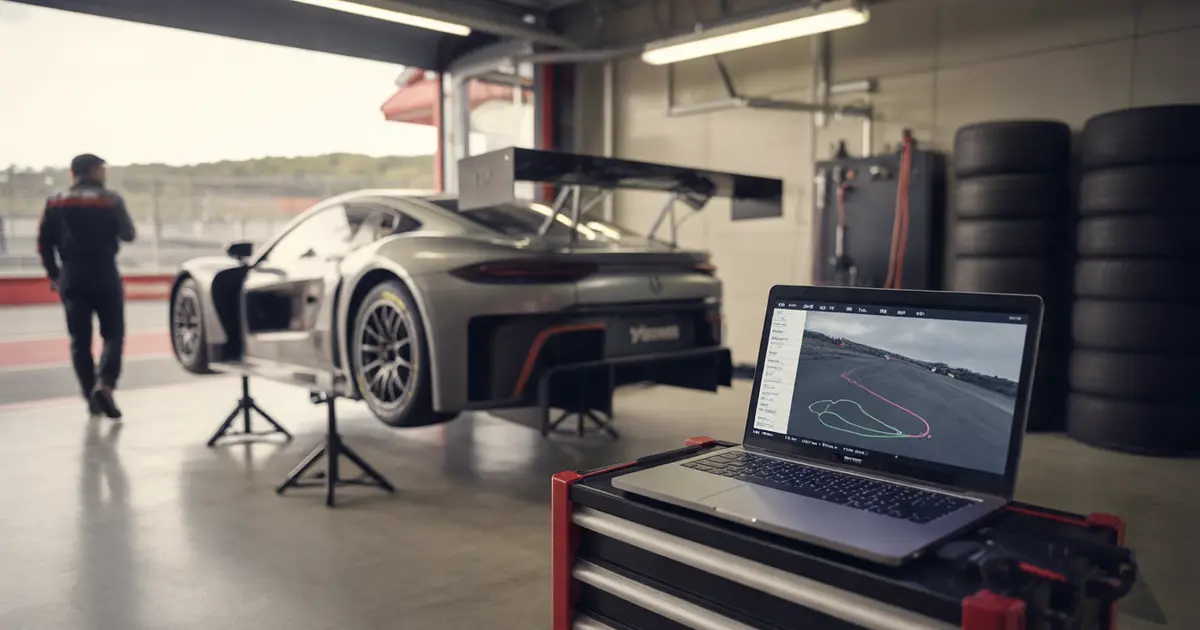
Running wide on the exit of Sun Curve almost always starts before it. See where to diagnose the mistake and how to train the right sequence of braking, rotation and throttle.
Running wide on the exit of Sun Curve almost always begins before you even get there: either from excessive steering input on entry or from applying throttle before the car is aligned with the track. The fix isn't to brake earlier. It's to rotate the car during braking and confirm the trajectory before returning to the throttle.
This corner is deceptive because it looks simple: downhill, open radius, clean sightline. The real issue is exactly the downhill section — it reduces load on the tires at the very moment you need it most, and any early throttle shows up as a loose rear right on the exit kerb.
Why the mistake shows up on exit, but starts earlier
When the car runs wide at Sun Curve, instinct is to blame the right foot. In most cases the real problem happened earlier: the car is still rotating when throttle is applied, or rotating more than it needs to because entry was made with excessive steering input.
This connects directly to the rotation phase of the corner, which is where time is actually won or lost, not during braking itself. At Sun Curve this effect is amplified by the downhill section: the car rotates faster than the driver expects, and throttle arrives too early relative to the steering angle still present.
The shape of the corner and what it demands from the car
Sun Curve comes right after the Senna S, downhill, with a radius that tightens slightly in the middle. The car arrives loaded from the previous sequence and loses vertical load exactly at the point where the driver wants maximum traction.
This combination — downhill plus tightening radius — demands an earlier and more contained rotation than constant-radius corners on flat ground. Overdoing the entry steering here costs more than at any other point on the track, because there's little load left to correct afterward.
Sequence to attack without losing the rear
- Release the brake on a ramp, not all at once: the front tire needs residual load to accept entry steering without pushing the car wide.
- Turn the wheel in a single motion, without correction: a second correction mid-corner signals that the first steering input was larger than necessary.
- Confirm the car is already pointing toward the exit before touching the throttle: this means waiting for the wheel to start unwinding, not waiting for the apex to pass.
- Apply throttle on a short ramp, matching the wheel's return: throttle and steering should move in opposite directions at the same time, never one after the other.
- Use the exit kerb only as a visual reference, not as a load-bearing surface: hitting it with high lateral load still present is the most common trigger for running wide at Sun Curve.
- 1Brake release
Brake released on a ramp, keeping residual load on the front.
- 2Rotation
Steering applied in a single motion, without mid-corner correction.
- 3Confirmation
Wheel starts unwinding before any throttle input.
- 4Application
Throttle on a short ramp, matching the wheel's return.
- 5Exit
Kerb used as a visual reference, not as load support.
Symptom and cause: where to look first
The table below helps separate things that look the same on screen but have different origins.
| Exit symptom | Likely cause | Where to fix it |
|---|---|---|
| Loose rear when getting on throttle | Steering still applied when throttle comes in | Delay application, don't reduce power |
| Car pushes wide before the apex | Excessive steering on entry | Reduce initial turn-in angle |
| Running wide only with cold tires or an evolving track | Lateral load lower than expected for the downhill | Release the brake slightly earlier |
Worth remembering that excessive steering on entry is usually invisible in the cockpit because the car still completes the corner — the cost only shows up afterward, on exit, looking like a throttle problem.
How this changes by car
A GT3 with high downforce tolerates more aggressive rotation because aerodynamic load compensates for part of the transfer lost on the downhill. A car without a wing, or on more worn tires, needs an earlier and smoother rotation — there's no extra load available to correct a mid-corner steering mistake.
- GT3 and cars with significant downforce: the throttle application window is a bit wider, but excessive steering still costs time on exit.
- Light cars or cars without a wing: the steering-throttle sequence needs to be almost simultaneous, with a longer throttle ramp.
- Tires in advanced degradation: the corner behaves as if it had less load drop, requiring a more gradual brake release.
How to confirm it in the data, not the feeling
The feeling of running wide is deceptive: sometimes the car really did lose traction, sometimes the driver just corrected late and felt a bigger scare than what actually happened. Comparing the steering channel with the throttle channel at the same track point shows whether the two cross at the right moment or whether throttle arrives before the wheel starts unwinding.
At Sun Curve, time lost on exit was almost always decided three tenths earlier, in how the steering wheel turned — not in the instant the foot touched the throttle.
If your app already records the lap automatically, checking this channel crossover is quick: Laptics' analysis splits the corner by phase and shows how much time this delay between steering and throttle cost relative to your own reference lap, with no need to build a spreadsheet or export a file.
Practical summary
Before adjusting setup or blaming the car, check the order: contained entry steering, full rotation before throttle, application on a ramp matching the wheel's return. Repeat this for three or four laps in a row and compare the steering trace with the throttle trace — that's where Sun Curve tells the truth about where the time went.
Frequently asked questions
Why do I run wide exiting Sun Curve even though I brake early?
Braking early doesn't help if the entry steering was excessive or if throttle comes in before the car is aligned. The problem is usually in rotation, not braking.
Does the downhill at Sun Curve change the throttle application point?
Yes. The downhill reduces vertical load exactly when the driver is looking for traction, so the throttle ramp needs to be longer and start with the wheel already unwinding.
Do cars without downforce need a different style for this corner?
They do. Without extra aerodynamic load, the steering-throttle sequence has to be almost simultaneous, leaving less margin for an entry angle mistake.
Does using the exit kerb help or hurt at Sun Curve?
It helps as a visual trajectory reference, but hitting it with high lateral load still present is one of the most common triggers for running wide at this corner.
How do I know if the mistake is steering and not throttle?
Compare the steering channel with the throttle channel at the same track point. If throttle comes in before the wheel starts unwinding, the mistake is in rotation.
Does Laptics help train specifically for this corner?
The phase-based corner analysis shows how much time the delay between steering and throttle costs at Sun Curve, compared to your own reference lap.
Want to see this in your own telemetry?
I want to analyze my laps at Interlagos